Checklists
Year-End Tax Planning Documents to Request (2026)
Year-end tax planning documents to request from clients before December 31, with US and Canada lists, 2026 rule changes, a timeline and a request template.
By Bibin MathewUpdated 25 min read
The short answer
A tax planning meeting needs numbers for the year so far, not the final year. Before the meeting, ask each client for a profit and loss and balance sheet through October, a year-to-date payroll summary, proof of estimated payments or instalments already made, last year's return or notice of assessment, and a short list of what they plan to buy, sell, give or contribute before December 31. Add a few items by client type, such as realized gains from a brokerage account or an RRSP deduction limit. Send the request in late October or the first week of November with a needed-by date about a week before the meeting, so there is still time to act before December 15 and December 31.
Every November the same thing happens. A client books a tax planning meeting, arrives with nothing, and spends the hour guessing. "I think we're up about 20% on last year." "I'm planning to buy a truck, maybe in December, maybe January." "I paid some estimated tax, I'm not sure how much." You can't plan on guesses, so the meeting turns into a list of things to send afterward, and by the time they arrive it's December 20 and most of the options are gone.
Tax planning only works while there is still time to act. A truck placed in service on January 3 is a 2027 deduction. A donation made on January 2 counts for 2027. A December 15 instalment that was never paid can't be fixed in February. The value of the meeting depends almost entirely on whether the right numbers were on the table early enough to change something.
This guide covers the documents side of year-end tax planning: exactly what to ask clients for before the meeting, how the list differs for business owners, individuals and Canadian clients, which 2026 rule changes are worth a question, when to send the request, and how to send it once so it arrives complete. It is written for independent bookkeepers, tax preparers and small accounting firms in the United States and Canada.
It sits between two other guides. The quarterly estimated tax documents checklist covers what to collect each quarter during the year. The year-end bookkeeping checklist covers closing the books after December 31: final statements, year-end balances and the 1099, W-2 and T4A run. This post covers the window before the year ends, when the numbers are still moving and decisions still matter.
Tax planning, tax filing and year-end close are three different requests
Firms often send one giant "year-end" list that tries to do all three jobs. It's too long for the client, too early for the filing documents, and too late for planning. Splitting it makes each request short and well-timed.
| Tax planning request | Year-end close request | Tax filing request | |
|---|---|---|---|
| When to send | Late October to early November | Late November, then the first week of January | January to February, once slips arrive |
| Numbers it uses | Year to date through September or October, plus plans | The full year, final statements | Final figures and official slips |
| Typical items | Interim P&L, YTD payroll, estimated payments, last year's return, planned purchases and gifts | December statements, loan balances, inventory count, open invoices, contractor details | W-2, 1099s, 1098, T4, T5, T3, RRSP receipts, donation receipts |
| What happens with it | Decisions before December 31: buy, defer, contribute, give, pay | Books closed, adjusted and locked | Return prepared and filed |
| Cost of being late | Options disappear | Close and reporting slip | Extensions, penalties, stress |
The planning request is the smallest of the three. Most of what you need is a few reports the client can download in minutes, plus answers to questions only they know: what they plan to do between now and December 31.
The core planning set every client sends
Whatever the client looks like, five things make a planning meeting useful.
| Item | Format to ask for | Why you need it | What arrives instead |
|---|---|---|---|
| Last year's return, or notice of assessment in Canada | PDF of the full return as filed, or the CRA notice of assessment | The baseline: prior-year tax for safe harbor math, carryforwards, last year's choices | Page 1 only, or "you did it, don't you have it?" |
| Income so far this year | Year-to-date pay stub, interim P&L, or both | The starting point for a projection | A number from memory |
| Taxes already paid | Payment confirmations for estimated tax or instalments, plus YTD withholding on the latest pay stub | So the projection shows what's still owed, not the gross tax | "I paid something in June" |
| Big events this year | Answers, with a document when one exists | Home sale, inheritance, new business, marriage, a move, a child, retirement | Silence, discovered in March |
| Plans before December 31 | A short list in the client's own words | Purchases, sales, gifts, contributions, bonuses, hires | Nothing, because nobody asked |
The last two items are questions, not documents. They are also where most of the planning value sits. A client won't mention that they're selling a rental property in December unless the request asks "Are you planning to sell any property or investments before December 31?"
Business owner checklist
For self-employed clients, partnerships, S corporations and small corporations, add these to the core set.
Financial statements and payroll
- Profit and loss, January 1 through October 31, 2026. PDF or spreadsheet export from the accounting software. Ask for the same period last year next to it if the software can do it, so you can see the trend in one view.
- Balance sheet as of October 31, 2026. Cash, receivables, payables, loans and owner equity are what you use to talk about timing: whether to bill or pay before year-end.
- Year-to-date payroll summary. From the payroll provider, through the last pay date in October. It shows owner wages, which matter for S corporations. See payroll reports for bookkeepers for exactly which report to ask for.
- Owner draws and distributions so far. Usually visible in the books. Ask only if you don't keep them.
Equipment and vehicles
- Assets bought in 2026 and planned before year-end. For each: what it is, cost, purchase date and the date it was or will be delivered and put to use.
- Assets sold, traded in or retired in 2026. With the sale price and the date. A trade-in changes the depreciation math.
- Vehicle use. For any vehicle bought this year, the business-use percentage and whether a mileage log exists. Our guide on getting mileage logs from clients covers the log itself.
Retirement plans, health and benefits
- Existing retirement plan statements. Year-to-date contributions to any 401(k), SEP, SIMPLE or solo plan, from the plan provider.
- Plans the client is considering. If they want to open a plan, ask now. Deadlines to set up and fund each plan type differ, and some must exist before year-end to be used for 2026. Check the plan rules with the provider and the IRS 401(k) contribution limits page.
- Health insurance paid by the business for S corporation shareholders. The IRS page on S corporation compensation and medical insurance explains why this needs to show up on the W-2, which means sorting it out before the last payroll of the year.
Timing items
- Unbilled work and unpaid bills. A cash-basis business can sometimes shift income or expenses across the year-end. Ask for an aged receivables and payables report, or a simple list.
- Planned bonuses or hires. Year-end bonuses run through payroll, so the decision has to land before the final December pay date.
- Inventory on hand. A rough count or estimate, if the business holds stock. The formal count comes later with the year-end close.
Individual and household checklist
For W-2 employees, retirees and owners whose personal return you also plan.
- Latest pay stub for each earner, showing year-to-date wages and federal and state withholding. One stub per job, including any second job or spouse's job.
- Brokerage gains and losses so far. Most brokerages offer a "realized gain/loss" report for the year to date. It shows gains already locked in and losses available to harvest before December 31.
- Retirement account contributions and planned withdrawals. IRA, 401(k), HSA. Note any required minimum distribution still to be taken this year.
- Charitable giving so far and planned. Totals by organization, cash versus non-cash, and anything planned for December. The 2026 rules changed, so this one gets a section below.
- Real estate. Any sale, purchase or refinance in 2026. Settlement statements if it already happened; expected dates if not. Rental owners can use the rental property tax documents checklist later for filing.
- Life changes. Marriage, divorce, a new child, a dependent who left home, a move to another state, a death in the family. Each one can change filing status, credits or residency.
Canadian clients: what changes
The planning logic is the same in Canada, but the documents and deadlines differ.
| Item | What to ask for | Why it matters before December 31 |
|---|---|---|
| Notice of assessment for 2025 | PDF from CRA My Account | Shows the RRSP deduction limit for 2026 and confirms last year's figures |
| Instalment reminders and payments | The instalment reminder, plus confirmations of payments made in 2026 | The last instalment date is December 15 for most individuals |
| RRSP contributions so far | Statements or receipts for 2026 contributions | Plan the remaining room; contributions in the first 60 days of 2027 can still count for 2026 |
| TFSA activity | Contributions and withdrawals in 2026 | Withdrawals restore room only the following year, so timing matters (CRA TFSA page) |
| Donations | Receipts so far and planned gifts | Gifts must be made by December 31 to count for 2026 (CRA line 34900) |
| Business assets | Purchases with invoices and the date each became available for use | Capital cost allowance generally starts when property is available for use |
| Interim statements | P&L and balance sheet through October | Same purpose as in the US: project the year and plan owner pay |
For incorporated clients, add the question of how the owner will be paid for 2026: salary, dividends or a mix. The decision changes T4 and T5 slips, so it has to be made before the final payroll.
2026 changes worth a question (US)
The 2025 tax law the IRS now calls the Working Families Tax Cuts, also known as the One Big Beautiful Bill Act, changed several rules starting with the 2026 tax year. You don't need to explain them in the request. You need the request to ask the questions that reveal whether a client is affected. The IRS provisions page lists them in full.
| What changed | Question to put on the request | Source |
|---|---|---|
| Starting in 2026, people who don't itemize can deduct up to $1,000 of cash gifts to eligible charities ($2,000 for married filing jointly). Gifts to donor-advised funds don't qualify. | "How much have you given to charity in cash this year, and to which organizations?" | IRS charitable contributions topic |
| For people who itemize, charitable gifts count only above 0.5% of adjusted gross income. | "Are you planning any large gifts before December 31, or bunching gifts into one year?" | IRS charitable contributions topic |
| 100% bonus depreciation is back for qualified property acquired and placed in service after January 19, 2025. | "List any equipment, vehicles or furniture bought this year or planned before December 31, with delivery dates." | IRS Publication 946 |
| The Section 179 limit for tax years beginning in 2026 is $2,560,000, reduced once qualifying purchases exceed $4,090,000. | Same question as above. Most small clients never reach the limit, but you need the list to know. | IRS Publication 946 |
| Inflation-adjusted figures for 2026, including the standard deduction and brackets. | No question needed; use the figures in your projection. | IRS 2026 inflation adjustments |
Estimated taxes and the safe harbor
Most clients who owe at year-end owe because nobody checked their estimated payments in the fall. The planning request is where you catch it.
The IRS estimated taxes page explains that most people avoid the underpayment penalty if they owe less than $1,000 after withholding and credits, or if they paid at least 90% of this year's tax or 100% of last year's, whichever is smaller. Higher-income taxpayers face a stricter prior-year rule. To run that test you need three things from the client:
- Last year's return, for the prior-year tax.
- Every 2026 estimated payment: date and amount. IRS Online Account or EFTPS confirmations work; so do bank statement lines.
- Year-to-date withholding from the latest pay stub, for clients with wages.
The fourth payment for the 2026 tax year is due in mid-January 2027 (see Form 1040-ES for the exact dates). For clients with wages, extra withholding in November and December often works better than a large January payment, because withholding is generally treated as paid evenly through the year. That only works if the request goes out early enough to change payroll.
In Canada, the equivalent check uses the instalment reminder and the December 15 date. A client who skipped the September instalment can still pay before December 15 and reduce instalment interest.
When to send it: a planning timeline
| When | What happens |
|---|---|
| Third week of October | Build the planning checklist. Book meeting slots for November. |
| Last week of October | Send the planning request with a needed-by date about a week before each client's meeting. |
| First week of November | Reminders for missing items. Run projections as documents arrive. |
| Early to mid November | Planning meetings, with numbers on the table. |
| Late November | Client acts: new W-4, extra estimated payment, purchase orders, retirement plan paperwork. |
| December 15 | Last CRA instalment date for most individuals. Last practical date to change the final payroll at many firms. |
| December 31 | Last day for gifts, purchases placed in service, and most payments to count for 2026. |
| Mid-January 2027 | Fourth US estimated payment for 2026. Year-end close requests go out. |
| March 1, 2027 | End of the RRSP contribution period for 2026 (confirm on the CRA page). |
Plan meetings for the first half of November if you can. Every week later removes options: retirement plan setup, equipment lead times and payroll changes all need lead time that late December doesn't have.
Questions that trim the list for each client
Not every client needs every item. Ask these yes/no questions first, then show the follow-up item only when the answer is "Yes." One checklist then fits every client.
| Question | If "Yes," ask for |
|---|---|
| Did you have wages from a job in 2026? | Latest pay stub with YTD withholding, for each job |
| Did you make estimated tax payments or instalments in 2026? | Payment confirmations with dates and amounts |
| Do you have a brokerage or investment account? | Realized gain/loss report, year to date |
| Did you buy or plan to buy equipment, vehicles or furniture for the business? | List with cost and delivery or available-for-use dates, plus invoices |
| Did you sell, trade in or scrap any business assets? | Sale details and dates |
| Do you contribute to a retirement plan or want to start one? | Year-to-date statement, or the plan you're considering |
| Have you given or do you plan to give to charity this year? | Totals by organization, cash versus non-cash, receipts so far |
| Did you buy, sell or refinance real estate? | Settlement statement, or expected dates |
| Any major life changes this year? | One-line description |
| Anything else we should know before the meeting? | Free text |
A planning request email you can copy
Keep the email short. The checklist does the explaining.
Subject: Your 2026 tax planning meeting: a few things to send by November 6
Hi Maria,
Your planning meeting is on November 13. To make it worth your time, we need a handful of numbers for this year so far. Everything is on one checklist at the link below, and it only asks about what applies to you.
It should take about 15 minutes. Most items are a download from your bank, payroll or brokerage website, plus a few yes/no questions about your plans before December 31.
[Link to the checklist]
Please send everything by Friday, November 6. If something is hard to find, reply to this email or ask on the checklist page and we'll help.
Thanks, Daniel Harbor Bookkeeping
For more variations, see document request email templates, and for the follow-ups, the client reminder schedule.
Ways to send the planning request, compared
| Method | Client effort | Completeness | Follow-ups | Best for |
|---|---|---|---|---|
| Email with a list in the body | Low to read, high to answer | Poor: items get missed and replies are scattered | Manual, from your inbox | A single client you talk to often |
| Fillable PDF questionnaire | Medium: download, fill, attach | Answers are good, but documents still arrive separately | Manual | Firms that already use one each year |
| Client portal of your tax software | High if the client must log in | Good once they're in | Built-in, but clients often ignore portal emails | Clients already active in the portal |
| Shared folder | Medium | Poor: no checklist, no checks | Manual | Large files from one client |
| One private link with a checklist | Low: no account, opens on a phone | Good: one item per document, yes/no gates, checks on upload | Automatic, paced to the needed-by date | Every client, especially those who never log in |
Clients who ignore portals usually ignore them for good reason: one more password for something they use twice a year. Our post on clients who won't use a client portal goes into the alternatives.
Tax planning requests in Tangentflow, step by step
Tangentflow sends each client one private link with your checklist. The client opens it on a phone with no account, sees only what applies to them, and uploads each item. Each file is checked as it arrives, and the AI collection agent handles reminders and questions.
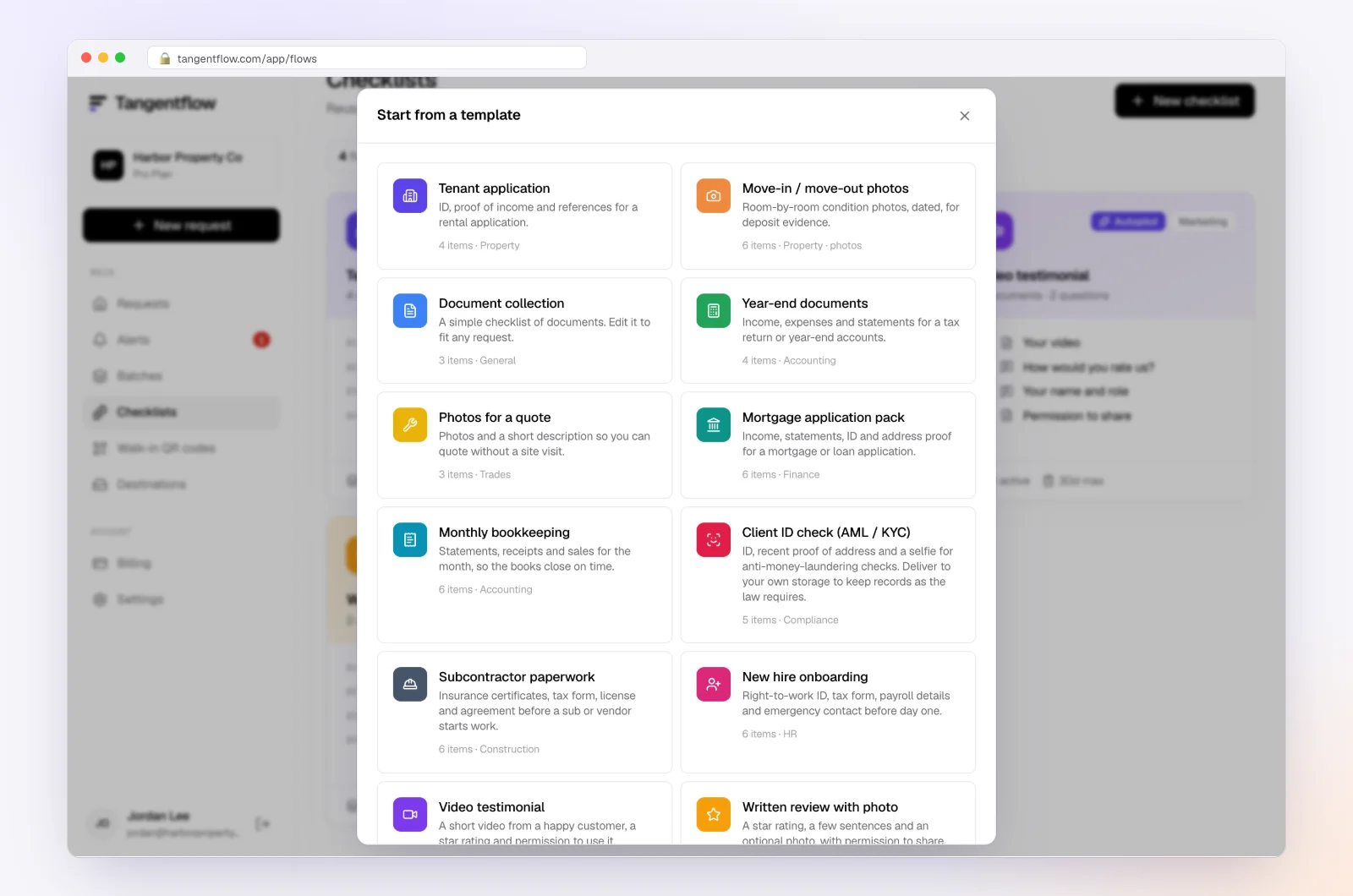
1. Start from a template or a blank checklist
Go to Checklists, choose "Browse templates" and start from "Year-end documents," or start blank. Rename it "2026 tax planning" so it's clearly separate from your year-end close checklist.
2. Add the planning items
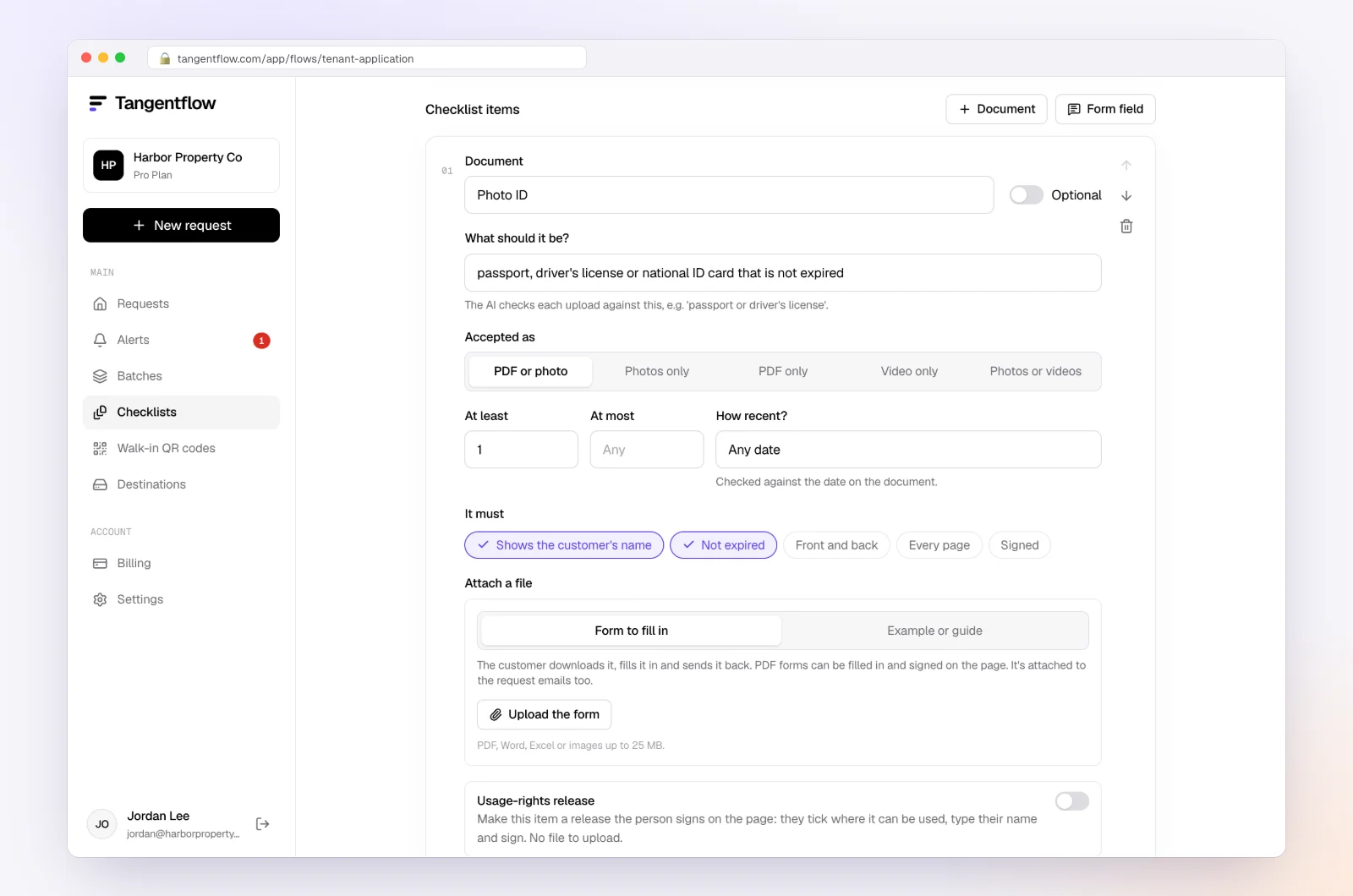
Add file items for "Last year's tax return," "Latest pay stub," "Estimated payment confirmations," "Profit and loss through October," "Balance sheet as of October 31," "Year-to-date payroll summary" and "Realized gain/loss report." Set reports to "PDF or spreadsheet" so a QuickBooks or payroll export is accepted, and fill in "What should it be?" For example: "profit and loss for January 1 to October 31, 2026." The check then flags a report that covers the wrong period.
3. Turn the questions into gates
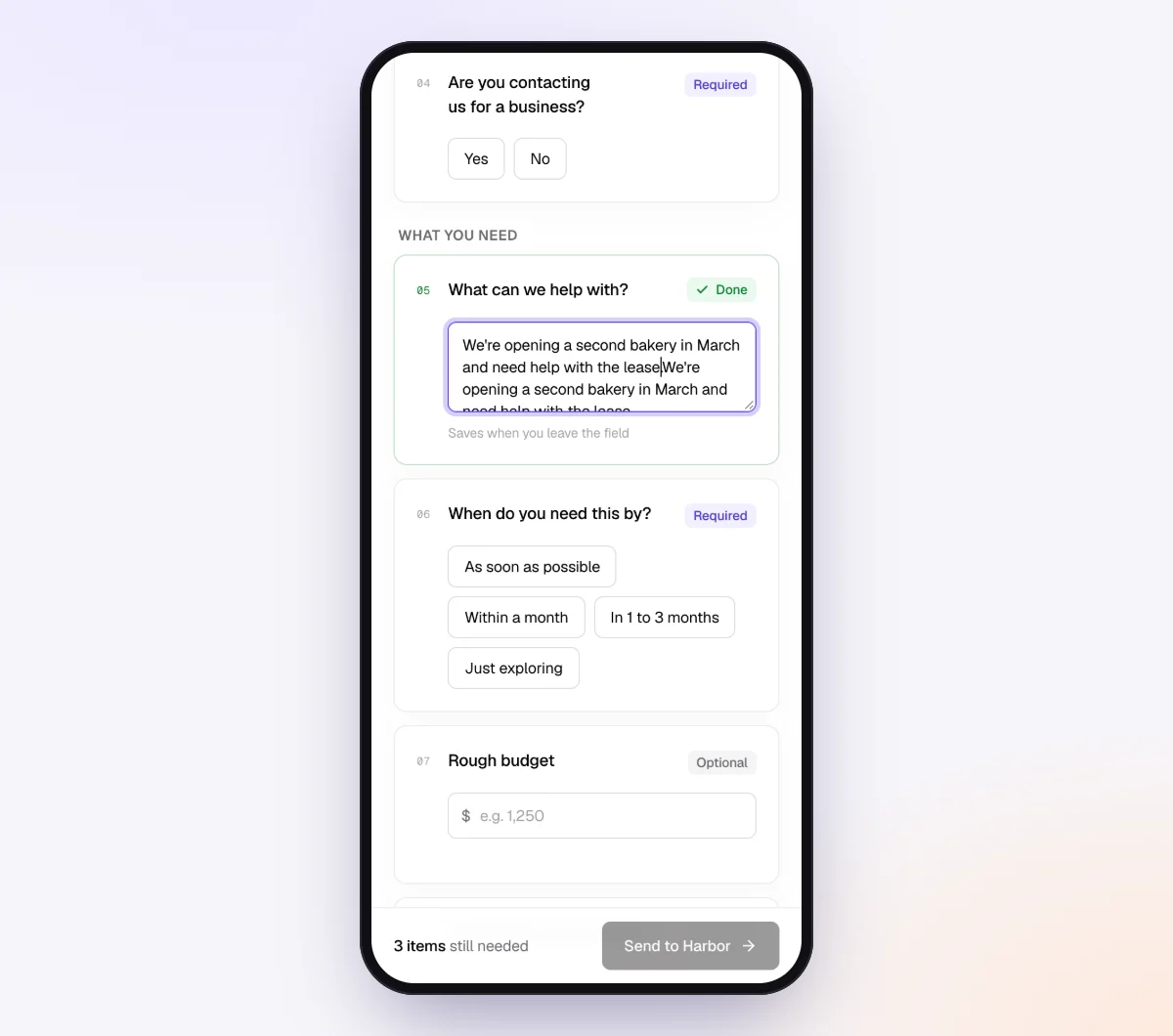
Add the yes/no questions from the table above as form fields, then use "Only ask if" on each follow-up item. A retiree with no business never sees the payroll or equipment items. Add a free-text field for "Purchases, sales or gifts planned before December 31" and another for "Anything else we should know."
Use "Notes for the agent (private)" for context the client shouldn't see but the agent should use, such as "Meeting is November 13; we need the P&L before then. Don't answer tax questions; pass them to Daniel."
4. Send it, now or on a schedule
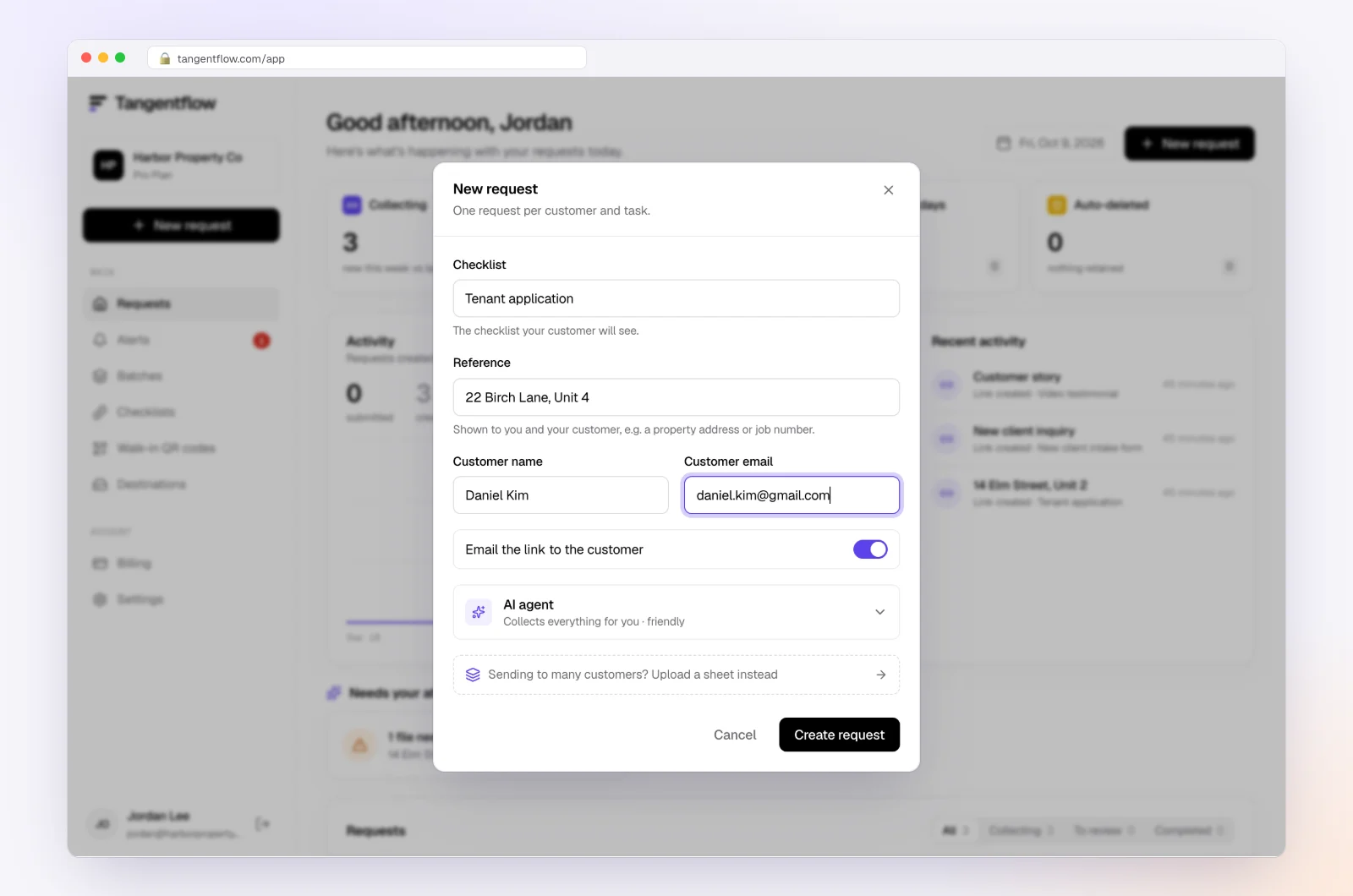
Open New request, pick the checklist, enter the client's name and email, and set the needed-by date about a week before the meeting. Choose "Send later" to schedule the invitation, for example for 8 a.m. on the Monday after you book the meeting. To send to every client at once, use Batches with a spreadsheet of names, emails and needed-by dates. Bulk requests are part of Pro.
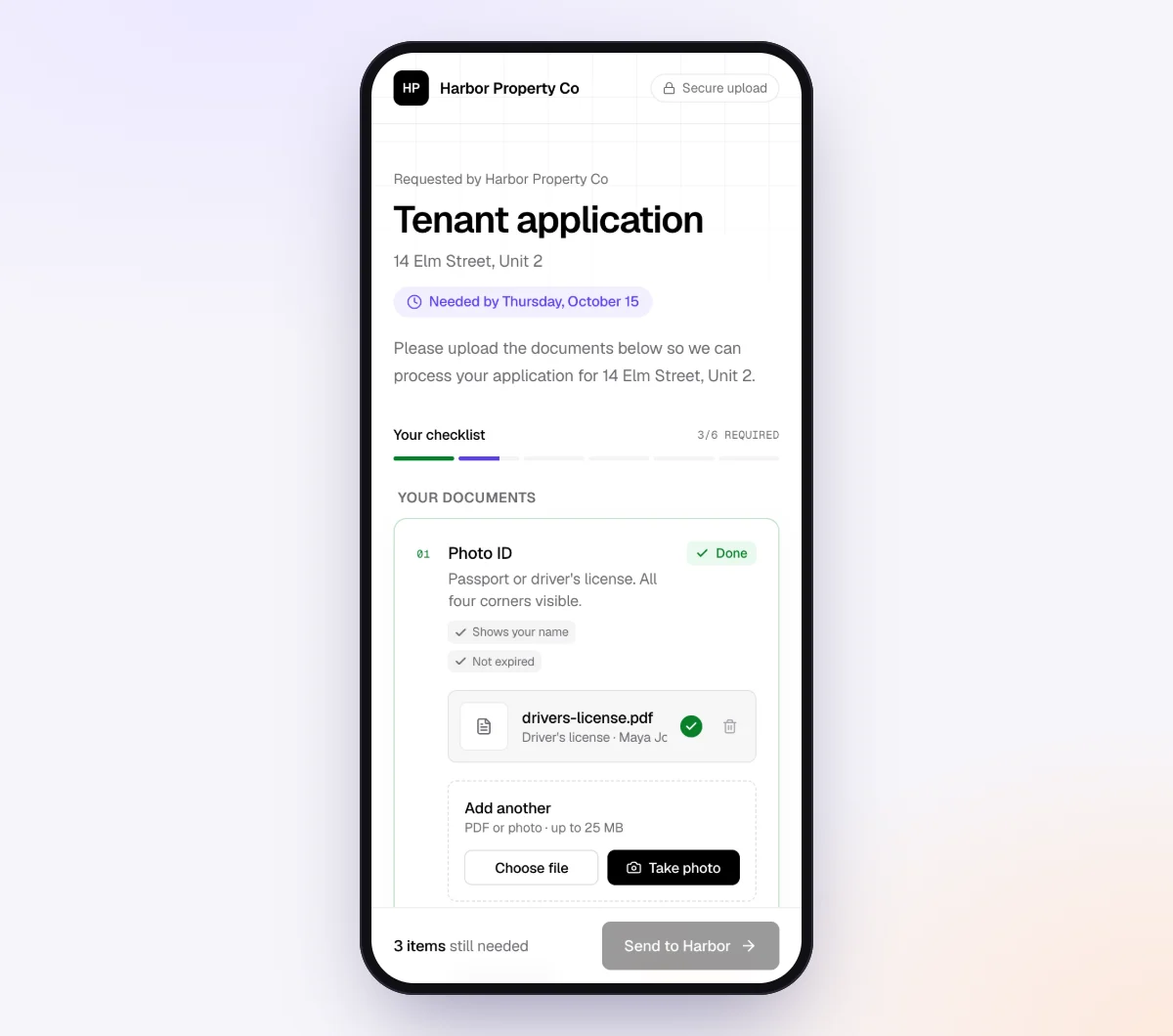
The client gets an email with one link. On a phone, they see the checklist, what's done and what's left, and can come back later on the same link.
5. Review everything in one place before the meeting
As files arrive, document checks read each one. A 2025 pay stub, a P&L for the wrong months or a single page of a multi-page return gets a friendly note right away, while the client still has the document open. With "Chase until it's all in" on, reminders are "Paced to each request's deadline" and list only what's still missing. When a client asks "do I need to include my wife's pay stub?", the agent answers from your checklist and notes, and passes real tax questions to you.
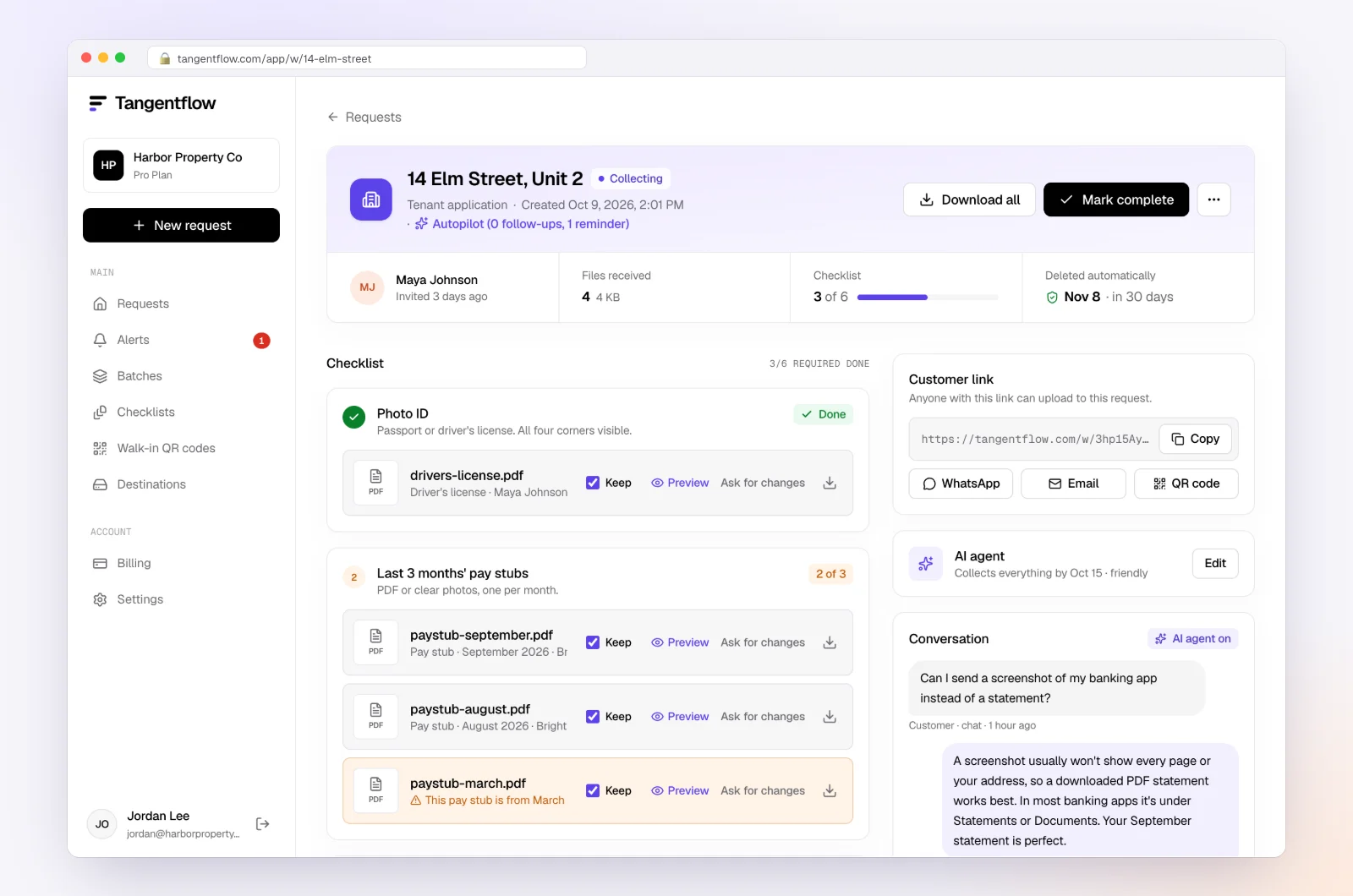
Before the meeting, open the request to see every file, its check result and the answers to the planning questions. Download the ZIP for your workpapers, or on Pro deliver to Google Drive. The "Evidence index (CSV)" in the request's menu lists each item, file, check result and answer in one sheet.
Planning setups by type of client
| Client type | Core items | Add | Watch for |
|---|---|---|---|
| W-2 household | Last year's return, pay stubs for each job | Brokerage gains, retirement contributions, charitable giving | Under-withholding from a second job |
| Sole proprietor | Last year's return, P&L through October, estimated payments | Equipment list, vehicle use, retirement plan | Estimates based on last year's lower income |
| S corporation owner | Last year's 1120-S and 1040, P&L, balance sheet, YTD payroll | Owner wages, health insurance paid by the company, distributions | Owner wages and benefits fixed before the final payroll |
| Partnership | Last year's 1065 and K-1s, P&L, balance sheet | Guaranteed payments, partner draws, asset purchases | Partners planning on their own without the partnership numbers |
| Landlord | Last year's return, rent roll and expenses YTD | Planned repairs versus improvements, any sale | A December sale nobody mentioned |
| Retiree | Last year's return, retirement account statements | Required distributions still to take, charitable giving | Missed distributions or estimated payments |
| Canadian sole proprietor | Notice of assessment, instalment payments, interim T2125 figures | RRSP room, assets and available-for-use dates | December 15 instalment |
| Canadian small corporation | Last T2 and owner's notice of assessment, interim statements | Salary versus dividend plans, assets bought | Owner pay decided before the final payroll |
For the bookkeeping side of each, see our page for bookkeepers and the accounting and tax use case.
When something goes wrong
The client sends last year's P&L instead of this year's. This is the most common mix-up, because both live in the same reports menu. Put the exact period in "What should it be?" so the check flags it, and add an "Example" with the date range written out.
The client doesn't know their estimated payments. IRS Online Account shows payments made. Bank statements show them too, as lines to the US Treasury or the CRA. Ask for either. Don't accept "about $5,000."
The client says "you have my return." If you prepared it, use your copy and remove the item for that client. If someone else did, it's worth asking for the full PDF. See requesting records from a previous accountant when the client doesn't have it.
Brokerage reports are confusing. Ask for the "realized gain/loss" report for the year to date, not the monthly statement. Name it exactly that in the item.
The client is late and the meeting is next week. Hold the meeting anyway with what you have, and use it to finish the list. The best planning decisions (W-4 changes, December purchases, gifts) depend on a few numbers, not all of them. The late document policy post covers how to set expectations for next year.
A sensitive file arrives that you didn't ask for. A full Social Security card, a password written on a sticky note. Delete it from the request and tell the client what you need instead. Our guide to secure ways to receive sensitive documents covers what to avoid.
Free and Pro, honestly
You can run a real request without paying anything.
| Free | Pro ($29/month) | |
|---|---|---|
| Open requests | 1 at a time | Unlimited |
| AI check on each file | Yes | Yes |
| AI autopilot (answers, reminders, follow-ups) | Your first request | Every request |
| Clients reply by email with attachments | No | Yes |
| Branding | Tangentflow badge | Your logo |
| Delivery to Google Drive or a webhook | No | Yes |
| Works with AI assistants (MCP) | No | Yes |
| File retention | 7 days | 60 days |
Both plans include unlimited checklists, QR codes and posters, ZIP export, AI summaries and email delivery. Pro is billed monthly with no contract, and you can cancel any time. Full details on the pricing page.
What Tangentflow does not do: SMS or text messages, a native mobile app, full legal e-signature certificates, identity verification, collecting payments, or permanent storage. It also doesn't calculate tax or give tax advice; the agent passes tax questions to you. If you need any of those, pair it with a tool that does.
Tax planning as a checklist
- Build one planning checklist, separate from year-end close and tax filing.
- Core items: last year's return or notice of assessment, YTD income, taxes already paid, big events, plans before December 31.
- Business items: P&L through October, balance sheet, YTD payroll, assets with placed-in-service or available-for-use dates.
- Individual items: pay stubs, realized gains, retirement contributions, charitable giving.
- Canadian items: notice of assessment, instalments, RRSP and TFSA activity, donations.
- 2026 US questions: cash gifts, planned large gifts, equipment purchases with delivery dates.
- Yes/no questions with follow-up items shown only when they apply.
- Send in the last week of October, with a needed-by date a week before the meeting.
- Meet in the first half of November.
- Act before December 15 and December 31.
Sources
Official pages for the rules named in this guide. Links checked on October 26, 2026; rules and figures change, so confirm on the official page before relying on them.
- IRS, Working Families Tax Cuts provisions: the 2025 law's changes by topic
- IRS Topic 506, charitable contributions: the 2026 non-itemizer deduction and 0.5% floor
- IRS Publication 946: depreciation, placed in service, Section 179 and bonus depreciation
- IRS 2026 inflation adjustments: 2026 standard deduction, brackets and other figures
- IRS, estimated taxes: who pays and the underpayment penalty
- IRS Form 1040-ES: estimated tax for individuals and due dates
- IRS Tax Withholding Estimator: checking withholding with a current pay stub
- IRS, 401(k) contribution limits: annual limits by year
- IRS, S corporation compensation and medical insurance: owner wages and health insurance
- CRA, instalment due dates: March 15, June 15, September 15 and December 15
- CRA, important dates for RRSPs: the contribution deadline for each tax year
- CRA, tax-free savings account: contribution room and withdrawals
- CRA, line 34900 donations and gifts: claiming charitable gifts
- CRA, claiming capital cost allowance: CCA and the available-for-use rule
Frequently asked questions
What documents do I need for a year-end tax planning meeting?
Last year's tax return (or a notice of assessment in Canada), current year-to-date income, proof of taxes already paid, and a list of big events and plans before December 31. Business owners add a profit and loss and balance sheet through October, a year-to-date payroll summary and a list of assets bought or planned. Individuals add pay stubs, a realized gain/loss report and charitable giving totals.
When should I send a tax planning request to clients?
In the last week of October or the first days of November, with a needed-by date about a week before the meeting. That leaves time to act before December 15 (the last CRA instalment date for most individuals) and December 31, when most purchases, gifts and payments must happen to count for 2026.
How is a tax planning request different from a year-end request?
Planning uses year-to-date numbers and the client's plans, to make decisions before the year ends. A year-end close request collects final December statements, year-end balances and contractor details after the year ends. Sending them separately keeps each request short and on time.
Why does the placed-in-service date matter more than the purchase date?
Under IRS rules, depreciation starts when property is placed in service, meaning ready and available for its intended use, not when it's ordered or invoiced. Equipment invoiced in December but delivered in January is generally a deduction for the next year. In Canada, capital cost allowance generally starts when property is available for use. Ask clients for delivery and install dates.
What changed for charitable gifts in 2026?
Starting with 2026, US taxpayers who don't itemize can deduct up to $1,000 of cash gifts to eligible charities, or $2,000 for married couples filing jointly; gifts to donor-advised funds don't qualify. For people who itemize, charitable gifts count only above 0.5% of adjusted gross income. Confirm the details on the IRS charitable contributions page.
What should Canadian clients send for tax planning?
Their 2025 notice of assessment (for the RRSP deduction limit), any instalment reminders and payment confirmations, RRSP and TFSA activity for 2026, donation receipts, interim business statements and a list of business assets with the date each became available for use. Owners of corporations should also decide how they'll be paid for 2026 before the final payroll.
What if a client can't find their estimated tax payments?
US payments show in the client's IRS Online Account and on bank statements as payments to the US Treasury. Canadian instalments show in CRA My Account and on bank statements. Ask for a screenshot or PDF of either, never the login.
Can clients send tax planning documents without creating an account?
Yes, with a private link. In Tangentflow, the client opens one link on a phone or computer, sees only the items that apply to them, uploads each document and answers the planning questions, with no account and no password.