Templates
Late Document Policy for Bookkeepers: Fees and Wording (2026)
A late document policy for bookkeepers: six options compared, how to set a catch-up or rush fee, and copy-paste engagement letter and reminder wording.
By Bibin MathewUpdated 19 min read
The short answer
A late document policy says when monthly documents are due, what happens if they arrive late, and what it costs. The simplest version is a due date plus a rule that anything received after it moves to next month's close, with a catch-up or rush fee only for extra work you actually do. Put it in the engagement letter, explain it at onboarding, mention it in every reminder, and keep a record of what you asked for and when. Apply it consistently, waive it out loud when you choose to, and have an advisor review the clause.
Every bookkeeper has the client. Statements were due on the 7th. On the 19th, three PDFs and a photo of receipts arrive with a note: "Can we still get the reports this week? My lender wants them." You either work the weekend, or say no and feel like the bad guy.
A late document policy takes that decision out of the moment. You agree on the rules once, in writing, before anyone is late. When documents arrive on the 19th, the answer is already decided: the close moves to next month, or there is a rush fee to do it now. Nobody has to negotiate, and nobody has to feel bad.
This guide is for independent bookkeepers and small firms in the US and Canada who close books for small business clients every month. You will get the options compared, a way to set fee amounts, copy-paste wording for every stage, advice on enforcing it kindly, and a Tangentflow setup that keeps a record of what was asked and when.
Why you need a policy at all
A written policy does four things:
- It protects the close. If one late client can push work into the days you set aside for everyone else, every client's reports get later.
- It sets expectations before there is a problem. A client who signed a clause saying "documents received after the 7th are processed in the next month's close" is not surprised when that happens.
- It turns a personal conversation into a process. You are not refusing to help. You are following the schedule you both agreed to.
- It pays for real extra work. Catch-up months and same-week turnarounds take more time than a normal close.
It also shows you patterns: clients who are late because the request is confusing (fixable), because their month-end is busy (move the date), or because it is not a priority (a fit conversation).
Six late document policies, compared
There is no single right policy. Most practices combine two or three of these, escalating from the gentlest.
| Policy | What it says | Best for | Upside | Downside |
|---|---|---|---|---|
| Due date and reminders only | Documents are due on a set day; you remind until they arrive | New practices, small client lists, clients who are rarely late | Zero friction, easy to start | No consequence, so chronic lateness continues |
| Deferral to next month's close | Anything received after the due date is processed in the following month's close | Most monthly bookkeeping clients | Protects your schedule without charging anyone | Reports for that month arrive later, which some clients will not accept |
| Catch-up fee | Months that fall behind are billed as catch-up work, often hourly or per month | Clients who skip months and then send everything at once | Pays for genuinely extra work | Needs a clear definition of "behind" |
| Rush fee | If documents are late and the client still needs reports on the original date, a rush fee applies | Clients with lenders, investors or tax deadlines | Client chooses: wait or pay for speed | Can feel like a penalty if not explained up front |
| Flat late fee | A fixed amount is added to the invoice when documents miss the due date | Practices that have tried softer options without success | Simple to understand and bill | Most likely to feel punitive; ask an advisor how it reads in your jurisdiction |
| Pause service | After a set number of missed months, work stops until the client catches up | Clients whose lateness puts you at risk of errors | Prevents you from producing reports you cannot stand behind | Interrupts revenue and needs clear notice |
| End the engagement | After repeated misses and a written warning, you part ways | The rare client who will not change | Frees time for clients who work with you | Requires notice terms and a clean handover |
Due date and reminders only works better than people expect when reminders are predictable and list only what is missing. Many "late" clients simply forgot. Deferral is the workhorse: it costs the client nothing but time and protects you completely, as long as you word it as a schedule, not a punishment. Catch-up and rush fees charge for work, not for lateness, which is how clients hear them best. A flat late fee is the bluntest tool; some clients start treating it as the price of being late, so ask your advisor how a fee not tied to extra work is viewed where you practice. Pausing and ending the engagement are last resorts that belong in the letter so you can use them if you need to.
How to set the amounts
There is no standard rate for a late document fee or a catch-up month. Set yours from your own numbers.
Start with your time
Look at your last few months:
- How long does a normal monthly close take for this client? Use your time tracking or a rough estimate.
- How much longer does it take when the documents arrive late? Count the extra time: re-opening a reconciliation, re-running reports, extra emails, a weekend session.
- What is your effective hourly rate? Your monthly fee divided by the normal hours.
A rush or catch-up fee that covers the extra hours at your effective rate is easy to defend, because it is what the work costs.
Pick a structure
| Structure | How it works | Example (illustrative only) |
|---|---|---|
| Hourly | Extra time billed at your standard rate | "Catch-up work is billed at our standard hourly rate." |
| Per catch-up month | A fixed amount for each month processed outside its normal close | "Each month processed as catch-up is billed at one month's standard fee." |
| Percentage of the monthly fee | A rush adds a share of the normal fee | "Rush processing adds 50% of the monthly fee." |
| Flat amount | The same fee every time documents miss the date | "A $[amount] late document fee applies." |
These are placeholders showing the shape of each option, not recommended rates.
Sanity-check it
- Would I be comfortable explaining this number on a phone call? If not, it is probably too high or not tied to real work.
- Does it fit how I price everything else? Flat monthly packages pair naturally with a per-month catch-up fee.
- Will I actually charge it? A policy you never enforce trains clients to ignore it.
Copy-paste wording
Adapt these to your voice and have your engagement letter reviewed. Replace everything in brackets.
Engagement letter clause
Put this in the client responsibilities or fees section. Keep the language plain and specific.
Client documents and due dates

To close each month on schedule, you agree to provide the documents
listed in our monthly request (including bank and credit card
statements for every business account, receipts and bills, sales and
payout reports, and payroll reports where applicable) by the [7th] day
of the following month.

Documents received after the due date will be processed in the next
month's close. If you need reports for a month on our normal schedule
despite late documents, we can provide rush processing for an
additional fee of [amount or method].

Months that are more than [60] days behind when documents are received
will be treated as catch-up work and billed at [amount or method] per
month.

If documents are not received for [two] consecutive months, we may
pause work until your records are brought up to date. We will tell you
in writing before pausing.

We may waive these fees at our discretion. Waiving a fee once does not
waive it for future months.
The last sentence matters. It lets you be generous without accidentally changing the agreement.
Onboarding explanation
Say it out loud at kickoff and repeat it in your welcome email. Clients rarely read every clause; they remember what you told them.
Subject: How our monthly schedule works

Hi [First name],

Welcome aboard. Here's how each month works, so there are no surprises:

- On the [1st] of each month, you'll get a request listing what we need
  for the month before. It comes with a private link where you can
  upload everything from your phone.
- Everything is due by the [7th]. You'll get reminders before then,
  listing only what's still missing.
- We close your books and send reports by the [15th].
- If documents arrive after the [7th], that month moves to the next
  month's close. If you ever need reports on time anyway, for a lender
  or a tax deadline, just tell us and we can rush it for [fee].

This is all in our engagement letter, but I'd rather you hear it from
me now than discover it later. Any questions, just reply.

[Your name]
[Firm name]
For the full onboarding sequence, see our accounting client onboarding checklist.
The monthly request, with the policy line
Add one sentence to the request you already send, just above your sign-off: "As a reminder, anything that arrives after [date] will be included in the [next month] close." Not a threat, just the schedule.
Reminder before the due date
Subject: [Month] bookkeeping: [number] items left, due [day]

Hi [First name],

Thanks for what you've sent so far. To close [Month] on schedule,
we still need:

- [Item 1]
- [Item 2]

Same link: [link]

If these arrive after [day, date], [Month] will move to the [next
month] close, and your reports for it will follow then.

Thanks,
[Your name]
For more reminder variations and tones, see our document request email templates. For how many reminders to send and when, see the client reminder schedule.
The "your close moves to next month" notice
Send this the day after the due date. It is factual, gives the client a choice and does not scold.
Subject: [Month] close moved to [next month]

Hi [First name],

We didn't receive everything for [Month] by [date], so as we agreed,
[Month] will be closed together with [next month]. Your reports for
both will come by [date].

Still needed for [Month]:
- [Item 1]
- [Item 2]

You can keep using the same link: [link]

If you need [Month] reports sooner, for a lender or a deadline, let me
know and we can rush them for [fee] once the documents are in.

Thanks,
[Your name]
Rush fee confirmation
Always get a yes in writing before doing rush work. Two lines are enough: "To confirm, we'll close [Month] and send reports by [date] once we have [remaining items]. Rush processing is [fee], added to your next invoice. Reply yes to go ahead."
Waiving it gracefully
Waiving a fee is a gift. Name it as one, so it does not quietly become the new rule.
Hi [First name],

I know [Month] has been a lot, with [the move / the new location / a
family matter]. I've waived the rush fee this time and we'll have your
reports by [date].

Going forward, the [7th] due date still applies. If that date is
genuinely hard for you, let's talk about moving it rather than running
late.

[Your name]
Pause or final notice
Only after the softer steps, and only if your engagement letter allows it.
Subject: Pausing your bookkeeping until records are caught up

Hi [First name],

We haven't received documents for [Month] or [Month], so as set out in
our engagement letter, we're pausing monthly work from [date] until
your records are up to date.

To restart, please upload [list] here: [link]. Catch-up months will be
billed at [rate], as agreed.

I'd like to keep working together. Can we talk this week?

[Your name]
How to enforce it kindly
- Lead with the schedule, not the fee. Most of the time, deferral is the only consequence anyone needs.
- Make the first late month a conversation. "I noticed [Month] came in late. Is the 7th a bad date for you?" Some clients have a genuine reason, and a different due date fixes it for good.
- Apply it the same way to everyone. Waive deliberately, not by default.
- Give a choice, not an ultimatum. "We can close it next month at no cost, or rush it for [fee]" lets the client decide what matters to them.
- Keep the record. "We asked on the 1st, reminded on the 4th and 6th, and the documents arrived on the 19th" settles a dispute quickly.
- Never hold their records hostage. Pausing new work is different from refusing to return what you already have. Ask your advisor about your obligations when work stops.
Late document policies in Tangentflow, step by step
Tangentflow does not charge fees or send invoices. It handles the other half of the policy: a due date the client sees everywhere, reminders paced to it, and a timeline of what was asked for and when. If you work with monthly clients, our page for bookkeepers shows the full setup.
1. Start from the "Monthly bookkeeping" template
Open "Checklists", choose "Browse templates" and pick "Monthly bookkeeping". It comes with items such as "Bank statements for the month," "Receipts and bills you paid" and "Anything unusual this month?"

Put your policy line in "Instructions for the customer" on the checklist. It is shown at the top of the upload page and as a note from your business in the invitation email. A good line is: "Everything is due by the date below. Anything that arrives after it is included in next month's close."
2. Tell the agent about the policy
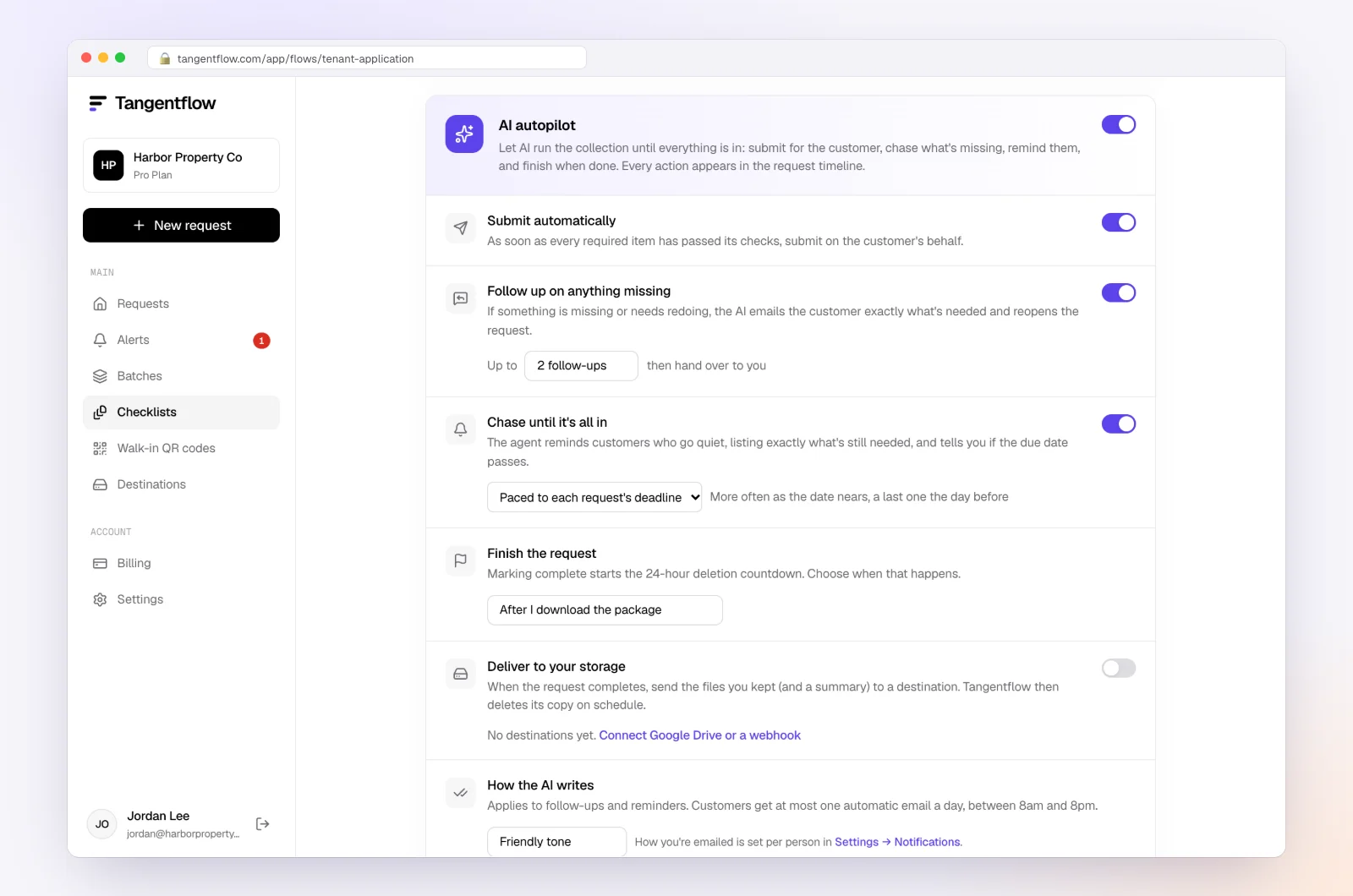
In the checklist's AI agent settings, choose a tone under "How the AI writes" and add optional guidance, such as "Mention that documents received after the due date move to next month's close. Never mention fees." The agent uses that guidance when it writes reminders and follow-ups.
3. Send the month to every client with a needed-by date
Open "Batches", choose "Send to many customers" and pick your bookkeeping checklist. Upload an Excel file or CSV, or paste rows from Excel or Google Sheets, with each client's name, email, reference and needed-by date. You can send now or schedule the send up to 30 days ahead, and skip clients who already have an open request. Batches are part of Pro, up to 100 clients per sheet. See bulk requests for details.
For a single client, click "New request", choose the checklist, add a reference such as "Acme Bakery, October 2026" and set the needed-by date. The date appears as "Needed by" in the invitation and every reminder.

4. Let the agent pace the reminders
With the AI collection agent on, reminders are spaced out when there is time and come closer as the needed-by date approaches, with at most one automatic email a day. Each reminder lists only what is still missing. If the client was just active on the request, the agent skips a reminder.
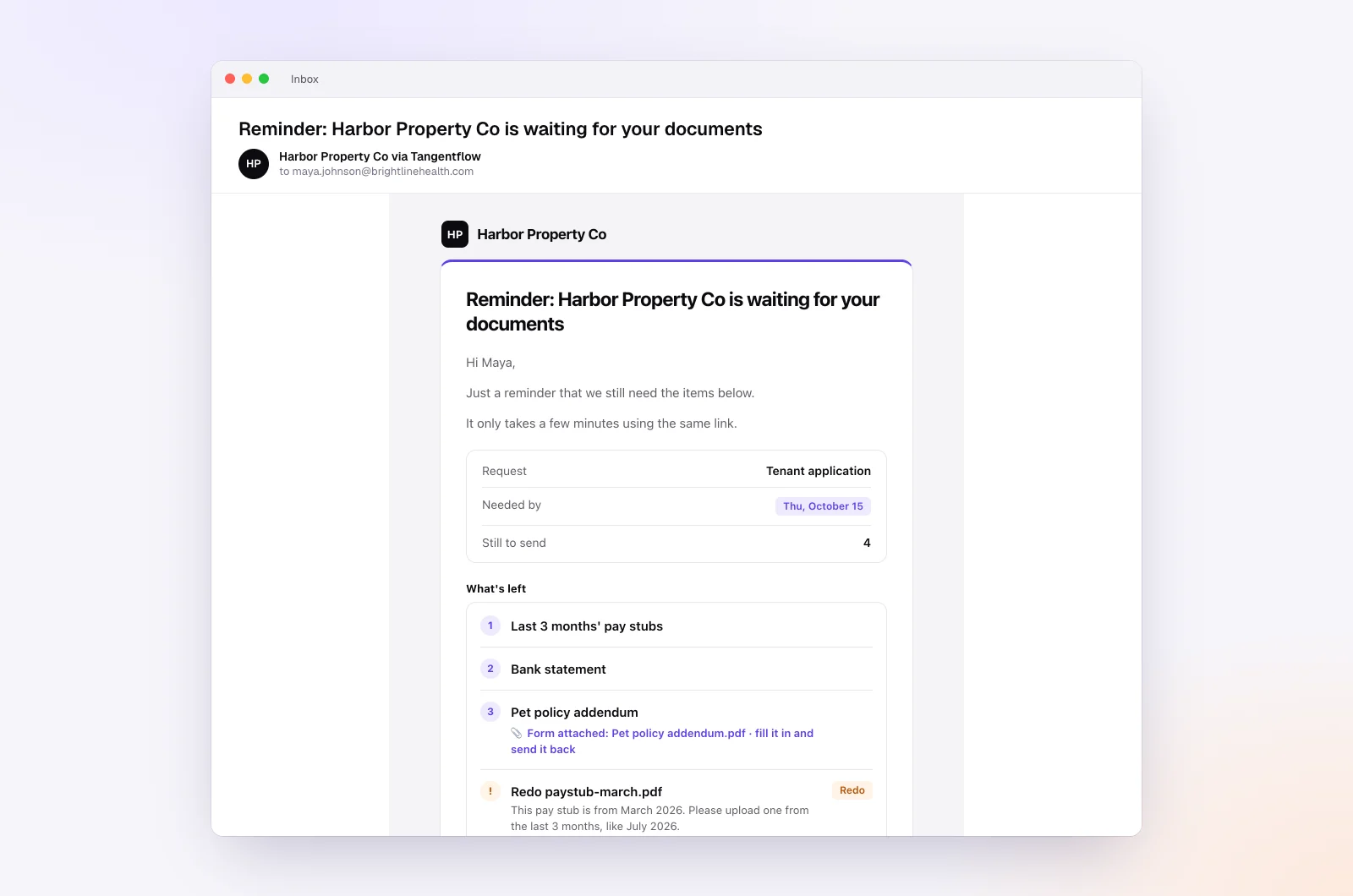
When the needed-by date passes with items still missing, the agent stops reminding, notes it on the request and alerts you. That is your cue to send the "moves to next month" notice, or extend the date on the request if you agreed to give more time.
5. Use the activity timeline as your record
The request page shows every file with its check result, what is still missing and an activity timeline. The timeline lists each event with who did it (the AI, the customer, you or the system) and when: the invitation emailed, each reminder and the items it asked for, the customer submitting, and the due date passing with what was still missing.

When a client asks why their month moved, the record is on the request.
Policies by type of practice
Your policy should match your clients and how you price. These are starting points, not standards.
| Practice | Suggested policy mix | Settings worth turning on | Learn more |
|---|---|---|---|
| Solo bookkeeper, 10 to 30 monthly clients | Due date plus deferral; rush fee on request | Needed-by date on every request, agent paced to it | For bookkeepers |
| Small firm with staff | Deferral, rush fee, catch-up fee after 60 days | One checklist per client group, a batch per group | Bulk requests |
| Clients with lenders or investors | Rush fee clearly priced in the engagement letter | Earlier needed-by date for those clients | Monthly bookkeeping checklist |
| Clients with sensitive payroll files | Same as above | "Require an email code" on the checklist | Security |
"Require an email code" is an optional checklist setting: the client enters a 6-digit code sent to their email before the link opens. If a link goes to the wrong person, reset the customer's link from the request and the old one stops working. After the client sends everything, the link no longer shows the files.
When something goes wrong
| Problem | Likely cause | Fix |
|---|---|---|
| Client says they never got the request | Email went to spam or a different inbox | Check the activity timeline for the invitation, resend, or copy the link and send it yourself |
| Client disputes a rush fee | No written yes before the work started | Always confirm rush work in writing first; waive this one and use the confirmation email next time |
| Client is late every month by a few days | The due date does not suit their month-end | Move their date, and their needed-by date on each request, instead of charging every month |
| Client sends everything at once for three months | They skipped months, then caught up | Bill as catch-up per your clause; send one request per month so each has its own record |
| Client asks to be exempt | They feel the policy does not apply to them | Point to the engagement letter kindly; offer a different due date, not an exemption |
Check "Alerts" daily during close week. Missed due dates and handoffs show up there, so you only spend time on the clients who need a person.
Free and Pro, honestly
You can run a real request without paying anything.
| Free | Pro ($29/month) | |
|---|---|---|
| Open requests | 1 at a time | Unlimited |
| AI check on each file | Yes | Yes |
| AI autopilot (answers, reminders, follow-ups) | Your first request | Every request |
| Send to many clients at once (Batches) | No | Yes |
| Clients reply by email with attachments | No | Yes |
| Branding | Tangentflow badge | Your logo |
| Delivery to Google Drive or a webhook | No | Yes |
| Works with AI assistants (MCP) | No | Yes |
| File retention | 7 days | 60 days |
Both plans include unlimited checklists, QR codes and posters, ZIP export, AI summaries and email delivery. Pro is billed monthly with no contract, and you can cancel any time. Full details on the pricing page.
What Tangentflow does not do: SMS or text messages, a native mobile app, full legal e-signature certificates, identity verification, collecting payments, or permanent storage. If you need any of those, pair it with a tool that does. It also does not send invoices or charge late fees; those stay in your billing system.
Your late document policy as a checklist
- Fix the monthly request first: a specific checklist, the same send day every month, a needed-by date.
- Set a due date earlier than you really need the documents, and start with deferral to next month's close.
- Add a rush fee and a catch-up fee only for real extra work, priced from your own hours.
- Write it into the engagement letter, including a line that a waiver once is not a waiver forever.
- Have a lawyer or your professional association review the clause.
- Explain the policy at onboarding, out loud and in the welcome email.
- Mention the due date and the deferral rule in every request and reminder.
- Send the "moves to next month" notice the day after a missed date, with a rush option.
- Get a written yes before rush work, and keep a record of what was asked for and when.
- Waive on purpose, say so, and review the policy once a year.
Frequently asked questions
Should bookkeepers charge a late document fee?
Many do, but it works best as a second step. Start with a due date and a rule that late documents move to the next month's close, which costs the client nothing but time. Add a rush or catch-up fee for the extra work late documents actually cause, and have the clause reviewed by an advisor.
How much should I charge for late documents?
There is no standard amount. Work out how much extra time a late month takes you and price that at your effective hourly rate, or as a share of your monthly fee. Pick a number you would be comfortable explaining on a phone call and willing to charge every time.
What should a late documents clause in an engagement letter say?
It should name the due date, what happens to documents received after it (usually deferral to the next close), any rush or catch-up fee and how it is calculated, when you may pause work and with what notice, and that waiving a fee once does not waive it in future. Have a lawyer or your professional association review it.
What is a catch-up bookkeeping fee?
It is a charge for processing months that have fallen behind, often billed hourly or per month. It applies when a client skips one or more months and then sends everything at once, which takes more work than a normal close because reconciliations and questions pile up.
How do I enforce a late document policy without losing clients?
Explain it at onboarding, mention it in every request, and lead with deferral rather than fees. Talk to the client the first time they are late, offer a different due date if theirs does not fit, and waive fees deliberately.
Can I add a late fee to existing clients?
Generally, change the engagement letter first rather than announcing a fee by email. Give written notice, get the updated letter signed and start on a clear future date. Ask your advisor what notice is appropriate where you practice.
Can Tangentflow charge late fees for me?
No. Tangentflow does not collect payments or send invoices. It handles the document side: a needed-by date on every request, reminders paced to it, an alert when the date passes and an activity timeline showing what was asked for and when, which supports the fee you bill from your own system.
When should I let go of a client who never sends documents?
When late documents are chronic despite a clear policy, a call to find the cause and a consequence you've actually applied, the client usually costs more than they pay. Give written notice and a final date that match your engagement letter, and hand back their records cleanly. Many bookkeepers set a rule, such as three late months in a row, so the decision isn't personal.