Checklists
Rental Property Tax Documents Checklist (2026)
A rental property tax documents checklist for Schedule E and T776, split US and Canada, per property, with first-year vs every-year items and a collection plan.
By Bibin MathewUpdated 20 min read
The short answer
For each rental property, ask for rent received, the lender's mortgage interest statement (Form 1098 in the US), property tax bills, insurance, repair and maintenance invoices, utilities the owner paid, management statements, and a list of rental and personal-use days. In the first year a property is rented, or any year it is improved, also ask for the closing statement and improvement invoices, because those build the depreciation or CCA record. Send one request per property with yes or no questions for short-term rentals, co-owners and sales, and set the due date weeks before your filing deadline.
Landlords are some of the hardest tax clients to collect from. The paperwork isn't exotic, it's scattered. Rent sits in a bank account or a manager's portal, the mortgage interest is on a lender statement, the property tax bill is in a drawer, and the closing statement from the purchase is in an email from 2019.
Then there is the per-property problem. Each rental is reported separately, but "send me your rental stuff" usually returns one folder with everything mixed together.
This guide is for bookkeepers, tax preparers and accountants in the United States and Canada who need a client-facing request list for rental property owners: split by country, organized per property, with a clear line between what you need every year and what you need only the first year. You'll also get a US and Canada comparison, questions that trim the list, a step-by-step setup in Tangentflow, and fixes for common problems.
If you need the full individual return list (W-2s, T4s, investment slips, deductions), start with our tax document checklist for clients. This post goes deep on the rental piece only.
Every year vs first year: the distinction that saves the most chasing
Most rental checklists list everything for everyone, which is why clients resend old closing documents every spring and forget the property tax bill. Split your request into two layers.
| Item | Every year | First year or when it changes | Why |
|---|---|---|---|
| Rent received by property | Yes | Income for the year | |
| Mortgage interest, property tax, insurance | Yes | Main deductible expenses | |
| Repairs, utilities, HOA or condo fees | Yes | Deductible in the year paid | |
| Management statements | Yes | Income, fees and expenses in one place | |
| Rental and personal-use days | Yes | Affects how much can be deducted | |
| Closing statement on purchase | Yes | Builds the cost basis or capital cost | |
| Land vs building split | Yes | Land is not depreciable in either country | |
| Improvement invoices | Any year with improvements | Added to basis, depreciated over time | |
| Date first available for rent | Yes | Starts depreciation or CCA | |
| Prior-year depreciation or CCA schedule | New client only | Carries the history forward | |
| Closing statement on sale | Year of sale | Gain, recapture and final figures |
US checklist: Schedule E documents for a tax preparer
Individuals generally report rental real estate on Schedule E (Form 1040), Part I, one column per property. These documents map to what the form asks for.
Property basics (per property)
- Property address and type (single family, multi-family, condo, short-term rental, commercial).
- Days rented at fair rental price and days of personal use. Schedule E asks for both.
- Ownership: sole owner, spouses, or co-owned. Spouses may be able to elect qualified joint venture treatment (a box on line 2 of Schedule E); the preparer decides.
- Whether an LLC or partnership holds it. If so, it may belong on an entity return. See our business tax return documents checklist.
Income
- Rent received: the manager's year-end owner statement, a rent ledger, or statements for the account rent goes into.
- Advance rent and security deposits kept. Per Pub 527, advance rent is income in the year received, and deposits are income only if the owner keeps them.
- Expenses the tenant paid for the owner, such as a repair taken off the rent. Pub 527 treats these as rental income.
- Form 1099-MISC from a property manager, if one was issued. Rents are reported in box 1.
- Form 1099-K from a payment app or booking platform, if one was issued.
Expenses (one set per property)
These follow the expense lines on Schedule E Part I:
- Mortgage interest: Form 1098 for each loan. A lender generally issues one when it receives $600 or more of mortgage interest from an individual. For a private or family loan, ask for a signed interest summary.
- Property tax bills and proof of payment. If taxes are paid through escrow, Form 1098 often shows the amount.
- Insurance: the premium notice for the rental policy.
- Repairs, cleaning and maintenance: invoices, kept separate from improvements.
- Management fees and commissions: usually on the owner statement.
- Advertising, supplies and legal or professional fees.
- Utilities the owner paid, plus HOA dues and other costs.
- Auto and travel: a mileage log, if the owner claims trips to the property.
- Other interest on a credit line used for the rental.
Payments to contractors
Schedule E asks whether the owner made payments that would require Forms 1099, and whether they filed them. Ask for a list of contractors paid with totals, and a Form W-9 for anyone who may need a 1099. See our guide to collecting W-9 forms from vendors.
Short-term rentals (Airbnb, VRBO)
- The platform's annual earnings report or payout summary from the host account.
- Form 1099-K, if the platform issued one.
- Platform fees, cleaning costs and any occupancy taxes the owner paid.
- Number of stays and average length of stay.
- Services provided to guests, such as daily cleaning or meals.
That last item matters. The Schedule E instructions say to use Schedule C instead when the owner provides significant services, such as maid service; heat, light, trash collection and cleaning of public areas don't count. Short average stays can also change how passive activity rules apply. Collect the facts and let the preparer decide.
Depreciation records and cost basis for a rental
This causes the most back and forth in year one. A residential rental building is generally depreciated over 27.5 years under the General Depreciation System, using a mid-month convention, per Pub 527. To set it up, the preparer needs to know what the owner paid and what part of that was land, because land is not depreciable.
What to ask for in the first rental year
- The Closing Disclosure or settlement statement from the purchase, every page. Pub 527 lists settlement costs such as legal fees, recording fees, surveys and title insurance as part of basis.
- A land vs building split, often from the property tax assessment or an appraisal. Ask for the assessment notice.
- The date the property was placed in service, meaning first available for rent, not the date of the first tenant.
- If it was a former home: the original purchase documents, past improvements, the conversion date and an estimate of market value at conversion, since depreciation generally starts from the lower of adjusted basis or fair market value.
- Appliances, furniture and carpet bought for the rental, which may depreciate faster than the building.
Improvements vs repairs
Pub 527 says an improvement results in a betterment, restoration or adaptation and must be capitalized, while repairs are deducted in the year paid. It also tells owners to keep the two separate, because improvement costs are needed when the property is depreciated or sold.
| Usually a repair | Usually an improvement |
|---|---|
| Fixing a leaking faucet | Replacing all the plumbing |
| Patching a section of roof | Replacing the whole roof |
| Repainting a room between tenants | Adding a room or a deck |
| Replacing a broken window pane | Replacing all the windows with a new type |
| Fixing a furnace part | Installing a new HVAC system |
These are common patterns, not rules. Safe harbors in the regulations can change the answer, so leave classification to the preparer. Your request only needs invoices showing what was done, where and when.
For new clients
If a client is new to you and the rental isn't, ask for the prior-year return with every page, including the prior preparer's depreciation report. The Schedule E instructions require Form 4562 only for property first placed in service in the tax year, so for older property the carried-forward schedule is the record you need. Our post on requesting records from a previous accountant has a request you can send.
Year of sale
When a rental is sold, add the settlement statement for the sale, Form 1099-S if one was issued, the mortgage payoff statement, and the full improvement and depreciation history, since depreciation affects the gain.
Canada checklist: T776 documents
In Canada, individuals generally report rental income on Form T776, Statement of Real Estate Rentals, for the calendar year. The CRA's Rental Income guide (T4036) asks landlords to keep invoices, receipts and contracts for at least six years from the end of the tax year they relate to.
Property basics (per property)
- Address, number of units, and ownership percentage with co-owner names. Per T4036, co-owners report their share, but the gross rent for the whole property is shown on the form.
- Whether part of the owner's own home is rented, such as a basement suite. The guide allocates shared costs by the rented share, for example by rooms or floor area.
Income and expenses
- Gross rents by property, plus related income such as parking or laundry fees.
- Mortgage interest: the lender's annual mortgage statement. Principal is not deductible, so ask for a statement that splits them.
- Property tax bills, insurance, repair and maintenance receipts.
- Utilities, condo fees, management fees, advertising and legal and accounting fees.
- NR4 slips, if the owner is a non-resident and tax was withheld. Non-resident landlords have separate rules.
CCA for rental property in Canada
Canadian landlords may claim capital cost allowance (CCA) instead of depreciation, and it is optional each year. T4036 lists the common classes for rental buildings as Class 1 (4%), Class 3 (5%) and Class 8 (20%), depending on the building and when it was acquired; furniture and appliances are generally Class 8. A rental property costing $50,000 or more generally goes in its own class. Land is not depreciable, and CCA cannot create or increase a rental loss, which is why the preparer wants every property's figures before deciding how much to claim.
What to ask for in the first year, or any year with capital work:
- The lawyer's statement of adjustments from the purchase, plus legal fees and land transfer tax receipts.
- The municipal assessment showing land and building values.
- The date the property became available for rent.
- Capital improvement invoices. Per T4036, a capital expense gives a lasting benefit or improves the property beyond its original condition, while a current expense restores it.
- Prior CCA schedules for any new client, and the sale statement of adjustments in the year of sale.
Short-term rentals in Canada
T4036 says expenses connected to non-compliant short-term rentals cannot be deducted, with a chart on the form to work out the denied amount. Ask short-term rental owners for platform payout reports, the municipal or provincial licence or registration number where one is required, days rented and days of personal use, and GST/HST records if they are registered. Our guide on GST/HST receipt requirements for ITCs covers the receipt side.
US and Canada, side by side
| What it covers | United States | Canada |
|---|---|---|
| Where rental income goes (individuals) | Schedule E (Form 1040), Part I | Form T776, Statement of Real Estate Rentals |
| Main IRS or CRA guide | Schedule E instructions, Publication 527 | Rental Income guide, T4036 |
| Mortgage interest | Form 1098 from the lender | Lender's annual mortgage statement |
| Rent reported by a third party | 1099-MISC box 1, 1099-K (thresholds apply) | Usually no slip; platform and manager statements |
| Building depreciation | MACRS, 27.5 years for residential | CCA by class, optional each year |
| First-year form for depreciation | Form 4562 | CCA schedule on T776 |
| Land | Not depreciable | Not depreciable |
| Repairs vs improvements | Repair vs betterment, restoration or adaptation | Current vs capital expense |
| Personal use limits | 14 days or 10% rule | Expenses allocated to the rental share |
| Short-term rental twist | Significant services may mean Schedule C | Non-compliant rentals lose deductions |
| Co-owned property | Each owner reports their share; QJV option for spouses | Each co-owner reports their share |
Questions that trim the list
Most landlords don't need every item. Ask a few yes or no questions first, then show only what applies.
| Question | If yes, ask for |
|---|---|
| Is this your first year renting this property? | Closing statement, land and building values, date first available |
| Did you buy or sell a rental this year? | Purchase or sale closing statement, 1099-S (US) |
| Did you make any improvements this year? | Improvement invoices with dates |
| Do you use a property manager? | Year-end owner statement |
| Is any property rented short-term (Airbnb, VRBO)? | Platform earnings report, 1099-K (US), licence number (Canada) |
| Did you or your family use the property personally? | Personal-use days |
| Do you own the property with someone else? | Ownership split and co-owner names |
| Are you a new client? | Prior-year return with depreciation or CCA schedule |
Rental property tax documents in Tangentflow, step by step
Tangentflow doesn't prepare returns or decide what's deductible. It gets the documents in, per property and checked on arrival, and an AI agent does the chasing.
1. Start from the "Year-end documents" template
Open "Checklists", choose "Browse templates" and pick "Year-end documents." It comes with "Income documents," "Bank statements" (all accounts, for the whole tax year, every page), "Expense receipts" (optional) and "Any changes this year?" (optional).

Rename "Income documents" to "Rent received this year (owner statement or rent ledger)" and add the every-year items above. Reword "Any changes this year?" to "Did you buy, sell or improve anything on this property?"
2. Tell each item what "good" looks like
Open an item in the checklist editor. Fill in "What should it be?" ("Form 1098 for 2025 from your mortgage lender"), set a count, add a date rule, and turn on every page for closing statements and owner statements. Add a short "Example" and a tip: "If your mortgage is with a relative, upload a signed note of the interest paid instead."

Split "Repair receipts" and "Improvement invoices" into separate items. Add section headings such as "Income," "Expenses" and "First year only" to keep a long list readable on a phone.
3. Add the questions that trim the list
Add form fields for the questions in the table above: a yes/no for "Is this your first year renting this property?", a yes/no for short-term rentals, a number for personal-use days, a single choice for how the property is owned. Then use "Only ask if…" so the closing statement only appears when the first-year answer is yes, and the platform earnings report only appears for short-term rentals.
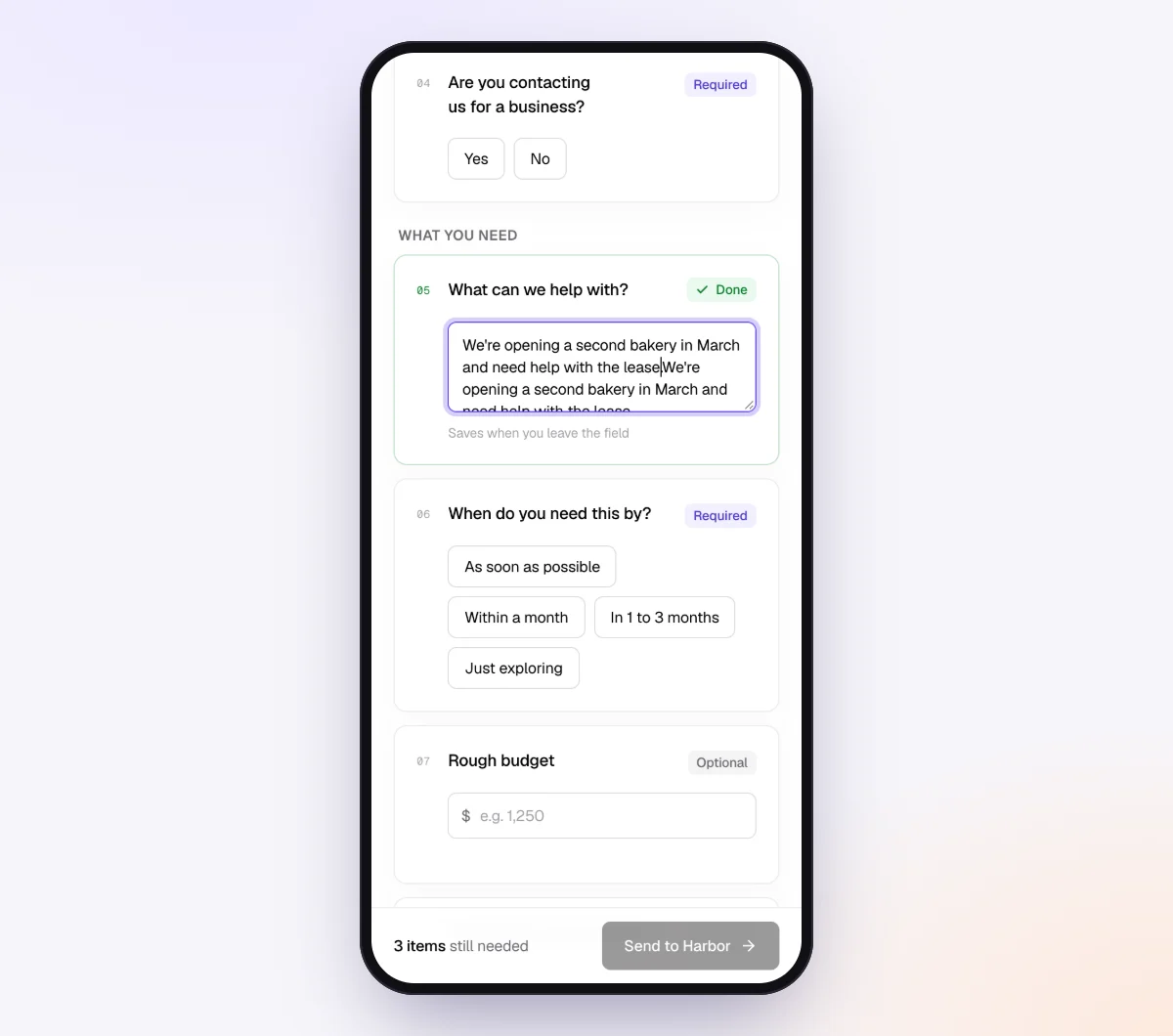
Keep one checklist for US rentals and one for Canadian rentals, so each client only sees forms from their own country.
4. Send one request per property
Click "New request," choose the checklist, and add a reference that names the property, such as "14 Elm Street, 2025 Schedule E" or "Unit 2, 88 King St, 2025 T776." Enter the owner's name and email and a needed-by date. Use "Notes for the agent (private)" for context like "Converted from home in March, closing docs already on file."
A client with three rentals gets three requests, each with its own link. That's the per-property structure your workpapers need, with no sorting by the client.
For many landlords at once, open "Batches," choose "Send to many customers," pick the checklist and upload an Excel file or CSV, one row per property. You can schedule the send up to 30 days ahead. Bulk requests are part of Pro, up to 100 clients per batch.
5. Owners upload, problems are caught, the agent chases
Each owner opens a private link on a phone or computer, with no account. Every upload is checked in seconds by document checks: right document, readable, recent enough, every page. A 2024 Form 1098 uploaded for the 2025 return is flagged on the spot, while the owner still has the lender's site open.
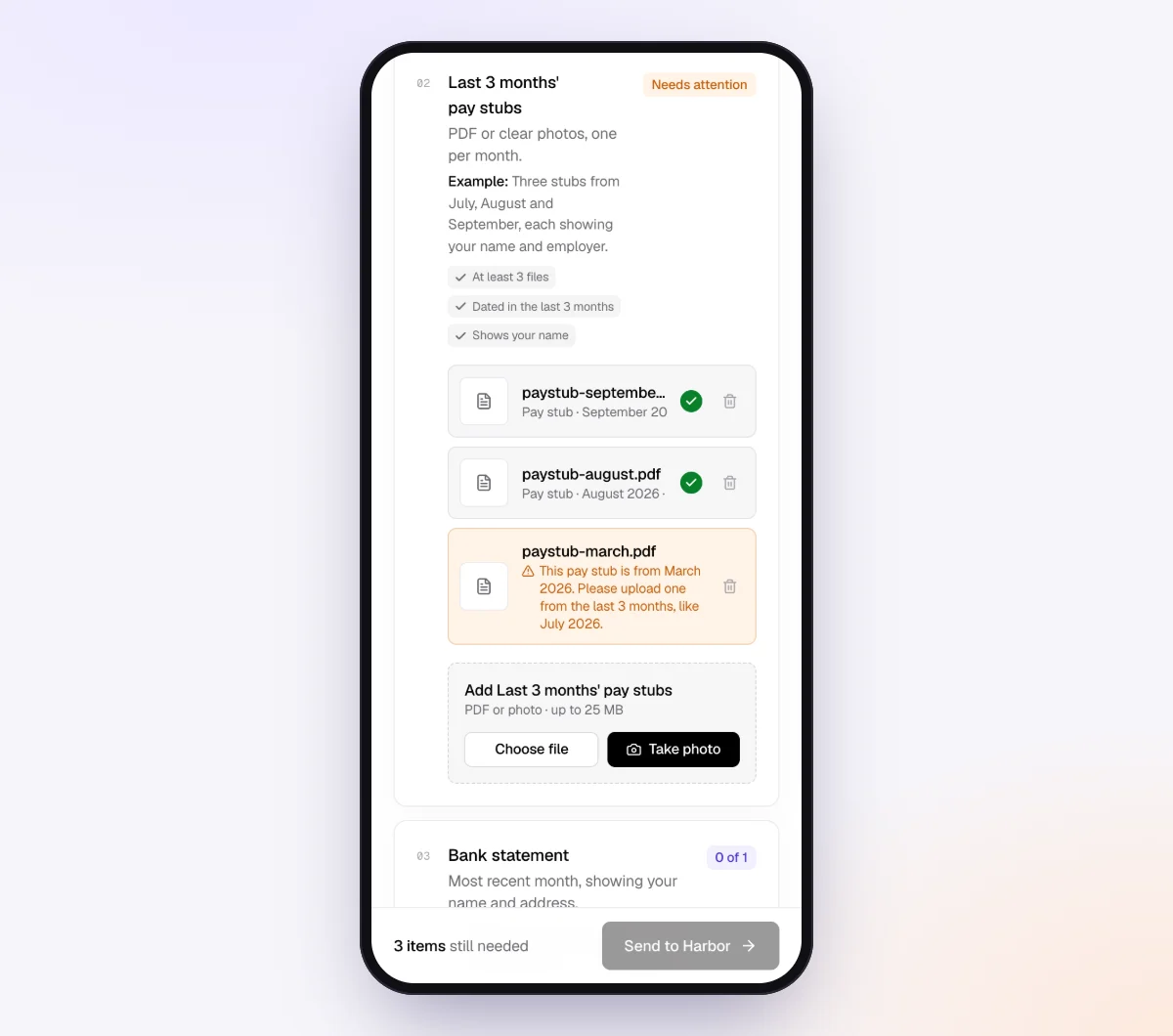
The AI collection agent paces reminders to the needed-by date, lists only what's missing, answers upload questions like "where do I find my Airbnb earnings report?" and hands tax questions ("is my new roof a repair?") to you. On Pro, owners can reply by email with files attached and each one is filed under the right item.
Review the request page, use "Ask for changes" on any file, then download the ZIP or, on Pro, deliver to Google Drive or a webhook.

Setups by landlord type
| Landlord type | Checklist items to add | Settings worth turning on | Learn more |
|---|---|---|---|
| One long-term rental, self-managed | Rent ledger, 1098 or lender statement, property tax, insurance, repairs | "Only ask if" on improvements | Accounting and tax |
| Several properties with a manager | Owner statement per property, 1099-MISC, lender statements | One request per property, every page on statements | Property management |
| Short-term rental host | Platform earnings report, 1099-K, occupancy tax, services provided | "Only ask if" on short-term rental | Document checks |
| First-year landlord | Closing statement, assessment, date available, appliances | Every page on the closing statement | Accounting and tax |
| Monthly bookkeeping client with rentals | Only year-end items the books don't already show | Run alongside the "Monthly bookkeeping" template | For bookkeepers |
If you already keep the books for landlord clients through the "Monthly bookkeeping" template, with a batch set to "Repeat every month," keep it running. Statements and receipts then arrive month by month, and the year-end rental request shrinks to what the books can't show: Form 1098 or the lender statement, property tax bills, improvement invoices and personal-use days. Our year-end bookkeeping client checklist covers the rest of the December handoff.
"Require an email code" is an optional checklist setting: the owner enters a 6-digit code sent to their email before the link opens. If a link goes to the wrong person, reset the customer's link from the request and the old one stops working. After the owner sends everything, the link no longer shows the files.
When something goes wrong
| Problem | Likely cause | Fix |
|---|---|---|
| All properties uploaded to one request | Client thought one link covered everything | Send one request per property with the address in the reference |
| No Form 1098 | Private loan, or interest under the reporting threshold | Ask for a lender statement or a signed interest summary |
| Last year's 1098 or tax bill | Downloaded the wrong year | The date rule on the item flags it at upload |
| Closing statement missing pages | Photographed the first page only | Turn on every page; the check flags missing pages |
| "I didn't get a 1099, so there's no income" | Thinks the form is the income | Ask for the rent ledger or bank deposits instead |
| Owner asks whether something is deductible | A tax question | The agent hands it to you; answer it personally |
Check "Alerts" daily from late January for handoffs and missed dates. For reminder pacing, see our client reminder schedule.
Free and Pro, honestly
You can run a real request without paying anything.
| Free | Pro ($29/month) | |
|---|---|---|
| Open requests | 1 at a time | Unlimited |
| AI check on each file | Yes | Yes |
| AI autopilot (answers, reminders, follow-ups) | Your first request | Every request |
| Send to many clients at once (Batches) | No | Yes |
| Clients reply by email with attachments | No | Yes |
| Branding | Tangentflow badge | Your logo |
| Delivery to Google Drive or a webhook | No | Yes |
| Works with AI assistants (MCP) | No | Yes |
| File retention | 7 days | 60 days |
Both plans include unlimited checklists, QR codes and posters, ZIP export, AI summaries and email delivery. Pro is billed monthly with no contract, and you can cancel any time. Full details on the pricing page.
What Tangentflow does not do: SMS or text messages, a native mobile app, full legal e-signature certificates, identity verification, collecting payments, or permanent storage. If you need any of those, pair it with a tool that does. It also does not prepare or file tax returns, calculate depreciation or CCA, give tax advice or replace your tax or bookkeeping software.
The whole process as a checklist
- Build a US or Canada checklist with the every-year items: rent, mortgage interest, property tax, insurance, repairs, utilities, fees and personal-use days.
- Add a "first year or changed" section: closing statement, land and building values, date first available, improvements.
- Add yes or no questions and use "Only ask if…" to hide what doesn't apply.
- Keep repairs and improvements as separate items.
- Send one request per property, a few weeks before your internal deadline.
- Let reminders run, listing only what's missing.
- Ask for income records, not just 1099s.
- Deliver closing statements and improvement records to your permanent files, then complete the request.
Frequently asked questions
What documents does a landlord need to give their accountant?
For each property: rent received, the mortgage interest statement (Form 1098 in the US or the lender's statement in Canada), property tax bills, insurance, repair and maintenance invoices, utilities and fees the owner paid, management statements and days of personal use. In the first year, or any year the property is bought, sold or improved, add the closing statement and improvement invoices.
What documents does a tax preparer need for Schedule E?
Rent received and the Schedule E Part I expenses for each property: mortgage interest, taxes, insurance, repairs, management fees and utilities. Add fair rental and personal-use days, any 1099-MISC or 1099-K forms, and depreciation records. For property placed in service this year, the closing statement and placed-in-service date are needed for Form 4562.
What documents do I need for form T776 in Canada?
Gross rents, the lender's annual mortgage statement, property tax bills, insurance, repair receipts, utilities, condo and management fees, and your ownership share if co-owned. For CCA, add the purchase statement of adjustments, the land and building split, and prior CCA schedules.
Do I need my closing statement for rental property taxes?
Yes, in the first year a property is rented and again in the year it is sold. The closing statement shows the purchase price and settlement costs that make up the cost basis (or capital cost in Canada), which drives depreciation or CCA and the gain on sale. After year one, your preparer carries the figures forward.
How do I know if an expense is a repair or an improvement?
Generally, a repair keeps the property in working condition and is deducted in the year paid, while an improvement adds value, restores a major part or adapts the property to a new use and is depreciated. The rules have safe harbors and exceptions, so upload invoices that describe the work and let your preparer classify them.
Will I get a 1099-K for my Airbnb or VRBO income?
Only if you pass the federal reporting threshold, which is currently more than $20,000 and more than 200 transactions for payment apps and online marketplaces, after a 2025 law change. Some states set lower thresholds. The income is taxable either way, so download the platform's earnings report and give it to your preparer.
Can I claim CCA on my rental property in Canada?
Usually, yes. Capital cost allowance is optional each year and is claimed by class, commonly Class 1, 3 or 8 for rental buildings and Class 8 for furniture and appliances. CCA cannot create or increase a rental loss, and land is not depreciable, so ask your preparer how much to claim.
Does Tangentflow give tax advice to landlords?
No. The AI agent answers questions about what to upload and how, from your checklist and notes. Questions about deductions, depreciation or CCA are handed off to you.