Checklists
Business Tax Return Documents Checklist: US and Canada (2026)
A business tax return documents checklist for S corps, partnerships, C corps and Canadian T2 returns, with entity extras, due-date rules and a collection plan.
By Bibin MathewUpdated 19 min read
The short answer
For any entity return, collect year-end financial statements (profit and loss, balance sheet, trial balance), every bank, card and loan statement for the final month, last year's return, fixed asset purchases and sales, payroll and contractor filings, and tax payments made. Then add the entity extras: officer pay and shareholder loans for an S corp, partner capital and guaranteed payments for a partnership, dividends and estimated payments for a C corp, and GIFI financials, shareholder register and CCA details for a Canadian T2. Ask a few yes or no questions to trim the list, and set the client's due date weeks before the entity deadline.
For a business tax return, the client needs to hand over five things: year-end financial statements (profit and loss, balance sheet and trial balance), closing statements for every bank, card and loan account, last year's return, records of assets bought and sold, and payroll, contractor and tax payment records. On top of that, each entity type adds its own items: officer pay and shareholder loans for an S corporation, partner capital and K-1 details for a partnership, dividends for a C corporation, and GIFI financials and a shareholder register for a Canadian T2.
The hard part is rarely the list. It is getting forty entity clients to send it before the deadline.
This guide is for bookkeepers, accountants and tax preparers in the US and Canada, and for owners who want to know what their CPA will ask for. You'll get a core checklist, the extras for each entity type, a US and Canada comparison, due-date rules and a step-by-step setup in Tangentflow.
Scope: this post covers entity returns only. For the owner's personal return, including Schedule C sole proprietors in the US and T2125 business income in Canada, use our client tax document checklist.
The core business tax return documents checklist
These items apply to almost every entity return, whatever the form number. If you keep the books, request only what you don't already have.
Entity basics and prior year
- Last year's federal and state or provincial returns, every page, for new clients
- Formation documents for new clients: articles of incorporation or organization, operating or partnership agreement, bylaws
- EIN confirmation letter (US) or business number (Canada)
- Ownership details: every owner's name, address, taxpayer number and percentage, with the dates of any changes during the year
- Every letter from a tax agency received during the year, from the IRS, a state, CRA or a province
Books and financial statements
- Year-end profit and loss and balance sheet, or access to the accounting file
- Trial balance and general ledger, if the preparer is not the bookkeeper
- Inventory count at year-end, if the business holds stock
Bank, card and loan records
- December (or fiscal year-end) statements for every account, including accounts that were opened or closed during the year
- Year-end loan statements showing the balance and the interest paid
- New loan documents for any loan taken out during the year, including vehicle and equipment financing
Assets
- Invoices for large purchases: equipment, vehicles, computers, furniture, improvements
- Sale or trade-in paperwork for any asset the business got rid of
- Vehicle use records, such as a mileage log, if a vehicle is used for both business and personal driving
- Last year's depreciation or capital cost allowance schedule, for new clients
Payroll and contractors
- Annual payroll reports: Forms W-2 and W-3 and the four quarterly Forms 941 (US), or the T4 Summary (Canada)
- 1099-NEC and 1099-MISC forms issued (US) or T4A slips issued (Canada)
Tax payments and other filings
- Estimated tax payments (US) or instalment payments (Canada), with dates and amounts
- Sales tax returns (US) or GST/HST, PST and QST returns (Canada) for the year
What to send your CPA for an S corp tax return (Form 1120-S)
An S corporation files Form 1120-S and gives each shareholder a Schedule K-1. On top of the core list, these items come up on almost every S corp return.
| Item | Why the preparer needs it |
|---|---|
| W-2s for each shareholder-employee | Officer pay is reported separately and should be reasonable |
| Health insurance paid for more-than-2% shareholders | Treated differently from other employees' coverage, usually shown on the owner's W-2 |
| Distributions to each shareholder, with dates | Affect basis and should follow ownership percentages |
| Shareholder loans, both directions | Needs a clear record (see below) |
| Expense reimbursements to owners | Home office, phone and mileage under an accountable plan |
| Changes in ownership, with dates | Changes how income is split on the K-1s |
If total receipts are $500,000 or more and the corporation deducts officer compensation, Form 1125-E (Compensation of Officers) is attached to the return.
S corp shareholders file Form 7203 with their own returns when they claim a loss, receive a non-dividend distribution, sell stock or are repaid a loan from the company.
Documents for a first-year S corp return
With no prior-year return to work from, ask for:
- Articles of incorporation or organization and the date the entity was formed
- The EIN confirmation letter
- Form 2553 as filed and the IRS letter accepting the S election
- An opening balance sheet: cash, assets and loans the owners put in on day one
- The ownership record showing who holds how many shares
- Start-up and organizational costs paid before the business opened, with receipts
- The final return of the old business, if the S corp took over from a sole proprietorship or an LLC taxed another way during the year
Partnership tax return documents (Form 1065 and K-1 information)
A partnership, including a multi-member LLC taxed as one, files Form 1065 and gives each partner a Schedule K-1.
| Item | Why the preparer needs it |
|---|---|
| Partnership or operating agreement, with every amendment | It sets how income, losses and distributions are split |
| Partner list: name, address, taxpayer number, entity type | Every partner gets a K-1, and some partners are themselves entities |
| Profit, loss and capital percentages, start and end of year | Shown on each K-1, and they change when partners come or go |
| Guaranteed payments to partners | Fixed payments to partners for services or capital are reported separately |
| Contributions by each partner, cash and property | Property needs its value and the partner's original cost |
| Distributions to each partner, cash and property | Affects capital accounts and each partner's basis |
| Partner changes during the year | A partner joining, leaving or selling an interest can change allocations and elections |
| Partnership debt and who is on the hook for it | Loan agreements and guarantees affect how liabilities are shared on the K-1s |
| Prior-year capital account balances | Capital accounts are reported on the K-1 using the tax basis method |
The partnership also names a partnership representative on the return for IRS audit purposes. Confirm who that person is each year, especially if partners changed.
C corporation return documents (Form 1120)
A C corporation files Form 1120 and pays its own tax. There are no K-1s, but a few items are specific:
- Dividends paid to shareholders during the year, and copies of any 1099-DIV forms issued
- Estimated tax payments made by the corporation
- Officer compensation, with each officer's ownership percentage, for Form 1125-E where it applies
- Loans to and from shareholders, with notes and interest terms
- Net operating loss and credit carryforward schedules from prior years, for new clients
Corporations with total assets of $10 million or more file Schedule M-3 instead of Schedule M-1.
Shareholder loan and officer compensation records
These two items cause the most back and forth on owner-managed company returns. Ask for them as separate checklist items.
Shareholder loans. Ask for every amount the owner put into the company or took out that was not payroll or a declared distribution or dividend, with dates. Ask for any written note, interest rate and repayment schedule. In the US, a "loan" with no paperwork or repayments may be treated as a distribution or pay. In Canada, a loan from a corporation to a shareholder is generally included in the shareholder's income unless it is repaid within one year after the end of the corporation's tax year in which it was made (with exceptions and anti-avoidance rules). The preparer decides how to treat each balance.
Officer compensation. Ask for each owner's W-2 or T4, or the payroll report showing their pay, and anything else the company paid for them, such as health insurance or a vehicle. In an S corp, the IRS expects shareholder-employees to take reasonable compensation before distributions. In a Canadian corporation, the salary versus dividend mix drives which slips (T4 or T5) the company issues.
T2 corporate tax return documents checklist (Canada)
Every resident corporation in Canada files a T2 each year, even with no tax payable. Request these on top of the core list.
| Item | Where it goes on the T2 |
|---|---|
| Year-end financial statements and notes | Converted to GIFI: Schedule 100 (balance sheet), Schedule 125 (income statement) and Schedule 141 (notes checklist) |
| Last year's T2 and Notice of Assessment | Carryforwards, instalment history and opening balances |
| Shareholder register or minute book | Schedule 50 lists shareholders holding 10% or more |
| Fixed asset additions and disposals | Schedule 8 capital cost allowance |
| Shareholder loan account detail | Shareholder loan rules and the balance sheet |
| Dividends declared, with T5 slips and the T5 Summary | Schedule 3 and the dividend refund calculation |
| GST/HST returns for the year | Reconciles tax collected and input tax credits to the books |
| Related and associated corporations | Schedules 9 and 23, which affect the small business deduction |
| Provincial items | Quebec and Alberta corporations also file a separate provincial return, and other provinces use T2 schedules |
For tax years starting after 2023, most corporations have to file the T2 electronically, with some exceptions such as insurance corporations and non-resident corporations. A clean trial balance makes the GIFI mapping easier.
US entities and the Canadian T2, side by side
For firms serving clients on both sides of the border, this table maps the main documents. Treat each row as "where similar information shows up," not as exact equivalents.
| What it covers | S corp (1120-S) | Partnership (1065) | C corp (1120) | Canadian corporation (T2) |
|---|---|---|---|---|
| Who pays the income tax | Shareholders | Partners | The corporation | The corporation |
| Owner information slip | Schedule K-1 | Schedule K-1 | 1099-DIV for dividends | T5 for dividends, T4 for salary |
| Financial statements | Schedule L and M-1 (with exceptions) | Schedule L, M-1 and M-2 (with exceptions) | Schedule L and M-1, or M-3 | GIFI Schedules 100, 125, 141 |
| Depreciation | Form 4562 | Form 4562 | Form 4562 | Schedule 8 (CCA) |
| Owner pay | W-2 and Form 1125-E | Guaranteed payments | W-2 and Form 1125-E | T4 slips |
| Filing due date rule | 15th day of the 3rd month after year-end | 15th day of the 3rd month after year-end | 15th day of the 4th month after year-end (generally) | Within 6 months after year-end |
Questions that trim the list
Send the core list, then let a few yes or no answers decide the rest.
| Ask this question | If yes, request |
|---|---|
| Did the business buy or sell equipment, vehicles or property? | Invoices, sale papers, financing documents |
| Did ownership change during the year? | Purchase or transfer agreement, dates, new owner details |
| Did you move money between the company and your personal accounts, other than payroll? | Shareholder loan detail, notes, repayment records |
| Did you pay any contractors enough to need a 1099? (US) | 1099s issued, W-9s on file |
| Did you receive any letters from the IRS, a state or CRA? | Every page of each letter |
| Is this the company's first year? | Formation documents, opening balance sheet, S election papers |
The 1099-NEC threshold is $600 for 2025 payments and $2,000 for 2026 payments, so check the IRS site before putting a number in the question.
When business tax documents are due to your accountant
Your client due date should come well before the entity deadline. Here are the federal rules. Dates move when they land on a weekend or holiday, and states and provinces have their own rules.
| Return | Federal due date rule | Calendar-year example | Extension |
|---|---|---|---|
| Form 1120-S (S corp) | 15th day of the 3rd month after year-end | Mid-March | Form 7004, 6 months |
| Form 1065 (partnership) | 15th day of the 3rd month after year-end | Mid-March | Form 7004, 6 months |
| Form 1120 (C corp) | 15th day of the 4th month after year-end, with a different rule for June 30 year-ends | Mid-April | Form 7004 |
| T2 (Canada) filing | Within 6 months after year-end | June 30 for a December 31 year-end | None in general |
| T2 (Canada) balance owing | 2 months after year-end, or 3 months for some Canadian-controlled private corporations | End of February or end of March | None |
That last row surprises clients: Canadian corporate tax is generally due two or three months after year-end, long before the filing deadline.
In the US, an extension gives more time to file, not more time to pay a C corporation's tax. K-1s go to owners when the return is filed, and their personal returns often wait on them. Late 1120-S and 1065 returns also carry a penalty charged per owner, per month.
A collection plan for March 15
A workable schedule for a firm with many calendar-year S corps and partnerships:
| When | What happens |
|---|---|
| Early December | Send the questions only, so you know which items each client needs |
| First week of January | Send the document request, with a needed-by date about four weeks out |
| Mid-January | Year-end payroll, 1099s and W-2s are done; ask for copies |
| Early February | Client needed-by date; follow up personally on anyone still missing |
| Mid-February | Decide which entities will be extended, and tell those owners |
| Before March 15 | File or extend, and send K-1s |
For Canadian corporations with December year-ends, aim to have the financial statements ready by the end of February, before the balance-due date. If you keep a client's books monthly, send a short list: year-end statements, loan statements and the owner questions.
Business tax return documents in Tangentflow, step by step
Tangentflow does not prepare returns. It gets the documents in, complete and correct. Here is the setup.
1. Start from the "Year-end documents" template
Open "Checklists", choose "Browse templates" and pick "Year-end documents." It comes with four items: "Income documents," "Bank statements" (all accounts, for the whole year, every page), "Expense receipts" (optional) and "Any changes this year?" (optional).

For an entity return, rename "Income documents" to something like "Year-end profit and loss and balance sheet," and add items from the core checklist: year-end loan statements, asset purchases, payroll year-end reports, 1099s or T4As issued, tax payments and agency letters.
2. Tell each item what "good" looks like
Open an item in the checklist editor. Fill in "What should it be?" ("December 2025 statement for each business bank account"), set a count, add a date rule and turn on every page for statements and prior-year returns. Add section headings such as "Books" and "Owners" to keep a long list readable on a phone.

3. Add the questions that trim the list
Add form fields for the questions in the table above: a yes/no for "Did ownership change this year?", a yes/no for money moved between the company and personal accounts, a date for the S election. Then use "Only ask if…" so the shareholder loan item only appears when the answer is yes.
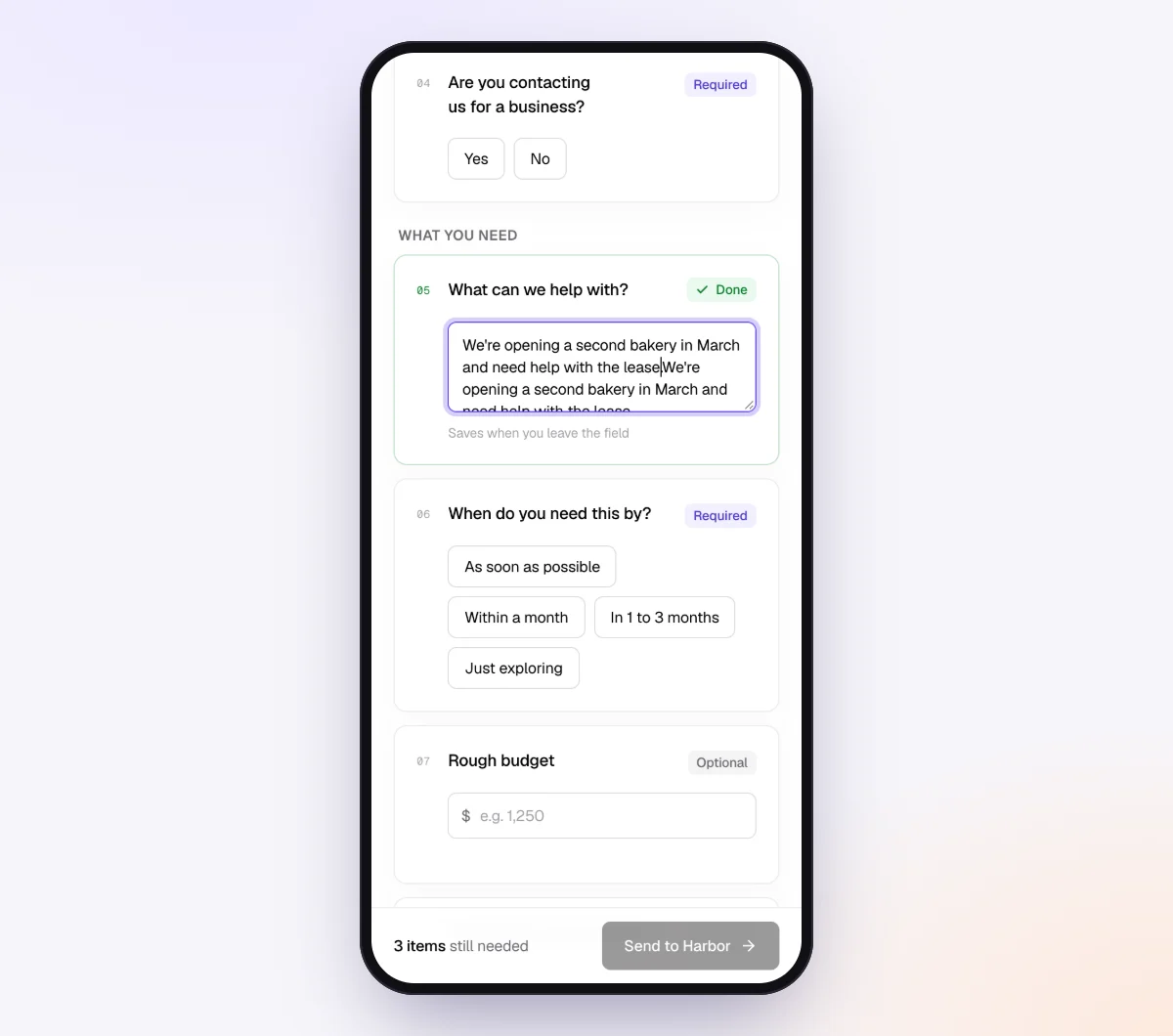
Keep one checklist per entity type, such as "S corp return," "Partnership return" and "T2 return," so each client sees only their own extras. A fillable PDF engagement letter can be attached to an item and signed online (forms and e-signatures).
4. Send one request per entity, or a batch
For one client, click "New request," choose the checklist, add a reference such as "Acme Design LLC, 2025 1065," enter the owner's name and email and set the needed-by date. Use "Notes for the agent (private)" for context like "Two partners, one left in June."
For everyone at once, open "Batches," choose "Send to many customers," pick the checklist and upload an Excel file or CSV, or paste rows from Google Sheets: name, email, reference, needed-by date and notes. You can schedule the send up to 30 days ahead, give each client their own date and skip clients with an open request. Bulk requests are part of Pro, up to 100 clients per batch.
5. Clients upload, problems are caught, the agent chases
Each owner opens a private link on a phone or computer, with no account. Every upload is checked in seconds by document checks: the right document, readable, recent enough and every page. A November statement uploaded instead of December's is flagged on the spot.
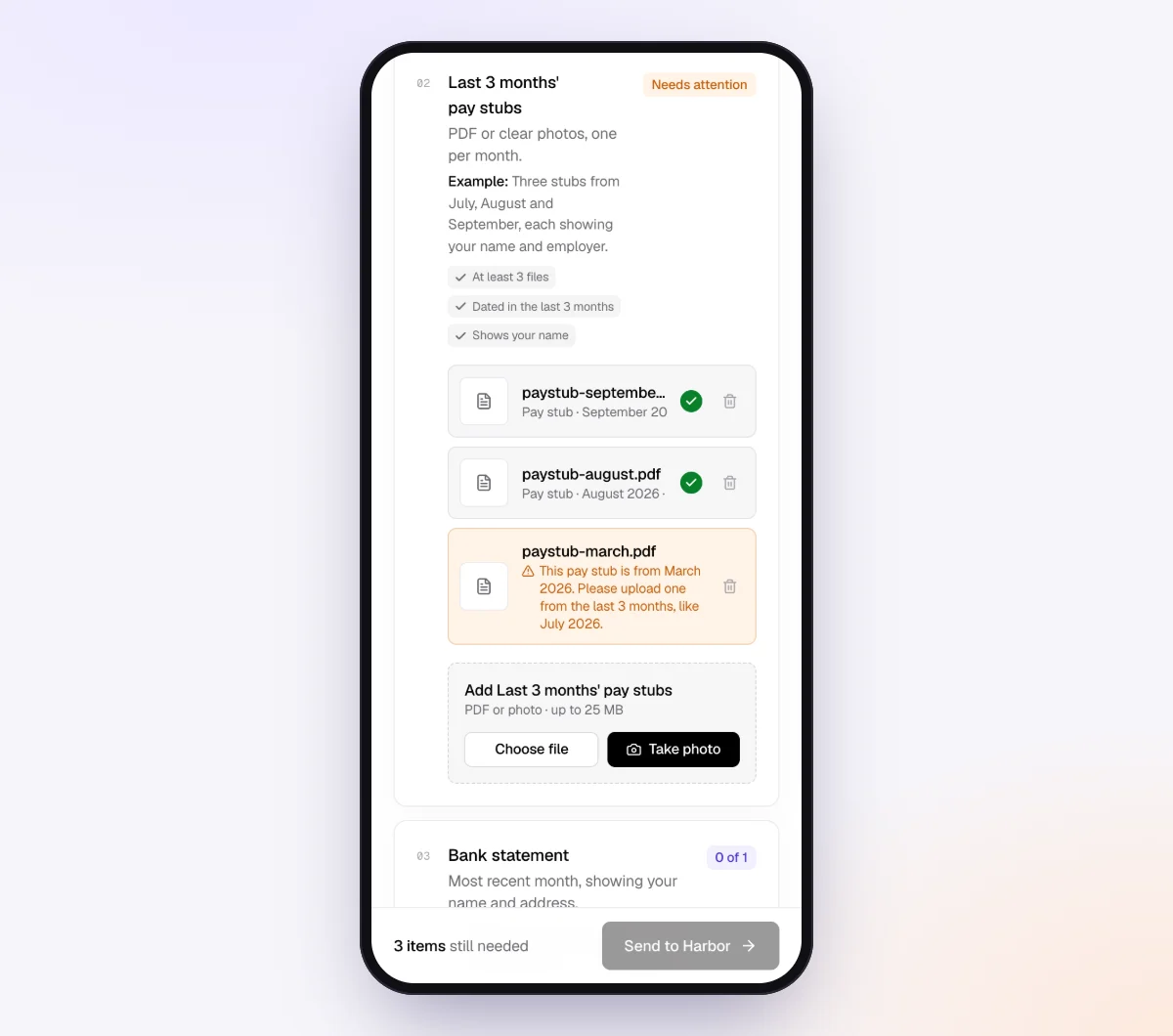
The AI collection agent paces reminders to the needed-by date, lists only what is missing, answers upload questions and hands tax questions to you. On Pro, owners can reply with files attached.
Review the request page, use "Ask for changes" on any file, then download the ZIP or, on Pro, deliver to Google Drive or a webhook.

Setups by entity type
| Entity | Checklist items to add | Settings worth turning on | Learn more |
|---|---|---|---|
| S corp | Officer W-2s, distributions, shareholder loans, health insurance for owners | "Only ask if" on the loan question, require an email code | Accounting and tax |
| Partnership or multi-member LLC | Agreement, partner list, guaranteed payments, contributions and distributions | Higher max count on agreements and amendments | Document checks |
| Canadian corporation (T2) | Financial statements, NOA, shareholder register, T5 Summary, GST/HST returns | Section headings, every page on statements | Accounting and tax |
| Monthly bookkeeping client | Only year-end statements, loan statements and owner questions | Run alongside the "Monthly bookkeeping" template | For bookkeepers |
If these clients already get the "Monthly bookkeeping" template through a batch with "Repeat every month" on, keep it running. Send the tax return checklist as a one-off batch in January, and add the year-end extras from our monthly bookkeeping checklist to December's request.
"Require an email code" is an optional checklist setting: the client enters a 6-digit code sent to their email before the link opens. If a link goes to the wrong person, reset the customer's link from the request and the old one stops working. After the client sends everything, the link no longer shows the files.
When something goes wrong
| Problem | Likely cause | Fix |
|---|---|---|
| Client sends a QuickBooks screenshot instead of reports | Doesn't know how to export | Add a tip naming the report and the PDF export, or ask for accountant access instead |
| Year-end statement is from the wrong month | Downloaded the latest one | Date rule on the item flags it at upload |
| Owner says "there are no shareholder loans" but the books show transfers | Thinks of it as "my money" | Send the specific transactions from your own email, and ask them to upload support |
| Client is silent two weeks before the date | Busy season for them too | The agent hands off when the date is missed; call them |
| Client asks whether to extend | A tax question | The agent hands it to you; answer it personally |
Check "Alerts" daily from late January for handoffs and missed dates.
Free and Pro, honestly
You can run a real request without paying anything.
| Free | Pro ($29/month) | |
|---|---|---|
| Open requests | 1 at a time | Unlimited |
| AI check on each file | Yes | Yes |
| AI autopilot (answers, reminders, follow-ups) | Your first request | Every request |
| Send to many clients at once (Batches) | No | Yes |
| Clients reply by email with attachments | No | Yes |
| Branding | Tangentflow badge | Your logo |
| Delivery to Google Drive or a webhook | No | Yes |
| Works with AI assistants (MCP) | No | Yes |
| File retention | 7 days | 60 days |
Both plans include unlimited checklists, QR codes and posters, ZIP export, AI summaries and email delivery. Pro is billed monthly with no contract, and you can cancel any time. Full details on the pricing page.
What Tangentflow does not do: SMS or text messages, a native mobile app, full legal e-signature certificates, identity verification, collecting payments, or permanent storage. If you need any of those, pair it with a tool that does. It also does not prepare or file tax returns, give tax advice or replace your tax or bookkeeping software.
The whole process as a checklist
- Build one core checklist: financial statements, year-end account and loan statements, prior-year return, assets, payroll, contractors and tax payments.
- Make a version per entity type with the S corp, partnership, C corp or T2 extras.
- Add yes or no questions that unlock situational items, especially shareholder loans and ownership changes.
- Send the questions in December and the document request in early January.
- Set each client's needed-by date about six weeks before the entity deadline.
- Let reminders run paced to the date, listing only what is missing.
- Call clients who are stuck, and decide on extensions by mid-February.
- Deliver the package to your own records system, then complete the request.
Frequently asked questions
What documents do I need for a business tax return?
Year-end profit and loss and balance sheet, statements for every bank, card and loan account at year-end, last year's return, records of assets bought or sold, payroll and contractor filings, and tax payments made. Each entity type adds its own items, such as officer pay for an S corp, partner capital for a partnership or GIFI financials for a Canadian T2.
What should I send my CPA for an S corp tax return?
The core business documents plus W-2s for shareholder-employees, health insurance paid for owners, distributions to each shareholder, shareholder loan records, expense reimbursements to owners and any changes in ownership. A first-year S corp also needs formation documents, the EIN letter, Form 2553 and the IRS acceptance letter, and an opening balance sheet.
What information does a partnership need for Form 1065 and the K-1s?
The partnership agreement and amendments, each partner's name, address, taxpayer number and percentages, guaranteed payments, contributions and distributions by partner, partnership debt, and last year's capital account balances.
When are business tax documents due to my accountant?
Earlier than the return. S corp and partnership returns are generally due by the 15th day of the 3rd month after year-end, so many firms ask for documents about six weeks before that. Ask your accountant for their exact date.
What documents are needed for a T2 corporate tax return in Canada?
Year-end financial statements and notes, last year's T2 and Notice of Assessment, the shareholder register, fixed asset additions and disposals, shareholder loan detail, dividends declared with T5 slips, the T4 Summary, GST/HST returns and instalments paid. Corporations in Quebec and Alberta also file a separate provincial return.
How should shareholder loans be documented?
Keep a record of every amount the owner put into or took out of the company that was not payroll or a declared distribution or dividend, with dates, plus any written note, interest rate and repayment schedule. In Canada, a loan to a shareholder that is not repaid within one year after the end of the company's tax year is generally included in the shareholder's income.
Does Tangentflow prepare business tax returns?
No. It collects and checks the documents, chases what is missing and delivers an organized package to you.