Checklists
Year-End Bookkeeping: What to Request From Clients (2026)
Year-end documents to request from bookkeeping clients, when to send them, a PBC-style list, email templates, and 1099, T4A and T5018 timing for 2026.
By Bibin MathewUpdated 19 min read
The short answer
Ask each client for December (or fiscal year-end) statements for every account, year-end loan statements, a list of large purchases and asset sales, an inventory count if they hold stock, open invoices and unpaid bills, the final payroll report, and a contractor list with W-9s (US) or SINs and business numbers (Canada). Send it in two parts, a pre-year-end request in November and a statements request in the first week of January, so W-2s and 1099s can go out by February 1, 2027 and T4s and T4As by March 1, 2027. Use one checklist for every client, yes or no questions to trim it, and a real needed-by date.
Before December 31, ask every bookkeeping client for the things only they can give you: a confirmed list of accounts, contractor details (W-9s in the US, SINs or business numbers in Canada), large purchases and asset sales, an inventory count plan and anything unusual this year. In the first week of January, follow up for December statements, year-end loan balances, open invoices and unpaid bills. Splitting it this way leaves time to file 1099s, W-2s and T4As, which for the 2026 year are due February 1, 2027 in the US and March 1, 2027 in Canada.
Most year-end checklists online are internal close lists. They don't separate your work from what you're waiting on, and the waiting is what wrecks January.
This guide is for independent bookkeepers and small accounting firms in the US and Canada. You'll get the client-facing checklist, a PBC-style list, an October to January timeline tied to the filing dates, copy-ready emails, and a step-by-step setup in Tangentflow if you'd rather an agent did the chasing.
Your work vs what only the client can give you
Sort every year-end task into two piles: what you can do from the books you already have, and what is blocked until the client sends something. The second pile is your year-end request.
| Year-end task | What you're waiting on | In the client request? |
|---|---|---|
| Reconcile December bank and card accounts | December statements | Yes |
| Tie loan balances and split interest | Lender's year-end statement | Yes |
| Record new equipment and vehicles | Invoices, purchase agreements | Yes |
| Adjust cost of goods sold | Inventory count and valuation | Yes |
| Prepare 1099s or T4As | Contractor list, W-9s, SINs or BNs | Yes |
| Accrue unpaid bills | Bills that arrived after December 31 | Yes |
| Review the trial balance, post depreciation, lock the period | Nothing | No |
For the internal steps, our month-end close checklist applies with more care.
The year-end bookkeeping checklist for clients
These are the items to request from a typical small business client. Mark what doesn't apply as optional, or hide it behind a yes or no question. This list covers the business only. If you also prepare the owner's personal return, use our client tax document checklist for the slips the owner receives.
Statements and a complete account list
- December statements for every business account, or the last month of the fiscal year. Every page, as a PDF from the bank website, not a screenshot.
- Accounts that rarely move: savings, a second checking account, a PayPal balance. Nothing happens in them, so they get forgotten, and their balance still has to tie out.
- Card statements that close in January but include December charges.
- A confirmed list of every account and card used this year, including ones opened or closed. Send the client your list and ask "Is anything missing?"
Loan statements and year-end balances
For each loan, line of credit, equipment financing or vehicle loan, ask for:
- The lender's year-end statement or annual summary, showing the principal balance at December 31 and total interest paid for the year. Many business loans come with no tax form, so this is often the only document showing interest.
- New loan documents signed this year, with the amortization schedule if there is one.
- Payoff or refinancing letters.
- Owner or shareholder loans: a note on money put in or taken out that wasn't salary or a draw.
Fixed asset purchases list for your accountant
Clients leave out large purchases because to them it's just another expense. Ask for:
- Every purchase over a threshold you set: equipment, vehicles, computers, furniture, leasehold improvements. Many US bookkeepers use $2,500 per invoice or item, the IRS de minimis safe harbor amount for businesses without an applicable financial statement. Whether the client elects it is a decision for their preparer.
- The invoice or purchase agreement for each, showing date, cost and what was bought.
- Anything sold, traded in or scrapped, with the date and price. Disposals matter for depreciation in the US and capital cost allowance (CCA) in Canada.
The easiest format: send your existing fixed asset list and ask the client to add new items and mark anything they no longer have.
Inventory count for year-end
If the client holds stock, ending inventory feeds straight into cost of goods sold, so it needs a real count, not last year's number:
- A count as of year-end, or close to it and rolled forward for sales and purchases in between.
- The count sheet or export, with quantity and cost per item.
- Obsolete or damaged stock, listed separately, plus goods in transit or on consignment.
Ask about the count date in November. A business closed over the holidays may count on December 23; one open on December 31 needs to plan staff.
Receivables, payables and deposits
- Open customer invoices at year-end, and which ones the client thinks won't be paid.
- Bills dated in the year but received after December 31, such as December utilities.
- Customer deposits for work not yet done, and prepaid expenses that cover next year, like an annual insurance premium.
Payroll and owner items
- The final payroll register and year-end summary from the payroll provider (Gusto, ADP, Wagepoint or similar), including year-end bonuses.
- US S corporations: health insurance premiums paid for more-than-2% shareholders, which generally belong in the shareholder's W-2 wages. Confirm the treatment with the client's preparer.
- Owner draws, contributions and personal expenses paid by the business that weren't flagged monthly.
- A vehicle mileage log, if the business claims vehicle expenses based on business use.
Contractors and vendors you paid
This item has the hardest deadline, so it belongs in the pre-year-end request:
- A list of everyone paid for services, with the total for the year. Your books produce the draft; the client confirms it and adds anyone paid outside the books.
- US: a signed Form W-9 for each. For payments made in 2026, Form 1099-NEC and most 1099-MISC boxes apply at $2,000 or more, up from $600, per the IRS Instructions for Forms 1099-MISC and 1099-NEC. Collect the W-9 anyway, since you often won't know who crossed the line until December. Our guide to collecting W-9 forms from vendors covers what to check.
- Canada: legal name, address and business number, or a SIN for sole proprietors, for anyone who may need a T4A. The CRA says a T4A must be issued when fees for services total more than $500 in the calendar year or tax was deducted, reported in box 048.
- Canadian construction businesses: subcontractor details and amounts for the T5018. It generally applies when construction is the main source of business income, and subcontractors paid $500 or less in the year don't need to be reported.
Sales tax, GST/HST and letters
- The last sales tax return for the year, or the annual GST/HST, PST or QST return, with the confirmation.
- Any notice from the IRS, CRA, a state or a province you haven't seen. Every page.
- 1099-K forms or annual platform summaries from Stripe, PayPal, Square or Shopify, which usually arrive in January and help tie gross sales.
Questions, not files
Ask these as yes or no questions so follow-up items only appear when they apply:
- Did you buy or sell equipment, vehicles or property this year?
- Did you take out, refinance or pay off a loan?
- Do you hold inventory?
- Did you pay any contractors or freelancers?
- Did you open or close any bank accounts or cards?
- Did ownership change, or did you add a partner?
- Anything else unusual? (an insurance claim, a grant, a new location)
A year-end PBC list for small business
Auditors call the list of items a client must supply a PBC list, for "provided by client." The format is worth borrowing even without an audit: each item gets a format, a date and the work it blocks, so the client sees why a late item matters.
| Item | Format | Needed by | Blocks |
|---|---|---|---|
| Confirmed account and card list | Yes/no plus additions | November 30 | Knowing what to reconcile |
| Contractor list with totals | Your draft, client confirms | December 15 | 1099s, T4As, T5018s |
| W-9s, or BNs and SINs | Via secure link | December 15 | 1099s, T4As |
| Inventory count plan | Date and who counts | November 30 | Planning |
| December statements, every account | PDF, every page | January 8 | Final reconciliations |
| Final payroll register | Provider report | January 8 | W-2 or T4 tie-out |
| Large purchases and disposals | Invoices plus a short list | January 15 | Fixed assets |
| Year-end loan statements | PDF with balance and interest | January 15 | Loan balances, interest |
| Inventory count sheet | Spreadsheet or export | January 15 | Cost of goods sold |
| Open invoices and unpaid bills | Report or list | January 15 | Accruals |
The dates assume a December 31 year-end. Move them to suit your workload, but keep the contractor items before the holidays.
When to send year-end requests: an October to January timeline
The common mistake is one big request in January. By then contractor information is already late, nobody counted inventory and half your clients are away until the 8th. Send it in two parts.
| When | What to send or do | Why then |
|---|---|---|
| Late October | Tell clients year-end is coming; confirm account lists and fiscal year-ends | Nobody is busy yet |
| Early to mid November | Request 1: contractor list, W-9s or BNs and SINs, inventory plan, yes/no questions | Contractors are easier to reach before the holidays |
| Early December | Remind about anything missing from Request 1 | Last chance before offices close |
| First business days of January | Request 2: December statements, loans, inventory sheet, open items, payroll register, asset invoices | December statements are usually out by now |
| Mid January | Reconcile; prepare 1099s, W-2s, T4s and T4As | Ahead of the filing dates |
The filing dates behind the timeline
Dates for the 2026 tax year, filed in early 2027. Weekends and rule changes move them, so check each year.
| Form | Due | Notes |
|---|---|---|
| Form W-2 (US) | February 1, 2027, to employees and the SSA | January 31 is a Sunday. See the IRS W-2 instructions. |
| Form 1099-NEC (US) | February 1, 2027, to recipients and the IRS | Same next-business-day rule |
| Form 1099-MISC (US) | Recipients February 1, 2027; IRS March 1, 2027 on paper or March 31, 2027 electronically | Some boxes have a later recipient date |
| T4 and T4A (Canada) | March 1, 2027 | The due date is the last day of February; February 28, 2027 is a Sunday. See CRA's When to file. |
| T5018 (Canada) | Six months after the end of the reporting period the payer chooses | June 30, 2027 for a calendar-year period |
Clients with a fiscal year-end
A client with a June 30 year-end needs Request 2 right after its year-end. But 1099s and T4As follow the calendar year (T5018 lets the payer choose calendar or fiscal), so that client also gets a short contractor request every November.
Ways to send year-end requests, compared
| Method | Setup effort | Client effort | Shows what's missing | Reminders | Good for SINs and W-9s |
|---|---|---|---|---|---|
| One long email | None | High | No | Manual | No |
| Shared PBC spreadsheet | Low | Medium | Yes, if updated | Manual | No, files still go elsewhere |
| Shared folder per client | Low | Medium | No | Manual | Depends on settings |
| Extra items in the December monthly request | Low | Low | Yes | Same as monthly | Same as monthly |
| Practice portal | Medium to high | Account and password | Partly | Some | Usually good |
| Private link with checklist and AI agent (Tangentflow) | Low | Low (no account) | Yes | Paced to the date | Yes, with an email code |
Extra items in the December request suit a client with one account and no contractors. Everyone else needs a separate request with its own date.
Year-end request email templates
Use the same subject line every year so clients recognize it.
Request 1: before year-end
Subject: Year-end [2026]: a few things we need by December 15

Hi [First name],

To get your 1099s [T4As] out on time and close [Business name]'s year
quickly in January, we need a few things before the holidays:

- Confirm your list of bank accounts and cards (we've listed what we have)
- Confirm your contractor list and amounts paid (we've drafted it)
- A W-9 for any contractor we don't have one for [US]
  / Business number or SIN for contractors who need a T4A [Canada]
- If you hold inventory: when you plan to count it
- A few yes/no questions about purchases, loans and changes this year

Upload here from your phone, no account needed:
[link]

In the first week of January we'll send a second, shorter list.

Thanks,
[Your name]
[Firm name]
Request 2: early January
Subject: Year-end [2026]: December statements and final items

Hi [First name],

Happy new year. To close [2026], please send these by [day, date]:

- December statements for every account and card, every page (PDF)
- Year-end loan statements showing balance and interest paid
- Invoices for anything you bought over [$2,500]
- Your inventory count, if you counted
- Open customer invoices and bills that arrived after December 31
- Your final payroll report for the year

[link]

Thanks,
[Your name]
For reminder wording, see our document request email templates.
Year-end requests in Tangentflow, step by step
Tangentflow sends each client a private link with your checklist, checks every upload as it arrives, and has an AI collection agent do the reminding. It ships with a "Year-end documents" template you can turn into your business year-end request.
1. Start from the "Year-end documents" template
Go to Checklists, choose "Browse templates" and pick "Year-end documents." It comes with "Income documents," "Bank statements" (all accounts, every page required), "Expense receipts" (optional) and an optional question, "Any changes this year?"
The template is written to cover a tax return or year-end accounts, so edit it for a business year-end. For example, rename "Income documents" to "Sales reports and 1099-K forms," and set "What should it be?" on "Bank statements" to "bank statement for December 2026, all pages."

2. Add the year-end items
Add file items for "Loan statements," "Invoices for large purchases," "Inventory count," "Open invoices and unpaid bills," "Final payroll report" and "W-9 forms" or "Contractor details." For each, fill in "What should it be?", a minimum count, every page for statements, and an "Example" for anything clients get wrong. Section headings such as "Accounts," "Purchases and loans" and "Contractors" keep the page scannable.

To have clients fill in your fixed asset or inventory spreadsheet, attach it to the item; Word and Excel forms are downloaded and returned. Fillable PDFs such as Form W-9 are filled in and signed online. See forms and e-signatures.
3. Turn questions into gates
Add the yes/no questions above as form fields, then use "Only ask if…" on the follow-up items. A client who answers "No" to "Do you hold inventory?" never sees the inventory item.
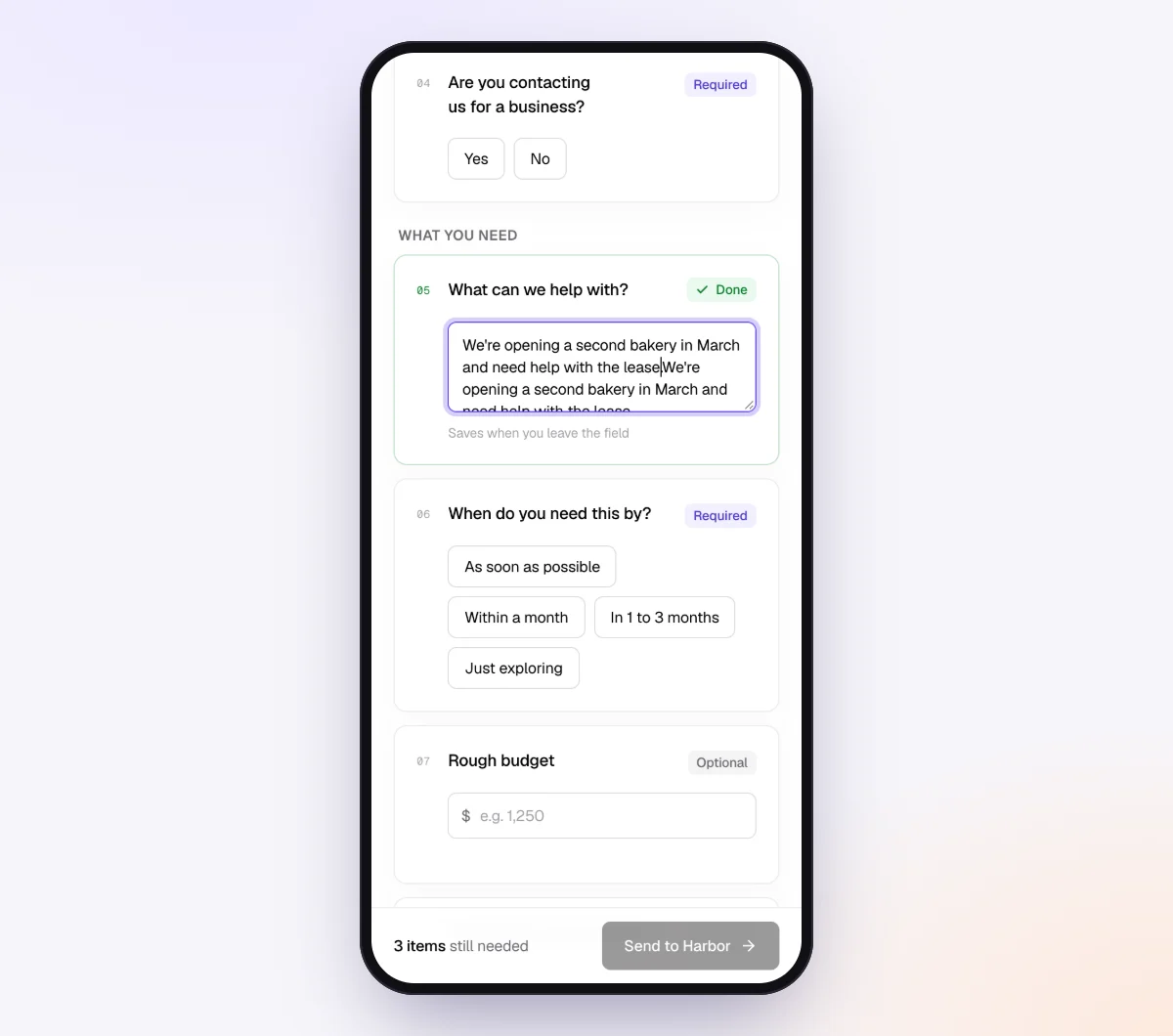
For a checklist that collects W-9s or SINs, turn on "Require an email code" so the client enters a 6-digit code sent to their email before the link opens, and consider switching the AI check off on those items so the files are stored for a person to review and never sent to the AI provider.
4. Send it to every client with Batches
Open "Batches," choose "Send to many customers," pick your year-end checklist, and upload an Excel file or CSV or paste rows: name, email, reference, needed-by date and notes. Extra columns like "has inventory" or "S corp" become context for the agent. You can schedule the send up to 30 days ahead, so Request 2 can be set up in December to go out at 8 a.m. on January 4. Bulk requests are part of Pro, up to 100 clients per batch.
Batches skip clients who already have an open request from the same checklist, so an open monthly request won't block the year-end one. Leave "Repeat every month" off here; that switch is for your batch built on the "Monthly bookkeeping" template (see our monthly bookkeeping checklist).
5. Problems are caught on arrival, and the agent chases the rest
Each upload is checked in seconds by document checks. If a client uploads November's statement instead of December's, or page one of four, they see a friendly note and can fix it on the spot. The agent paces reminders to your needed-by date, lists only what's still missing, answers questions like "does the PayPal account count?" from your checklist and notes, and hands tax questions to you.

Use "Ask for changes" on any file. When everything is in, download the ZIP, or on Pro deliver to Google Drive or a webhook, then mark the request complete. Files are deleted 24 hours later.
Year-end setups by type of client
Keep one year-end checklist and adjust with "Only ask if…" rather than building one per client. More for independent practices on our page for bookkeepers.
| Client type | Items to emphasize | Settings worth turning on | Learn more |
|---|---|---|---|
| Service business with contractors | Contractor list, W-9s or SINs and BNs, sent in November | "Require an email code," AI check off on W-9 items | Collect W-9 forms |
| Retail or e-commerce | Inventory count sheet, 1099-K and payout summaries | "Only ask if" on inventory | Document checks |
| Canadian construction | T5018 subcontractor details, GST/HST return, equipment | Contractor details as form fields | Accounting and tax |
| S corporation with payroll | Payroll register, shareholder health insurance | Notes for the agent about shareholders | AI collection agent |
| Fiscal year-end client | Statements at fiscal year-end, plus a November contractor request | Separate batch timed to their year-end | Pricing |
When something goes wrong
| Problem | Likely cause | Fix |
|---|---|---|
| Client sends November's statement | December's wasn't out yet | Name the month in "What should it be?"; the check flags the wrong one |
| A contractor won't send a W-9 or SIN | Distrust, or hard to reach | Keep a record of each request. In the US, backup withholding can apply when a payee gives no TIN; the CRA expects a reasonable effort to get a SIN. Ask the client's preparer what applies |
| An account turns up in February | It wasn't on anyone's list | Ask "anything missing?" in Request 1 and monthly |
| No inventory count | Nobody planned it | Ask in November; if missed, ask the preparer how to estimate |
| Client is frustrated by reminders | Busy season for them too | The agent stops and hands off to you; reply personally |
Check "Alerts" daily in January. That's where handoffs and missed dates show up. If late documents are a pattern, put a due date in your engagement letter; our late document policy post has wording.
Free and Pro, honestly
You can run a real request without paying anything.
| Free | Pro ($29/month) | |
|---|---|---|
| Open requests | 1 at a time | Unlimited |
| AI check on each file | Yes | Yes |
| AI autopilot (answers, reminders, follow-ups) | Your first request | Every request |
| Send to many clients at once (Batches) | No | Yes |
| Clients reply by email with attachments | No | Yes |
| Branding | Tangentflow badge | Your logo |
| Delivery to Google Drive or a webhook | No | Yes |
| Works with AI assistants (MCP) | No | Yes |
| File retention | 7 days | 60 days |
Both plans include unlimited checklists, QR codes and posters, ZIP export, AI summaries and email delivery. Pro is billed monthly with no contract, and you can cancel any time. Full details on the pricing page.
What Tangentflow does not do: SMS or text messages, a native mobile app, full legal e-signature certificates, identity verification, collecting payments, or permanent storage. If you need any of those, pair it with a tool that does. It also doesn't file 1099s, W-2s or T4As, reconcile accounts or replace your bookkeeping software.
Year-end as a checklist
- Split year-end into your work and what only the client can give you.
- Confirm account lists and fiscal year-ends in late October.
- Send Request 1 in November: contractors, W-9s or BNs and SINs, inventory plan, yes/no questions.
- Collect contractor details through a private link, not email.
- Schedule Request 2 for the first business days of January.
- Ask for every page of every December statement, including quiet accounts.
- Get each lender's year-end balance and interest paid.
- Get invoices for large purchases and a list of disposals.
- File W-2s and 1099s by February 1, 2027, and T4s and T4As by March 1, 2027.
- Keep what you must in your system of record and delete other copies.
Frequently asked questions
What documents do I need from bookkeeping clients at year-end?
December or fiscal year-end statements for every account, year-end loan statements with interest paid, invoices for large purchases and a list of disposals, an inventory count if they hold stock, open invoices and unpaid bills, the final payroll report, and a contractor list with W-9s (US) or BNs and SINs (Canada). Add tax agency letters and a few yes or no questions about changes during the year.
When should I send year-end requests to clients?
Send a first request in early to mid November for contractor information, the account list and inventory plans, then a second in the first business days of January for statements and balances. Two short requests get answered faster than one long one, and the contractor items arrive before the holidays.
What is a PBC list for a small business?
PBC means "provided by client." It lists every item the client must supply, with a format, a due date and the work it blocks. Bookkeepers borrow the format from audits because it turns a long email into something the client can work through and you can track.
What should a fixed asset list for my accountant include?
Each item's description, purchase date and cost, with the invoice, plus anything sold, traded in or scrapped with the date and price. Many US bookkeepers flag purchases of $2,500 or more per item or invoice, the IRS de minimis safe harbor amount, but the client's preparer decides how each item is treated.
When are 1099s and T4As due for the 2026 tax year?
In the US, Form 1099-NEC and Form W-2 are due February 1, 2027, because January 31 falls on a Sunday. In Canada, T4 and T4A slips are due the last day of February, which moves to March 1, 2027. T5018 returns are due six months after the end of the reporting period. Check the IRS and CRA pages each year.
Can I send one year-end checklist to all my clients?
Yes. Build one checklist, use yes or no questions with "Only ask if…" so each client only sees what applies, and send it as a batch with a needed-by date. In Tangentflow, batches are part of Pro and can be scheduled up to 30 days ahead.