Checklists
Self-Employed Tax Documents Checklist (2026)
A self-employed tax documents checklist for Schedule C and T2125, split US and Canada, with income, expenses, home office, vehicle and tax payments made.
By Bibin MathewUpdated 20 min read
The short answer
Ask every self-employed client for a record of all business income (not just 1099s or T4As), business bank and card statements, expense receipts or a categorized summary, and proof of tax payments made during the year (Form 1040-ES payments in the US, instalments in Canada). Add home office measurements and household bills if they work from home, a mileage log with total and business miles or kilometers if they drive for work, and health insurance and retirement contribution records. In the first year, or whenever something changes, also ask for asset purchase invoices, vehicle purchase details and registration numbers, then trim the list with a few yes or no questions.
Self-employed clients are the hardest part of most tax seasons. A salaried client hands over a W-2 or a T4 and you're most of the way there. A freelancer, contractor or sole proprietor has no single slip that tells the story. Income sits across a bank account, a payment app and three platforms, and the mileage log, if it exists, was rebuilt from memory in March. So you get everything they own, or a single 1099 and a note that says "that's all I got."
This guide is for bookkeepers, tax preparers and accountants in the United States and Canada who need a client-facing request list for self-employed people filing Schedule C (US) or Form T2125 (Canada). It's split by country, grouped into income, expenses, home, vehicle and payments made, and it separates what you need every year from what you need only the first year or when something changes.
If you need the full individual list (W-2s, T4s, investment slips, deductions), start with our tax document checklist for clients. If the client runs an S corp, partnership, C corp or Canadian corporation, use the business tax return documents checklist instead. This post covers the unincorporated, self-employed piece only.
Every year vs first year: the split that saves the most chasing
Returning clients resend last year's laptop invoice and forget the one thing that changed. Split your request into two layers.
| Item | Every year | First year or when it changes | Why |
|---|---|---|---|
| Income records (all sources) | Yes | Gross receipts for the year | |
| 1099-NEC, 1099-K, 1099-MISC or T4A slips | Yes | Cross-check against income records | |
| Business bank and card statements | Yes | Catches income and expenses with no receipt | |
| Expense receipts or categorized summary | Yes | Supports each expense line | |
| Home office bills and percentage | Yes | Recalculated every year | |
| Home office square footage | First year or after a move | The ratio rarely changes otherwise | |
| Mileage log (total and business) | Yes | Required every year the vehicle is claimed | |
| Vehicle purchase or lease documents | Year acquired | Sets up depreciation, CCA or lease records | |
| Equipment bought this year | Year bought | Depreciation, Section 179 or CCA | |
| Estimated tax or instalment payments | Yes | Credited against tax owed | |
| Health insurance and retirement records | Yes | Separate deductions for the self-employed | |
| EIN, business name, GST/HST number | New client or new registration | Goes on the form header | |
| Prior-year return with depreciation or CCA schedule | New client only | Carries the asset history forward |
US checklist: Schedule C documents for a tax preparer
A sole proprietor or single-member LLC that hasn't elected corporate treatment generally reports business income and expenses on Schedule C (Form 1040). Net earnings of $400 or more also generally mean Schedule SE for self-employment tax. These items map to what those forms ask for.
Business basics
- Business name and EIN, if they have them, and the principal business in a few words.
- Whether the business started, stopped or changed this year.
- Whether they had more than one business. Each one generally gets its own Schedule C.
Income
This is where the most income gets missed, because clients treat the forms as the income. They aren't.
- A full income record: an invoice list, a sales report from their invoicing tool, or a profit and loss report from their books, saved as a PDF.
- Forms 1099-NEC, 1099-K and 1099-MISC from clients, payment apps and marketplaces, if issued.
- Platform annual summaries from any app or marketplace they earned through, whether or not a form came.
- Refunds and chargebacks, since 1099-K amounts are gross, and cash or check income with no form.
Expenses
Schedule C Part II has a line for most common costs. Ask for receipts, or for a categorized summary from their books plus receipts for anything large or unusual.
- Contract labor: who they paid, how much, and a Form W-9 for each. Schedule C asks whether the client made payments that require Forms 1099 and whether they filed them.
- Business insurance, loan and card interest, and professional fees, including last year's tax prep fee.
- Advertising, software, office supplies, rent and repairs.
- Travel and meals, with the business purpose. Business meals are generally only 50% deductible.
- Phone and internet, with the business-use percentage.
- Inventory and cost of goods sold for product sellers: beginning and ending inventory and purchases.
Assets bought this year
Ask for invoices for equipment, computers and furniture with the date placed in service, and anything previously depreciated that was sold. The preparer decides whether to expense, depreciate or use Section 179.
Home office deduction records
The US rules generally require regular and exclusive use of part of the home as the principal place of business, or as a place to meet clients. Ask the client to confirm both before you collect anything.
US filers can choose between two methods, and they need different documents:
| Simplified method | Regular method (Form 8829) | |
|---|---|---|
| How it works | $5 per square foot, up to 300 square feet | Actual home costs times the business-use percentage |
| Maximum | $1,500 | No fixed cap, limited by business income |
| Square footage of office | Yes | Yes |
| Square footage of whole home | No | Yes |
| Mortgage interest, property tax | No | Yes (Form 1098, tax bill) |
| Rent | No | Yes (lease or 12 rent payments) |
| Utilities, insurance, repairs | No | Yes |
| Home depreciation | None | Purchase price, land value, date first used |
Collect enough for both methods in the first year, then let the preparer choose. After that, ask only for the bills and whether anything changed.
Vehicle mileage log
If the client claims a car, they need a log. Schedule C Part IV asks for the date the vehicle was placed in service, total business, commuting and other miles, and whether the client has written evidence to back it up. A reconstructed estimate is the most common weak spot in a self-employed return.
A usable mileage log shows the date, destination, business purpose and miles of each business trip, plus odometer readings at the start and end of the year so total miles and the business-use percentage can be worked out.
If the client uses the actual expense method, also ask for gas, repairs, insurance, registration, loan interest, and lease payments or the purchase documents. For the standard mileage rate, the log is the main record, plus parking fees and tolls.
Payments made: estimated taxes, health insurance and retirement
Estimated tax payments (Form 1040-ES)
Self-employed people usually pay federal estimated tax quarterly with Form 1040-ES, due April 15, June 15, September 15 and January 15 of the following year. Ask for:
- Date and amount of each federal payment, plus any overpayment applied from last year.
- State estimated payments, if the state has income tax.
Health insurance
Self-employed people may be able to deduct health insurance premiums for themselves and their family, subject to conditions. Ask for premium statements, Form 1095-A if they bought Marketplace coverage, and whether they or a spouse could have joined an employer plan in any month, which can limit the deduction.
SEP-IRA and solo 401(k)
- Contribution statements for a SEP-IRA, SIMPLE IRA or solo 401(k), with the dates and the year each contribution is for.
- Contributions they plan to make before filing. SEP contributions can generally be made up to the filing deadline, including extensions, so the preparer may help pick the amount.
- Form 5500-EZ filings for a solo 401(k), when plan assets pass $250,000.
Canada checklist: T2125 documents for an accountant
In Canada, self-employed individuals generally report business or professional income on Form T2125, Statement of Business or Professional Activities. Self-employed individuals have until June 15 to file, but any balance owing is still due April 30. The CRA asks you to keep records for at least six years from the end of the tax year they relate to.
Business basics
- Business name, business number, industry code (NAICS) and fiscal period, plus the GST/HST number if registered.
Income
- Sales and fees for the year: invoice list, sales report or bookkeeping profit and loss, as a PDF.
- T4A slips, especially fees for services (box 048).
- T5018 statements, if they're a construction subcontractor. See our guide to contractor info for T4A and T5018 slips.
- Platform payout reports from rideshare, delivery and marketplace apps. Platforms now report seller income to the CRA, and many send sellers a copy.
Expenses
T2125 has a line for most common expenses, from advertising and insurance to subcontracts and travel. Meals and entertainment are generally limited to 50%.
- Receipts or a categorized summary from the books.
- Receipts showing GST/HST paid, if the client claims input tax credits. Our GST/HST receipt requirements for ITCs explains what a receipt needs to show.
Business-use-of-home expenses
Per the CRA, the workspace has to be either the principal place of business or used only to earn business income and regularly to meet clients. Ask for:
- Square footage of the workspace and of the whole home.
- Heat, electricity, home insurance and maintenance bills.
- Rent, if renting, or mortgage interest and property tax if owned.
These expenses can't create or increase a business loss, and unused amounts can be carried forward. Claiming CCA on the home can have consequences when it's sold, so leave that call to the preparer.
Motor vehicle expenses
The CRA wants total kilometers and business kilometers. A full logbook shows the date, destination, purpose and distance for each trip. After one full year of logbook, the CRA allows a three-month sample logbook in later years, as long as business use stays within 10 percentage points of the base year.
Ask for the logbook, odometer readings at the start and end of the year, fuel, insurance, registration and repair costs, loan interest or lease payments, and the purchase agreement in the year the vehicle was bought. Passenger vehicles have CCA and interest limits that change over time, so check T4002 for the purchase year.
Capital cost allowance (CCA)
For equipment, computers, furniture and vehicles bought or sold this year, ask for the invoices or bills of sale and the date available for use. For a new client, ask for the prior-year CCA schedule so the undepreciated balances carry forward.
Payments made: instalments, CPP and RRSP
- Instalment payments: the CRA generally requires instalments when net tax owing is more than $3,000 ($1,800 in Quebec) in the current year and in either of the two previous years. The due dates are March 15, June 15, September 15 and December 15. Ask for the instalment summary from My Account, or confirmations with dates and amounts.
- CPP on self-employment: the client pays both the employee and employer shares on their return. There's no slip for this, but if they were also employed, ask for every T4, because CPP already deducted at work changes the calculation.
- RRSP contribution receipts, including the first 60 days of the following year, and last year's Notice of Assessment.
GST/HST
The small supplier threshold is $30,000 in taxable supplies over four consecutive calendar quarters. Rideshare and taxi drivers must register from their first fare, whatever their revenue. Ask every Canadian self-employed client:
- Are you registered? If yes: the GST/HST number, filing frequency, returns filed, and whether they use the Quick Method.
- If not registered: revenue by quarter, so you can check whether they crossed the threshold.
US and Canada, side by side
| What it covers | United States | Canada |
|---|---|---|
| Where self-employment income goes | Schedule C (Form 1040) | Form T2125 |
| Third-party income slips | 1099-NEC, 1099-K, 1099-MISC (thresholds apply) | T4A (box 048), T5018, platform reports |
| Self-employment pension or payroll tax | Self-employment tax on Schedule SE | CPP, both shares, on the return |
| Tax paid during the year | Form 1040-ES estimated payments | Instalments |
| Quarterly due dates | Apr 15, Jun 15, Sep 15, Jan 15 | Mar 15, Jun 15, Sep 15, Dec 15 |
| Home office | Simplified ($5/sq ft, 300 sq ft max) or Form 8829 | Business-use-of-home on T2125 |
| Vehicle records | Mileage log, standard rate or actual costs | Kilometer logbook, actual costs only |
| Sales tax | State and local, by state rules | GST/HST over $30,000 in four quarters |
| Filing deadline | Generally April 15 | June 15, with balance due April 30 |
Questions that trim the list
Most clients don't need every item. Ask a few yes or no questions first, then show only what applies.
| Question | If yes, ask for |
|---|---|
| Are you a new client? | Prior-year return with depreciation or CCA schedule |
| Did you get paid through apps or platforms? | 1099-K (US), platform annual summaries |
| Did you pay contractors? | Contractor list with totals, W-9s (US) or T4A details (Canada) |
| Do you work from home? | Square footage, rent or mortgage interest, utilities |
| Did you use a vehicle for business? | Mileage log, odometer readings, vehicle costs |
| Did you buy equipment or a vehicle? | Invoices or purchase agreement with dates |
| Did you make estimated tax or instalment payments? | Payment history with dates and amounts |
| Did you contribute to a SEP, solo 401(k) or RRSP? | Contribution statements or receipts |
| Are you registered for GST/HST? (Canada) | GST/HST number, returns filed |
| Do you sell products? | Inventory counts and purchases |
Self-employed tax documents in Tangentflow, step by step
Tangentflow doesn't prepare returns or decide what's deductible. It gets the documents in, checked on arrival, and an AI agent does the chasing.
1. Start from the "Year-end documents" template
Open "Checklists," choose "Browse templates" and pick "Year-end documents." It comes with "Income documents," "Bank statements" (all accounts, for the whole tax year, every page), "Expense receipts" (optional) and "Any changes this year?" (optional).

Rename "Income documents" to "All business income for the year (invoice list or sales report, as a PDF)" and add a separate item for 1099s or T4As. Add section headings such as "Income," "Expenses," "Home office," "Vehicle" and "Payments you made" so a long list stays readable on a phone.
2. Tell each item what "good" looks like
Open an item in the checklist editor. Fill in "What should it be?" ("mileage log for 2026 showing date, destination, purpose and miles for each trip"), set a count, add a date rule, and turn on every page for bank statements. Add a short "Example" and a tip: "Most mileage apps can export a yearly report. Save it as a PDF before uploading."

3. Add the questions that trim the list
Add form fields for the questions in the table above: yes/no for "Do you work from home?", yes/no for vehicle use, a number for the office square footage, a dollar amount for each estimated payment. Then use "Only ask if…" so the mileage log only appears when the vehicle answer is yes, and the home office bills only appear for clients who work from home.
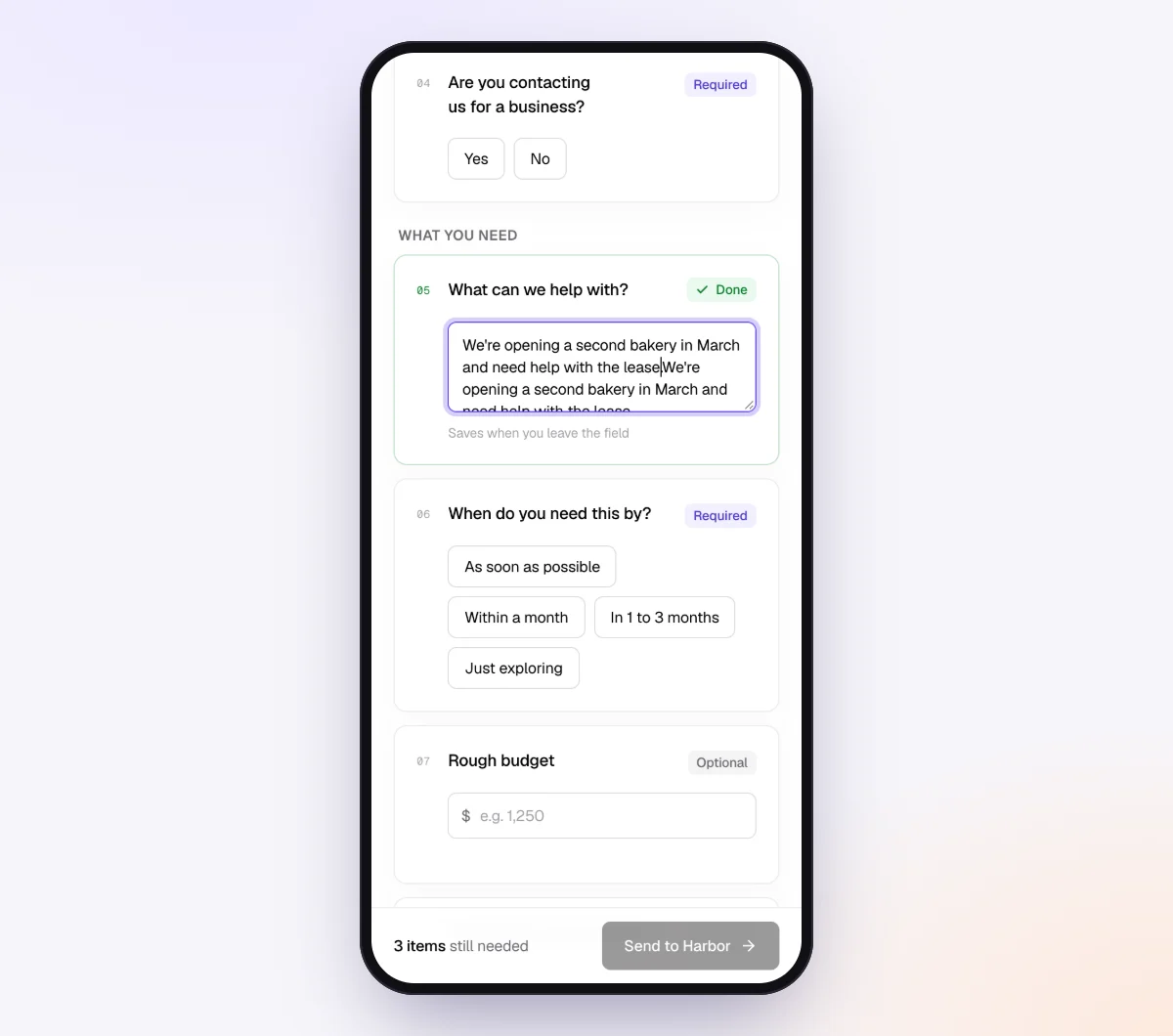
Keep one checklist for US clients and one for Canadian clients.
4. Send the request
Click "New request," choose the checklist, and add a reference such as "2026 Schedule C" or "2026 T2125." Enter the client's name and email and a needed-by date a few weeks before your internal deadline. Use "Notes for the agent (private)" for context like "Bought a van in June, purchase agreement needed" or "New client, prior preparer's CCA schedule missing."
For your whole self-employed list at once, use "Batches" and "Send to many customers" with an Excel file or CSV, scheduled up to 30 days ahead. Bulk requests are part of Pro, up to 100 clients per batch.
5. Clients upload, problems are caught, the agent chases
Each client opens a private link on a phone or computer, with no account. Clients can upload PDFs and photos (JPEG, PNG, WebP, HEIC) up to 25 MB each. Every upload is checked in seconds by document checks: right document, readable, recent enough, every page. A 2025 statement uploaded for the 2026 return is flagged on the spot.
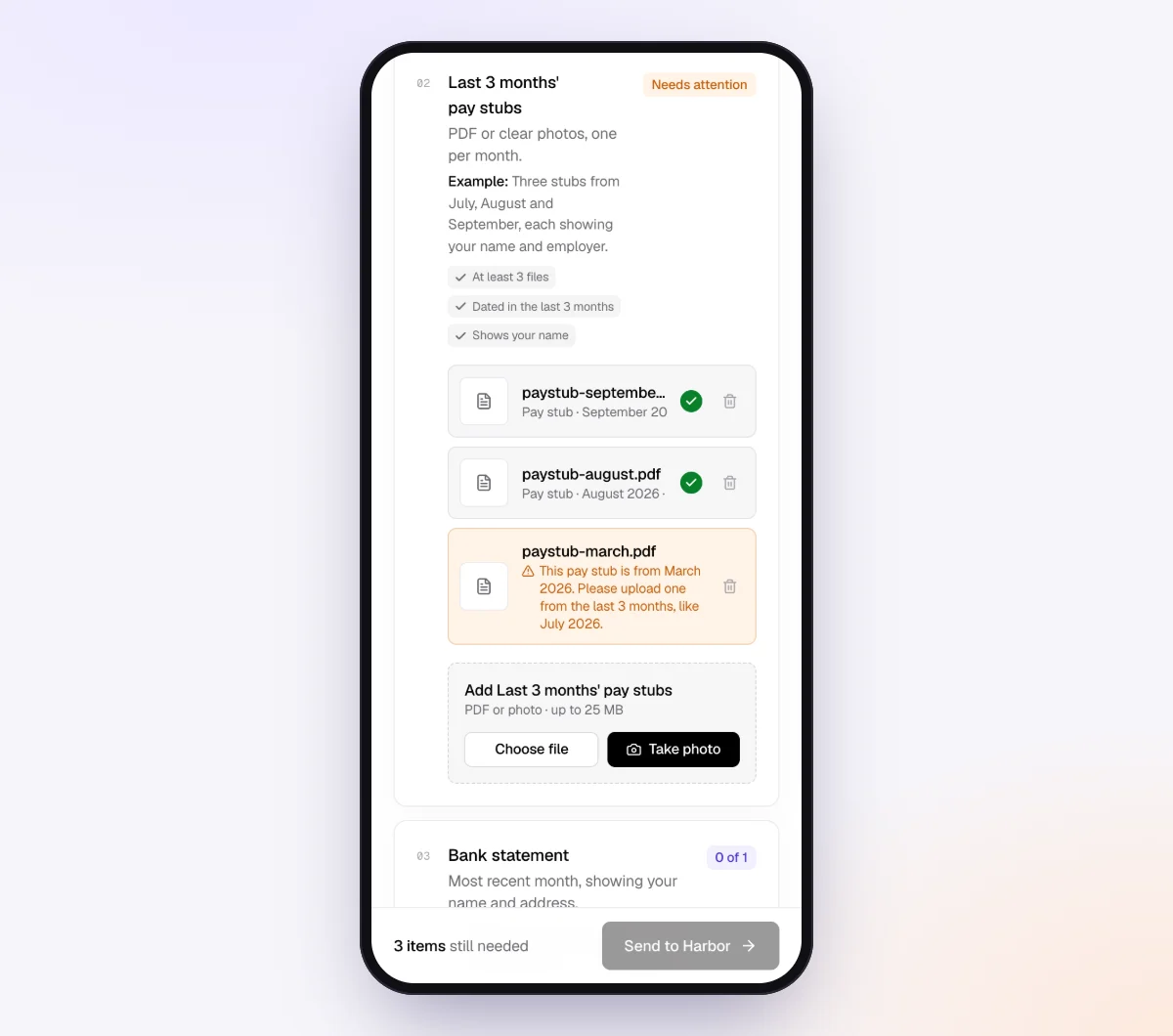
The AI collection agent paces reminders to the needed-by date, lists only what's missing, answers upload questions like "where do I find my Uber tax summary?" and hands tax questions ("can I deduct my gym membership?") to you. On Pro, clients can reply by email with files attached and each one is filed under the right item.
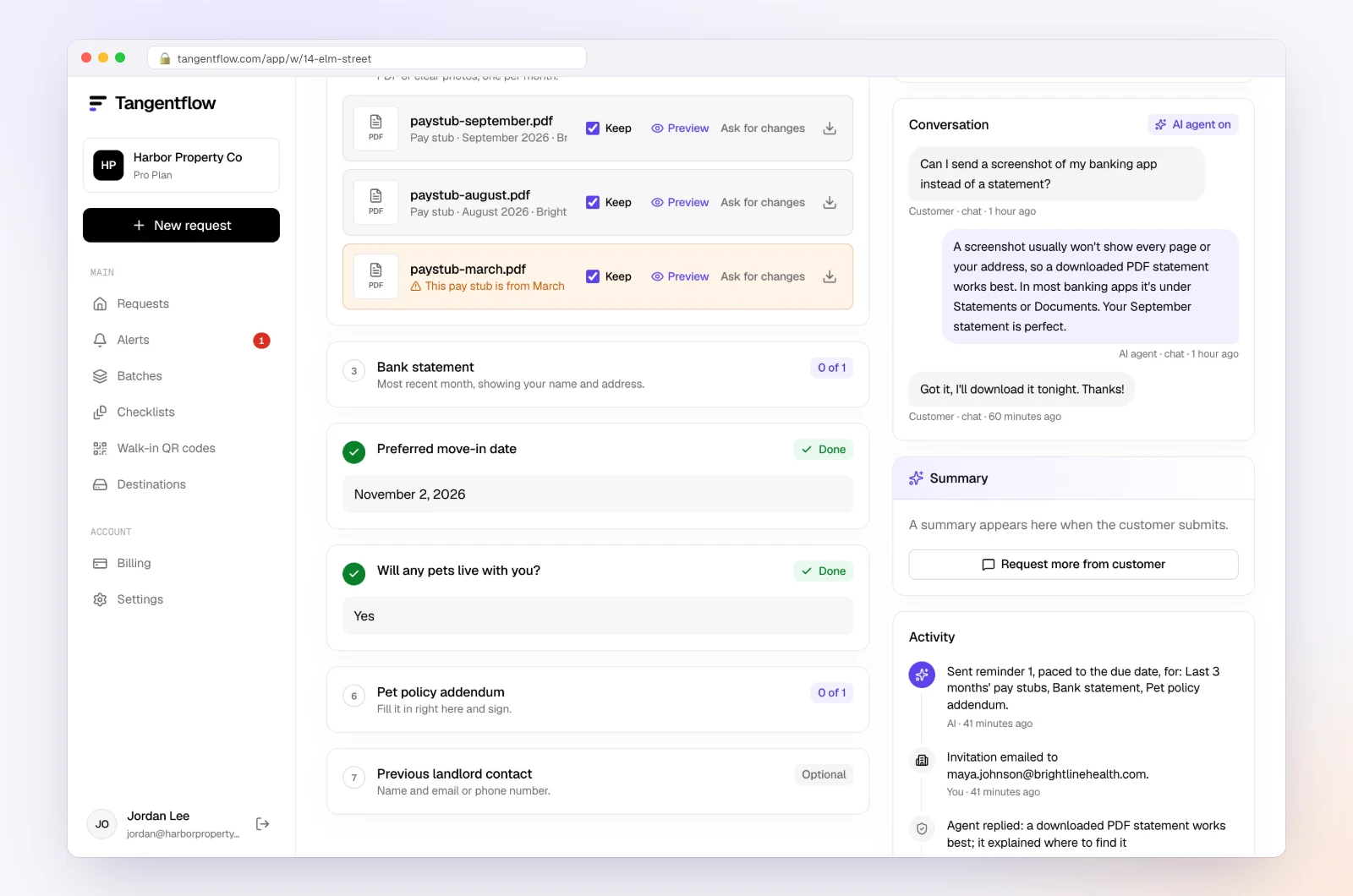
Review the request page, use "Ask for changes" on any file, then download the ZIP or, on Pro, deliver to Google Drive or a webhook.
Setups by type of self-employed client
| Client type | Checklist items to add | Settings worth turning on | Learn more |
|---|---|---|---|
| Freelancer or consultant | Invoice list, 1099-NEC or T4A, software and home office | "Only ask if" on home office | Accounting and tax |
| Rideshare or delivery driver | Platform tax summaries, 1099-K, mileage log, phone bill | Vehicle questions on, GST/HST number in Canada | Document checks |
| Online seller | Marketplace reports, 1099-K, inventory counts, shipping costs | Every page on platform reports | Accounting and tax |
| Trades contractor | Invoice list, T5018 (Canada), tools and equipment, vehicle log | "Only ask if" on equipment purchases | Accounting and tax |
| Monthly bookkeeping client | Only what the books can't show: home office, mileage, payments made | Run alongside the "Monthly bookkeeping" template | For bookkeepers |
If you already keep the books through the "Monthly bookkeeping" template, with a batch set to "Repeat every month," statements and receipts arrive month by month, and the year-end request shrinks to what the books can't show: home office, mileage, tax payments, health insurance and retirement. Our monthly bookkeeping checklist covers the month-by-month side.
"Require an email code" is an optional checklist setting: the client enters a 6-digit code sent to their email before the link opens. If a link goes to the wrong person, reset the customer's link from the request and the old one stops working. After the client sends everything, the link no longer shows the files.
When something goes wrong
| Problem | Likely cause | Fix |
|---|---|---|
| "I didn't get a 1099, so I had no income" | Thinks the form is the income | Ask for the invoice list or bank deposits instead |
| Income record uploaded as a CSV or spreadsheet | The invoicing tool's default export | Uploads accept PDFs and photos only; ask them to print the report to PDF |
| Mileage log is a yearly total | Never kept a trip log | Ask for calendar entries or invoices showing dates and places, and start a log now |
| Last year's statements | Downloaded the wrong year | The date rule on the item flags it at upload |
| Home office is also a guest room | Not used only for business | Flag it for the preparer; the exclusive-use rule may rule it out |
| Client asks whether something is deductible | A tax question | The agent hands it to you; answer it personally |
Check "Alerts" daily from late January for handoffs and missed dates.
Free and Pro, honestly
You can run a real request without paying anything.
| Free | Pro ($29/month) | |
|---|---|---|
| Open requests | 1 at a time | Unlimited |
| AI check on each file | Yes | Yes |
| AI autopilot (answers, reminders, follow-ups) | Your first request | Every request |
| Send to many clients at once (Batches) | No | Yes |
| Clients reply by email with attachments | No | Yes |
| Branding | Tangentflow badge | Your logo |
| Delivery to Google Drive or a webhook | No | Yes |
| Works with AI assistants (MCP) | No | Yes |
| File retention | 7 days | 60 days |
Both plans include unlimited checklists, QR codes and posters, ZIP export, AI summaries and email delivery. Pro is billed monthly with no contract, and you can cancel any time. Full details on the pricing page.
What Tangentflow does not do: SMS or text messages, a native mobile app, full legal e-signature certificates, identity verification, collecting payments, or permanent storage. If you need any of those, pair it with a tool that does. It also does not prepare or file tax returns, calculate self-employment tax, depreciation or CCA, give tax advice or replace your tax or bookkeeping software.
The whole process as a checklist
- Build a US or Canada checklist with the every-year items: income records, slips, bank and card statements, expenses and payments made.
- Add a "first year or changed" section: business details, asset and vehicle purchases, home office measurements, prior-year schedules.
- Keep the income record and the 1099s or T4As as separate items.
- Add yes or no questions and use "Only ask if…" for home office, vehicle, contractors, GST/HST and retirement.
- Ask for exports as PDFs, not spreadsheets.
- Send the request a few weeks before your internal deadline, or a batch for every self-employed client.
- Let reminders run, listing only what's missing.
- Deliver asset and vehicle records to your permanent files, then complete the request.
Frequently asked questions
What documents does a freelancer need for taxes?
A record of all business income, any 1099-NEC, 1099-K or T4A slips, business bank and card statements, and receipts or a categorized summary of expenses. Add home office records, a mileage log if they drive for work, and proof of estimated tax or instalment payments.
What documents does a tax preparer need for Schedule C?
Gross receipts with any 1099 forms, expenses by Schedule C category, cost of goods sold for product sellers, and total, business and commuting miles for any vehicle. Add home office square footage and costs, invoices for assets bought this year, and a list of contractors paid with W-9s.
What records do I need for the home office deduction?
For the simplified method, the square footage of the office, up to 300 square feet. For the regular method on Form 8829, also the total square footage of the home and the year's rent or mortgage interest, property tax, insurance, utilities and repairs, plus purchase details for depreciation. The space generally has to be used regularly and only for business.
What should a vehicle mileage log include?
The date, destination, business purpose and miles of each business trip, plus odometer readings at the start and end of the year so total miles are known. In Canada the CRA asks for the same in kilometers, and allows a three-month sample logbook after a full base year.
What documents do I need for form T2125 in Canada?
Sales and fee records, T4A and T5018 slips, platform payout reports, expense receipts, and business bank statements. Add workspace square footage and home bills, a kilometer logbook, invoices for CCA assets, your GST/HST number if registered, and your instalment history.
Do self-employed people have to pay estimated taxes?
In the US, usually yes when they expect to owe tax, using Form 1040-ES with four due dates during the year. In Canada, the CRA generally requires instalments when net tax owing is over $3,000 ($1,800 in Quebec) this year and in either of the two previous years. Ask your preparer what amounts to pay.
Does Tangentflow give tax advice to self-employed clients?
No. The AI agent answers questions about what to upload and how, from your checklist and notes. Questions about deductions, depreciation, CCA or what counts as business use are handed off to you.