Checklists
Trucking Bookkeeping Documents Checklist (2026)
A trucking bookkeeping documents checklist for owner-operators and small fleets: settlements, fuel, IFTA miles, per diem days, Form 2290, equipment and year-end items.
By Bibin Mathew20 min read

The short answer
Ask trucking clients for documents on three clocks. Every week or month, get carrier settlement statements, bank and fuel card statements, fuel and repair receipts, and broker or factoring reports. Every quarter, get trip sheets or ELD mileage by state or province plus fuel by jurisdiction for the IFTA return, due April 30, July 31, October 31 and January 31. Once a year, get the stamped Form 2290 Schedule 1, the 1099-NEC from the carrier, truck and trailer purchase or lease papers, loan statements, insurance and permits, and a count of nights away for the per diem or the Canadian meal claim. For travel on or after October 1, 2026 the IRS transportation rate is $80 a day in the continental US, deductible at 80% for drivers under DOT hours-of-service rules.
Ask trucking clients for documents on three clocks. Weekly or monthly: settlement statements from the carrier, bank and fuel card statements, receipts for fuel, repairs and tolls, and factoring or broker reports. Quarterly: miles and fuel by state or province for the IFTA return. Once a year: the stamped Form 2290 Schedule 1, the carrier's 1099-NEC, equipment purchase and loan papers, insurance, permits and a count of nights away from home for meals. Send each set when the paperwork actually exists, and make it easy for a driver to snap receipts from the cab.
A trucking client looks simple until you open the bank feed. The carrier pays a net deposit after taking out fuel advances, insurance, escrow and trailer rent. The fuel card is in the driver's name and half the receipts are thermal paper faded in a hot cab. The mileage you need for IFTA lives in an ELD export the driver has never opened. And the biggest deduction a solo driver has, the meal per diem, depends on a count of nights away that nobody wrote down.
This checklist is for independent bookkeepers and small firms in the US and Canada who keep books for owner-operators and small fleets. It covers what to collect and when, how settlement statements turn into proper entries, what IFTA and the per diem actually need from the client, a table for different kinds of trucking clients, fixes for the problems that come up most, and a way to collect all of it in Tangentflow without a driver ever logging in to anything.
Why trucking clients need their own checklist
Three things make trucking books different from a typical service business.
Revenue arrives net. An owner-operator leased onto a carrier gets a weekly settlement: gross linehaul and fuel surcharge at the top, then a column of deductions, then a net deposit. If you book the deposit as revenue, income is understated and every deduction the carrier took (fuel, insurance, plate fees, escrow) is missing from expenses. The settlement statement is the source document. The bank deposit only proves it was paid.
Fuel is a tax record twice over. Fuel receipts are an expense, and they are also the "fuel purchased by jurisdiction" half of the IFTA return. A receipt that shows the total but not the gallons or liters and the state or province is fine for the books but not for IFTA.
The biggest deduction depends on time, not receipts. A long-haul driver's meal deduction is usually figured on days or meals away from home rather than on restaurant receipts, so what you need from the client is dates and times, not a shoebox.
So instead of one long email in January, use three short lists, each sent when the documents exist.
The weekly or monthly document set
This is the core of every trucking engagement. Most bookkeepers request it monthly; clients with a lot of loads or a factoring account may be easier weekly.
| Item | What to ask for | Why it matters |
|---|---|---|
| Settlement statements | Every settlement for the period, as PDFs from the carrier portal | Gross revenue, fuel surcharge and every deduction the carrier took |
| Bank statements | Business checking and savings, full PDF statements | Reconciles net deposits and catches personal spending |
| Fuel card statements | The full statement from the fuel card or fleet card company | Fuel expense and fuel by location for IFTA |
| Business credit card statements | Full statements, every card used for the truck | Repairs, parts, tolls, parking, scales |
| Fuel receipts not on the fuel card | Photos showing date, location, gallons or liters and total | Expense plus IFTA fuel purchases |
| Repair and maintenance invoices | Shop invoices with the unit or VIN, plus parts receipts | Separates repairs from capital improvements |
| Tolls, scales, parking, washes | Toll account statements and receipts | Small but frequent deductions |
| Broker or factoring reports | Load list, advances, fees and reserves released | Revenue for own-authority carriers and factoring fees |
| Loads hauled | Rate confirmations or a load list for the period | Ties revenue to loads; catches missing settlements |
| Payroll reports (fleets) | Payroll journal and driver pay detail | See our payroll reports guide |
| Anything unusual | A short answer: new truck, big repair, accident, loan, cash advance | Explains what the statements can't |
How a settlement statement becomes entries
Book the gross, then the deductions, then the net. A typical week for a leased owner-operator might look like this:
| Line on the settlement | Where it goes |
|---|---|
| Linehaul revenue | Freight revenue |
| Fuel surcharge | Freight revenue (or a separate fuel surcharge revenue account) |
| Fuel purchased on the carrier's card | Fuel expense, and fuel by jurisdiction for IFTA if the carrier doesn't file |
| Occupational accident or bobtail insurance | Insurance expense |
| Trailer rental | Equipment rental expense |
| ELD or communications fee | Equipment or communications expense |
| Plate or permit charge-back | Licenses and permits |
| Escrow or maintenance reserve | An asset held by the carrier, not an expense |
| Cash advance | Reduces what the carrier owes; not income again |
| Net deposit | Matches the bank deposit |
Escrow is the line most often booked wrong. Money the carrier holds back in an escrow or maintenance account still belongs to the driver, so it sits on the balance sheet until the carrier spends it on a repair or pays it back. Ask the client for the escrow balance at year-end, which is usually printed on the last settlement of the year.
The quarterly document set: IFTA
If a client operates a qualified motor vehicle across state or provincial lines (generally a power unit over 26,000 pounds or 11,797 kilograms, or one with three or more axles), they likely hold an IFTA license and file a quarterly fuel tax return with their base jurisdiction. Some leased drivers run under the carrier's IFTA account instead; ask, because it changes what you need.
IFTA returns are due on these dates (the next business day if one falls on a weekend or holiday):
| Quarter | Months | Due |
|---|---|---|
| Q1 | January to March | April 30 |
| Q2 | April to June | July 31 |
| Q3 | July to September | October 31 |
| Q4 | October to December | January 31 |
For the return you need two things for every jurisdiction: miles driven and fuel purchased. Ask for:
- The ELD or GPS jurisdiction mileage report for the quarter, exported from the ELD provider (most have an "IFTA" or "state mileage" report), or trip sheets showing the route, odometer readings and miles by state or province.
- Fuel purchases by jurisdiction: the fuel card's IFTA or location report, plus receipts for anything paid another way.
- The odometer reading at the start and end of the quarter, per truck.
IFTA requires licensees to keep the records behind each return for four years from the due date or filing date, whichever is later, and base jurisdictions audit against the individual trip and fuel records. A quarterly total alone won't do. Make the quarterly request ask for the source reports, not just the numbers.
The yearly document set
Most of these exist once a year and get lost easily. Request them in December for things already in hand and again in January for year-end forms.
| Item | Who has it | Notes |
|---|---|---|
| Form 2290 and the stamped Schedule 1 (US) | Client or their e-file provider | Heavy vehicle use tax for trucks with a taxable gross weight of 55,000 pounds or more |
| Form 1099-NEC from each carrier (US) | Carrier, by February 1, 2027 for 2026 payments | Compare to your revenue total; differences are usually fuel surcharge or timing |
| Last settlement of the year | Carrier portal | Escrow balance and year-to-date totals |
| Truck and trailer purchase or lease papers | Client, dealer or lender | Bill of sale, lease agreement, trade-in details for depreciation |
| Loan statements and year-end balances | Lender | Split principal and interest; confirm the year-end balance |
| Insurance policies and premium invoices | Agent or carrier | Primary liability, physical damage, cargo, bobtail |
| Permits and registrations | Client | IRP apportioned plates, UCR, state permits, Canadian operating authority |
| Days or meals away from home | Client, from the ELD log or a calendar | Drives the per diem or the Canadian meal claim |
| Home office, phone and personal vehicle use | Client | Only the business share is deductible |
| W-9s or contractor details for anyone they paid (fleets) | Client | See our 1099 season checklist |
| Accident, claim or settlement paperwork | Client or insurer | Insurance proceeds and repair costs need to match |
Form 2290 and Schedule 1
The heavy highway vehicle use tax covers a tax period from July 1 to June 30. For trucks in use in July, Form 2290 is due by August 31; for a truck first used later, it is due by the last day of the month after the month it was first used. The IRS returns a stamped Schedule 1 as proof of payment, and states ask for it when the truck is registered, so it is also the easiest way to confirm the tax was paid. Ask for the Schedule 1 PDF every year and whenever the client buys a truck.
The 1099-NEC from the carrier
A leased owner-operator usually gets a 1099-NEC from each carrier. For payments made in 2026 the reporting threshold is $2,000, and the form is due to recipients by February 1, 2027. The carrier may report gross pay before deductions, so the 1099 total often won't match the net deposits. Reconcile it to the settlement totals, not the bank.
Meals and per diem: what to collect
The meal deduction is where a solo driver gains or loses the most, and it needs records that look nothing like receipts.
US. IRS Notice 2026-60 keeps the special transportation industry rate at $80 a day for travel within the continental US and $86 outside it, for travel on or after October 1, 2026 (the same rates applied from October 1, 2025). A self-employed driver can use this standard meal allowance instead of keeping meal receipts. For drivers subject to the Department of Transportation's hours-of-service limits, 80% of meal expenses is deductible instead of the usual 50%. On the day you leave and the day you return, IRS Publication 463 allows 75% of the daily rate.
What to ask the client for: the dates they left home and came back for each trip, which the ELD's duty status log or a simple calendar usually shows. One trip that started Monday morning and ended Friday night is five days, with Monday and Friday counted as partial days.
Canada. A long-haul truck driver (away from home for at least 24 hours, hauling goods at least 160 kilometres from where they report to work) can deduct 80% of meal expenses for an eligible travel period instead of 50%. Under the CRA's simplified method, the driver claims one meal every four hours from departure, to a maximum of three a day, at $23 per meal, without receipts. Employed drivers claim on Form TL2 with Part 3 completed by the employer; self-employed drivers claim on their business statement.
What to ask the client for: departure and return dates and times for each trip, plus the destination, so you can count meals.
Honest note: The rules for who qualifies, how partial days count and whether a client can use a flat rate change with their situation. Collect the dates and let the client's preparer decide the method.
How the list changes by type of trucking client
| Client type | What to emphasize | What to drop |
|---|---|---|
| Owner-operator leased to a carrier | Settlements, escrow, the carrier's 1099-NEC, per diem days | IFTA, if the carrier files it; broker reports |
| Owner-operator with own authority | Rate confirmations, broker or factoring reports, IFTA, 2290, UCR, IRP | Settlement statements |
| Small fleet (2 to 10 trucks) | Everything above per unit, plus payroll or driver settlements, W-9s and fuel by unit | Per diem for the owner, if they don't drive |
| Hotshot or non-CDL operator | Fuel, repairs, load list, per diem days | Form 2290 if under 55,000 pounds; IFTA if not a qualified vehicle |
| Local or regional hauler | Fuel, repairs, tolls, payroll | Per diem if they're home every night |
| Canadian owner-operator | Settlements, IFTA, GST/HST on fuel and repairs, meal dates for the long-haul claim | US-only items unless they run in the US |
For Canadian clients registered for GST/HST, receipts also need the supplier's GST/HST number to support input tax credits. Our GST/HST receipt requirements guide has the details by purchase amount.
Four ways to collect trucking documents, compared
| Method | Driver effort | Shows what's missing | Reminders | Works from the cab |
|---|---|---|---|---|
| Email and text photos | Low until it isn't | No | Manual | Yes, but files arrive scattered and unnamed |
| Shared cloud folder | Medium | No | Manual | Awkward on a phone |
| Client portal with a login | High; passwords get forgotten | Partly | Some | Only if they remember the login |
| Private link with a checklist and AI agent (Tangentflow) | Low, no account | Yes | Paced to your date | Yes, upload or photograph from the phone |
Drivers ignore anything that asks them to sign in from a truck stop. For more on why, see why clients don't use your client portal.
How to collect trucking documents in Tangentflow, step by step
Tangentflow sends each client a private link with a checklist, checks every file as it arrives, and has an AI collection agent send the invitation, answer questions and chase what's missing. Here's a setup for a trucking client list.
1. Build three checklists
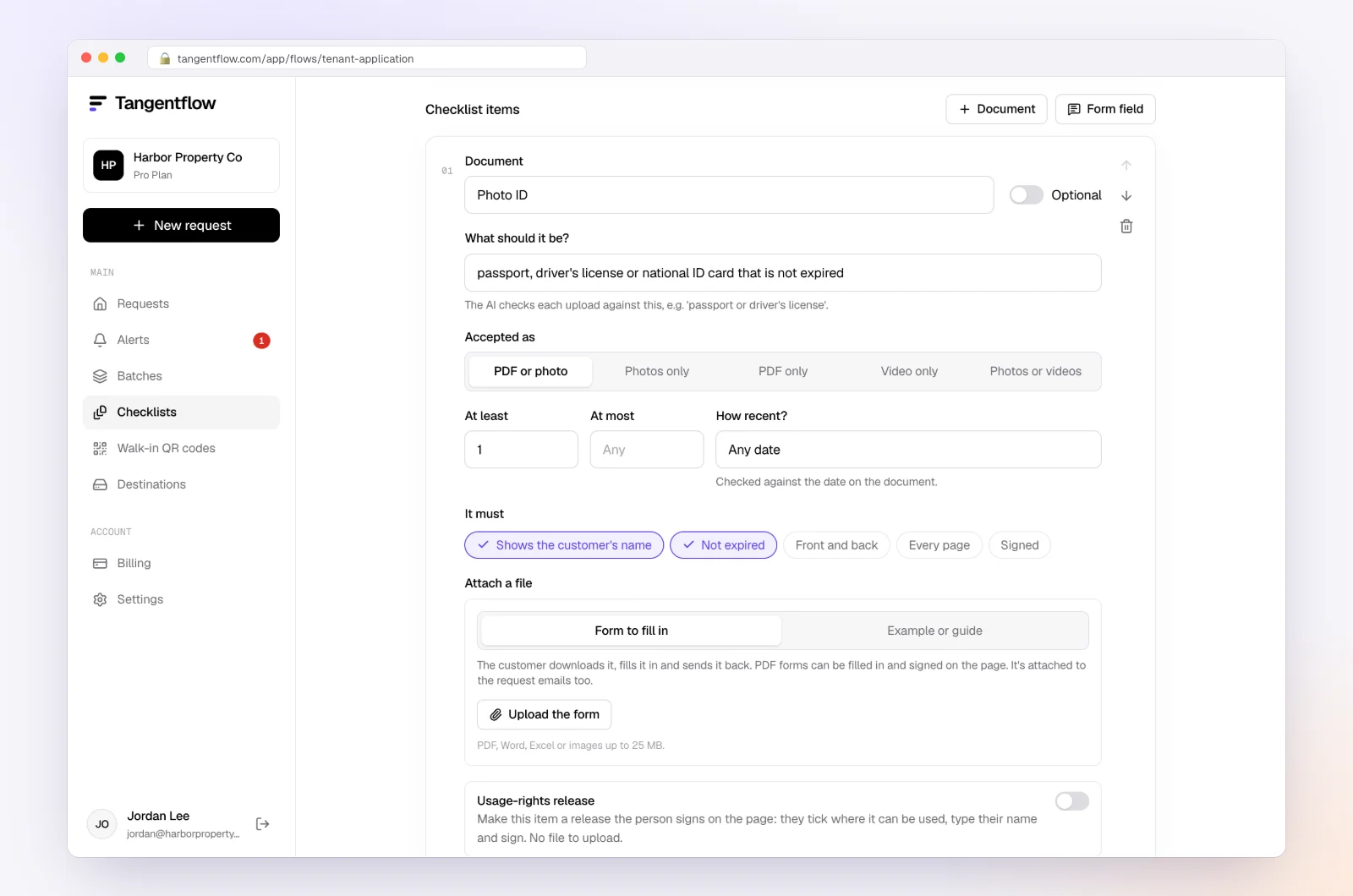
Go to Checklists. Start the monthly one from the Monthly bookkeeping template, which already asks for bank statements, card statements, receipts, sales and payroll, then add trucking items:
- "Settlement statements": a file item, PDF only, with "What should it be?" set to "Carrier settlement statements for the month, showing deductions."
- "Fuel card statement": a file item marked optional, for clients who use a fuel card.
- "Repair and maintenance invoices": a file item, photos allowed.
Then build an "IFTA quarter" checklist (jurisdiction mileage report, fuel by jurisdiction, start and end odometer) and a "Trucking year-end" checklist (Schedule 1, 1099-NEC, last settlement, equipment papers, loan statements, insurance, trip dates). You can also describe a checklist in a sentence and let AI draft the items.
2. Add questions that shape each request
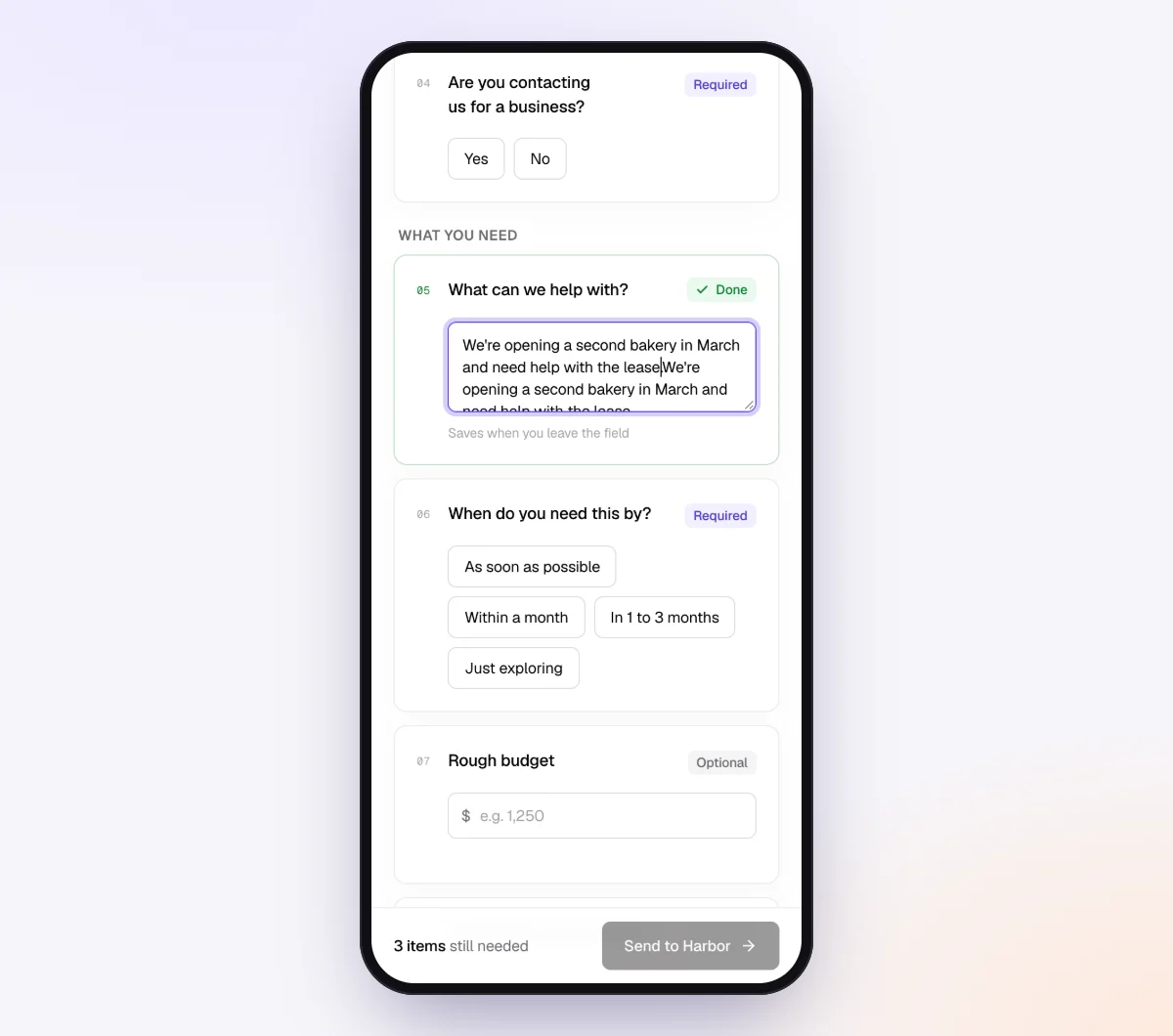
Add form fields (yes/no, short text, number, date and more) and gate follow-up items with "Only ask if…":
- "Are you leased to a carrier?" Yes shows Settlement statements; No shows Rate confirmations or broker reports.
- "Did you buy, sell or trade a truck or trailer this year?" Yes shows Purchase or lease papers.
- "Do you file your own IFTA?" No skips the mileage items.
- "Trips away from home this year": a long text question for departure and return dates, or a file item for the ELD log.
3. Send the monthly request on repeat, and the others on a schedule
Open Batches, choose "Send to many customers," pick the checklist and upload a spreadsheet or paste rows: name, email, reference, needed-by date and notes. Extra columns such as "carrier: Example Freight" or "fuel card: yes" become context for the agent. Turn on "Repeat every month" for the monthly checklist. Schedule the IFTA batch for the first business day after each quarter ends and the year-end batch for early December; you can schedule up to 30 days ahead. Bulk requests are part of Pro.
4. Put a QR poster in the cab for receipts
Open "Walk-in QR codes," pick a short "Receipts from the road" checklist (one photo item and a short text field for the unit or trip), and print the poster. Tape one to the dash or tuck it in the logbook. The driver scans it at the fuel island, photographs the receipt and is done, without digging for an email first. Each scan starts its own small request, so receipts arrive the day they're printed instead of faded in a folder at month-end.

5. Let the checks and the agent do the chasing
With the AI check on, each file is checked in seconds: a December settlement uploaded to the November request, a cut-off screenshot or an unreadable receipt gets flagged while the driver is still on the page, with a short note about what to fix.
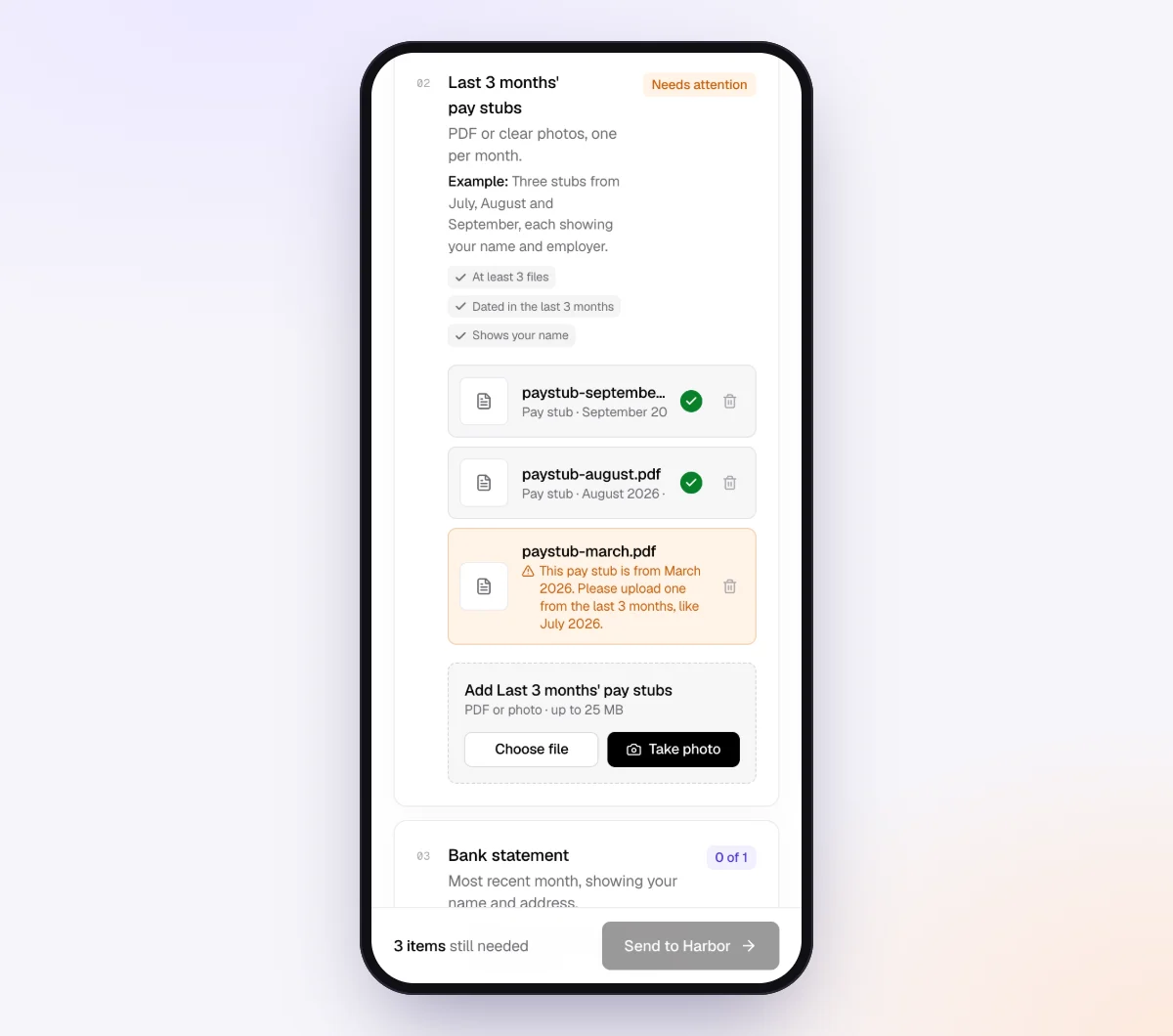
The agent paces reminders to the needed-by date, at most one automatic email a day, each listing only what's missing. It answers questions like "where do I find the IFTA report in my ELD?" from your checklist and private notes, and hands anything it can't answer to you. On Pro, drivers can reply by email with attachments, which suits clients who'd rather forward the carrier's settlement email.
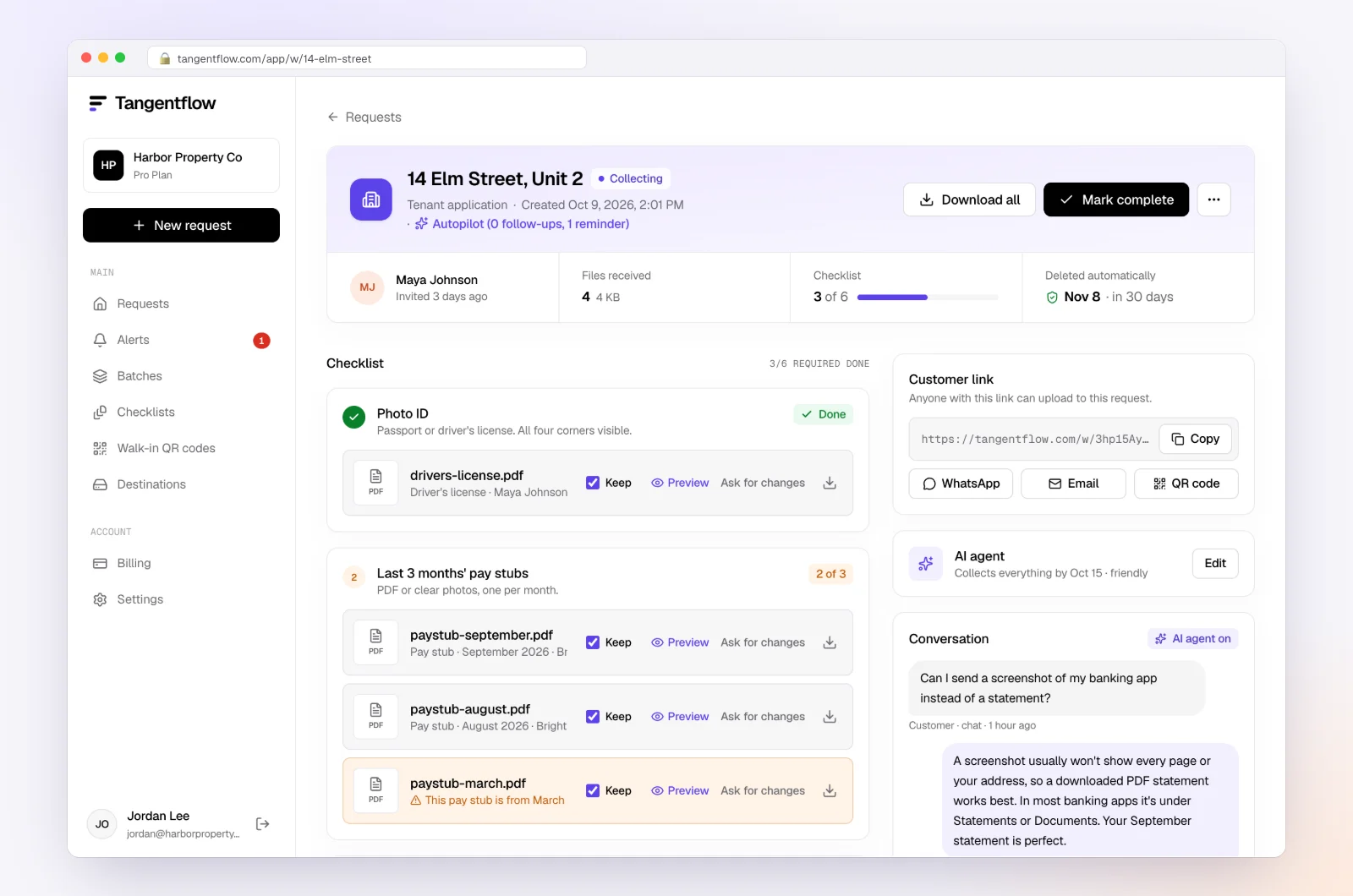
When everything is in, download the ZIP, or on Pro deliver to Google Drive or a webhook. Mark the request complete and the files are deleted 24 hours later.
When something goes wrong
| Problem | Likely cause | Fix |
|---|---|---|
| Revenue is far below the 1099-NEC | Deposits booked as revenue, not gross settlements | Rebook from settlements: gross revenue, then each deduction |
| Escrow disappears at year-end | Booked as an expense when withheld | Move to an asset; expense it only when the carrier spends it |
| IFTA miles don't match the odometer | ELD gaps, a second truck, personal conveyance miles | Ask for start and end odometer per truck and the ELD report for the full quarter |
| Fuel receipts without gallons or a location | Pump receipt printed short, or a card statement line only | Ask for the fuel card's location report; it shows gallons and jurisdiction |
| Faded thermal receipts | Heat in the cab | Ask drivers to photograph receipts the same day, using the QR poster |
| No record of nights away | Nobody tracked it | Rebuild from the ELD duty status log, settlement dates and fuel stops |
| Schedule 1 missing at registration time | Filed by a past provider or the dealer | Ask the client to download it from their e-file provider; it's also needed for the books |
| Client sends everything as texts | Habit | Send one link with a checklist and let the agent remind; texts stay a backup |
Check Alerts daily during the last week of each quarter. Missed dates and handoffs from the agent show up there.
Free and Pro, honestly
You can run a real request without paying anything.
| Free | Pro ($29/month) | |
|---|---|---|
| Open requests | 1 at a time | Unlimited |
| AI check on each file | Yes | Yes |
| AI autopilot (answers, reminders, follow-ups) | Your first request | Every request |
| Send to many clients at once (Batches) | No | Yes |
| Clients reply by email with attachments | No | Yes |
| Branding | Tangentflow badge | Your logo |
| Delivery to Google Drive or a webhook | No | Yes |
| Works with AI assistants (MCP) | No | Yes |
| File retention | 7 days | 60 days |
Both plans include unlimited checklists, QR codes and posters, ZIP export, AI summaries and email delivery. Pro is billed monthly with no contract, and you can cancel any time. A monthly request for every trucking client, plus quarterly IFTA, is really a Pro workflow. Full details on the pricing page.
What Tangentflow does not do: SMS or text messages, a native mobile app, full legal e-signature certificates, identity verification, collecting payments or permanent storage. It also doesn't calculate fuel tax, file returns or replace your bookkeeping software.
The whole process as a checklist
- At onboarding, ask whether the client is leased to a carrier or has their own authority, and who files IFTA.
- Get carrier portal access instructions or a standing monthly settlement export.
- Each month, collect settlements, bank, card and fuel card statements, and receipts for fuel, repairs and tolls.
- Book settlements gross: revenue, then every deduction, with escrow as an asset.
- Put a QR poster in the cab so receipts arrive the day they're printed.
- After each quarter, collect the ELD jurisdiction mileage report, fuel by jurisdiction and odometer readings.
- File or hand off IFTA by April 30, July 31, October 31 and January 31.
- In December, collect equipment, loan, insurance and permit papers and the Form 2290 Schedule 1.
- In January, collect each carrier's 1099-NEC and the trip dates for meals or per diem.
- Keep IFTA records for at least four years and tax records as long as the client's preparer advises.
Sources
Official pages for the rules named in this guide, checked on November 10, 2026. Rates and rules change, so confirm on the official page before relying on them.
- IRS Notice 2026-60: special per diem rates, including the transportation industry rate
- IRS Publication 463: travel, gift and car expenses, including the 80% limit for hours-of-service workers
- IRS Form 2290: heavy highway vehicle use tax return
- When Form 2290 taxes are due: due dates by first-use month
- IRS Form 1099-NEC: nonemployee compensation
- CRA Line 22900, other employment expenses: meals and lodging for transport employees
- CRA meal and vehicle rates: the simplified meal rate
- Missouri DOT IFTA filing: an example base jurisdiction's IFTA return page and due dates
Frequently asked questions
What documents does a truck driver need to give their bookkeeper?
Every month: carrier settlement statements, bank, credit card and fuel card statements, and receipts for fuel, repairs, tolls and parking. Every quarter: the ELD or trip sheet mileage by state or province and fuel purchased by jurisdiction for IFTA. Every year: the stamped Form 2290 Schedule 1, 1099-NECs from carriers, equipment purchase and loan papers, insurance, permits and the dates of trips away from home.
How do you record a trucking settlement statement?
Record the gross linehaul and fuel surcharge as revenue, then record each deduction to its own expense account (fuel, insurance, trailer rent, fees), put escrow or maintenance reserves on the balance sheet as an asset held by the carrier, and check that the net equals the bank deposit.
What records do I need for IFTA?
Miles driven and fuel purchased in each jurisdiction, backed by individual trip records (ELD or GPS reports, or trip sheets with routes and odometer readings) and fuel receipts showing date, location, quantity and price. IFTA requires licensees to keep these records for four years from the return's due date or filing date, whichever is later.
When are IFTA returns due?
April 30 for January to March, July 31 for April to June, October 31 for July to September and January 31 for October to December. If a due date falls on a weekend or holiday, it moves to the next business day.
What is the truck driver per diem for 2026?
For travel on or after October 1, 2026, IRS Notice 2026-60 sets the transportation industry rate at $80 a day within the continental US and $86 outside it, unchanged from the year before. Drivers subject to DOT hours-of-service limits can deduct 80% of meal expenses. The rate on departure and return days is 75%. Confirm the method with the client's preparer.
Can Canadian truck drivers claim meals without receipts?
Long-haul truck drivers can use the CRA's simplified method: one meal every four hours from departure, up to three a day, at $23 per meal, deductible at 80% for eligible travel periods. They need a record of departure and return times and destinations instead of receipts. Employed drivers use Form TL2.
Who needs to file Form 2290?
Anyone who registers a highway motor vehicle with a taxable gross weight of 55,000 pounds or more. The tax period runs July 1 to June 30; for vehicles in use in July, Form 2290 is due August 31, otherwise by the end of the month after first use. Keep the stamped Schedule 1 as proof of payment.
How do I get receipts from a driver who is always on the road?
Give them one way to send receipts that works from the cab without a login, like a QR code on the dash that opens an upload page, and ask for a photo the same day, before thermal paper fades. Then send a monthly request that lists only what's still missing.