Checklists
Loan Documents Bookkeepers Need From Clients (2026)
Loan documents for bookkeeping, by loan type: agreements, amortization schedules, closing statements and year-end interest statements, plus how to use them.
By Bibin MathewUpdated 19 min read
The short answer
For every loan a client has, ask at the start for the signed agreement, the amortization schedule and the closing or settlement statement showing fees and the amount actually deposited. After that, ask for the lender's statement (monthly for lines of credit, yearly at minimum for term loans) and a year-end statement showing the balance at December 31 and total interest paid. These are what let you split each payment into principal and interest and reconcile the loan balance in the books to the lender's number. Request them through one onboarding request and one year-end request, as PDFs, so nothing depends on memory.
Loans are where tidy books quietly go wrong. The bank feed shows a $1,208.95 debit to "ACME CAPITAL" every month, the client has no idea how much of it is interest, and somebody has been booking the whole payment to "Loan payable" for two years. The balance sheet now says the client owes $9,000 less than the lender says they do, and nobody notices until a refinance, a sale or a tax preparer asks.
The fix is having the right documents: the agreement, the amortization schedule, the closing statement and the lender's statements. With those, splitting a payment takes a minute, and reconciling the loan works like reconciling a bank account.
This guide is for independent bookkeepers and small firms in the US and Canada whose clients have term loans, equipment financing, vehicle loans, lines of credit, merchant cash advances, SBA loans, Canada Small Business Financing Program (CSBFP) loans or loans to and from the owner. You will get a checklist for each type, a comparison table, how to record and reconcile loans from those documents, and a step-by-step setup in Tangentflow.
Why loan documents matter more than the bank feed
A bank feed shows that money moved, not why. Three questions need lender documents:
- How much of this payment is interest? Interest is usually an expense. Principal reduces a liability. Booking the full payment to either one is wrong.
- What does the client actually owe? The lender's balance is the number the books need to match at every year-end.
- What happened on day one? Loan proceeds are rarely the same as the loan amount. Origination fees, prepaid interest, insurance and a payoff of an older loan are often taken out before the money lands.
The bank statement answers none of these, so ask for lender documents even when you have full access to the client's bank and software.
The loan documents checklist, by type
Each section lists what to request once, at onboarding or when the loan is new, and what to request on a schedule. Use the client's words in your request ("your loan for the new excavator"), not ours.
Term loans from a bank or online lender
- Once: the signed loan agreement or promissory note, every page (principal, rate, fixed or variable, term, payment, prepayment penalty); the amortization schedule, one row per payment with interest, principal and remaining balance, as a PDF from the lender portal; and the closing or disbursement statement showing the gross loan, every fee withheld and the net deposit.
- On a schedule: lender statements quarterly if the rate is variable, since the schedule drifts when the rate changes, and the year-end statement with the balance on December 31 (or fiscal year-end) and total interest paid.
Equipment financing and equipment leases
These documents arrive as a bundle from a vendor or finance company, and clients often keep only the invoice.
- Once: the financing or lease agreement, every page. Whether it is a loan, a $1 buyout lease or a fair market value lease changes how it is recorded, and that call belongs to the accountant. Also the equipment invoice (price, taxes, delivery, installation) for the fixed asset list, and the payment schedule, plus any down payment or trade-in.
- On a schedule: the year-end statement with the balance and finance charges, or a payment history PDF if that's all the lender issues.
Vehicle loans
- Once: the retail installment contract signed at the dealer (price, down payment, trade-in, amount financed, APR, term); the bill of sale, so add-ons like extended warranties and gap coverage can be separated; and the trade-in payoff if negative equity was rolled into the new loan.
- On a schedule: the lender's year-end statement with balance and interest, and a yearly question: "Is the vehicle still in the business's name and used for the business?"
Business lines of credit
No amortization schedule. The balance moves with draws and repayments, and interest is charged monthly on what is outstanding. Treat it like a bank account.
- Once: the agreement, showing the limit, rate (often prime plus a margin), fees, renewal date and security.
- On a schedule: the monthly statement, every page, showing draws, payments, interest and the closing balance. Add it next to "Bank statements for the month" in your monthly bookkeeping request.
Merchant cash advances
An MCA is usually structured as a purchase of future sales, not a loan. The provider pays a lump sum and takes back a larger fixed amount (the advance times a "factor rate") through daily or weekly debits or a share of card sales. There is often no interest rate on the paperwork.
- Once: the agreement, every page (advance, amount to be repaid, factor rate, fees, remittance method) and the funding statement. Renewals often pay off the old advance out of the new one, so the deposit can be far smaller than the advance.
- On a schedule: a payment history showing remittances and the remaining balance, quarterly and at year-end.
SBA loans (US)
Made by banks and other lenders with a partial guarantee from the U.S. Small Business Administration, or directly by the SBA for disaster loans. For the books they behave like term loans with more paperwork.
- Once: the note and loan agreement. A 504 usually means two loans, one from the bank and one through a Certified Development Company, each with its own documents and payments. Also the settlement statement showing the SBA guarantee fee and other costs, each disbursement if funds came in draws, and the amortization schedule or deferment terms. Some loans, including many disaster loans, accrued interest before the first payment.
- On a schedule: a year-end statement from each lender, or a payment history from the SBA's online portal for SBA-serviced loans.
CSBFP loans (Canada)
Under the Canada Small Business Financing Program, a bank or credit union lends and the Government of Canada shares the risk. The program charges a registration fee of 2% of the loan amount (paid by the lender and commonly passed on to the borrower) and an annual administration fee of 1.25% on the outstanding balance, which lenders typically build into the rate. Confirm current terms on the ISED program page.
- Once: the loan agreement (amount, rate, term, what it financed), a document showing how the registration fee was handled (paid, deducted from the advance or added to the loan), and the repayment schedule.
- On a schedule: the statement at the client's fiscal year-end, which is often not December 31.
Shareholder and owner loans
Money the owner puts in or takes out that is not salary, a dividend or a draw. The owner is the lender, so there is no bank statement to reconcile against.
- Once: a signed promissory note if one exists (if not, flag it to the accountant; don't draft one yourself) and proof of the original transfer from the owner's or the business's bank statement.
- On a schedule: a monthly question, "Did you put your own money in or take any out, other than payroll or draws?", and a year-end confirmation from the owner, including business expenses paid on a personal card.
Loan documents by type, compared
| Loan type | Request once | Ongoing statement | Year-end document | Common trap |
|---|---|---|---|---|
| Bank or online term loan | Agreement, amortization schedule, closing statement | Quarterly if variable rate | Balance and interest paid | Fees netted from the deposit |
| Equipment financing or lease | Agreement, equipment invoice, payment schedule | Usually none | Balance and finance charges | Lease vs loan, extras rolled in |
| Vehicle loan | Retail installment contract, bill of sale, trade-in payoff | Usually none | Balance and interest paid | Negative equity from the trade-in |
| Line of credit | Agreement with limit and rate | Monthly statement, every page | Total interest for the year | Draws booked as income |
| Merchant cash advance | Agreement, funding statement | Payment history, quarterly | Remaining balance | Renewal pays off the old advance |
| SBA 7(a) or 504 (US) | Note, settlement statement, schedule | Varies by lender | Statement from each lender | Two loans on a 504 |
| CSBFP (Canada) | Agreement, fee statement, schedule | Varies by lender | Balance at fiscal year-end | Registration fee handling |
| Shareholder or owner loan | Promissory note, proof of transfer | Client question, monthly | Owner's confirmation | No document at all |
Form 1098 and year-end interest statements
Form 1098, Mortgage Interest Statement, is filed by lenders that receive $600 or more of mortgage interest from an individual in the course of business, on a loan secured by real property. Sole proprietors count as individuals. The IRS instructions say lenders do not file it for interest received from a corporation, partnership, trust or similar entity. So a sole proprietor with a mortgage on a building may get one, while a partnership with an equipment loan or line of credit generally gets no tax form at all. See the IRS instructions for Form 1098.
Ask for the lender's year-end statement or annual summary instead. It shows total interest and the closing balance, which is all the books need. The same goes for Canadian clients.
How to record a business loan from these documents
These are the common bookkeeping steps. Check the accounts and treatment with the client's accountant, especially for fees and leases.
Day one: proceeds, fees and payoffs
Use the closing statement, not the bank deposit. Suppose a client borrows $50,000, the lender withholds a $1,000 origination fee, and $49,000 lands in the bank.
| Account | Debit | Credit |
|---|---|---|
| Bank | $49,000 | |
| Loan fees (or debt issuance costs, per the accountant) | $1,000 | |
| Loan payable | $50,000 |
If you book only the $49,000 deposit to the loan, the balance is understated by $1,000 for the life of the loan, and the fee never shows up anywhere. If the new loan paid off an old one, the closing statement shows that too: debit the old loan payable to clear it.
Every payment: split principal and interest
Use the amortization schedule. On a 48-month loan of $50,000 at 7.5%, the first $1,208.95 payment is $312.50 interest and $896.45 principal, debit interest expense $312.50, debit loan payable $896.45 and credit the bank $1,208.95. The split changes every month, so a fixed bank rule needs updating from the schedule or an adjustment at month-end. For lines of credit, use the interest charged on each monthly statement.
Loan statement reconciliation
At least every quarter and always at year-end, compare the loan payable balance in the books to the lender's statement on the same date. Differences usually come from fees or prepaid interest left out on day one, payments booked wholly to the loan or to interest, lender charges like late fees or insurance, a variable rate change, or a payment in transit on the statement date. Post a correcting entry and keep the statement with your workpapers. The same routine belongs in your month-end close checklist.
Collecting loan documents in Tangentflow, step by step
Tangentflow sends each client a private link with your checklist, checks each upload as it arrives, and has an AI collection agent send the reminders and answer questions. For loans, the cleanest setup is two requests: loan items in your onboarding request, and a short year-end request every January. More on how this fits a practice on the bookkeepers page.
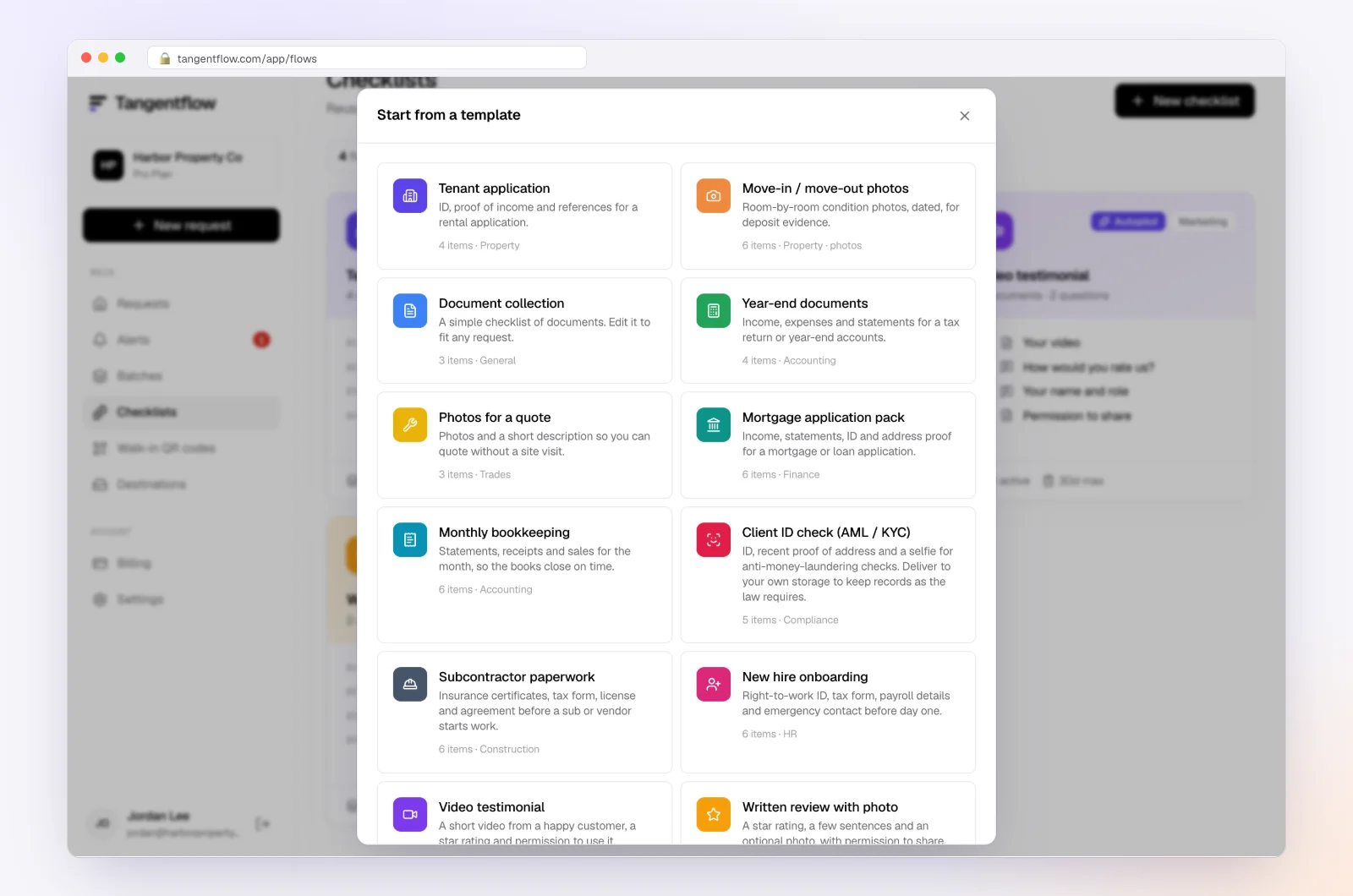
1. Start from a template
Go to Checklists and choose "Browse templates." For onboarding, start from "Document collection" or your existing onboarding checklist (our accounting client onboarding checklist has the full list). For January, start from "Year-end documents." You can also describe what you need in a sentence and let AI draft the items.
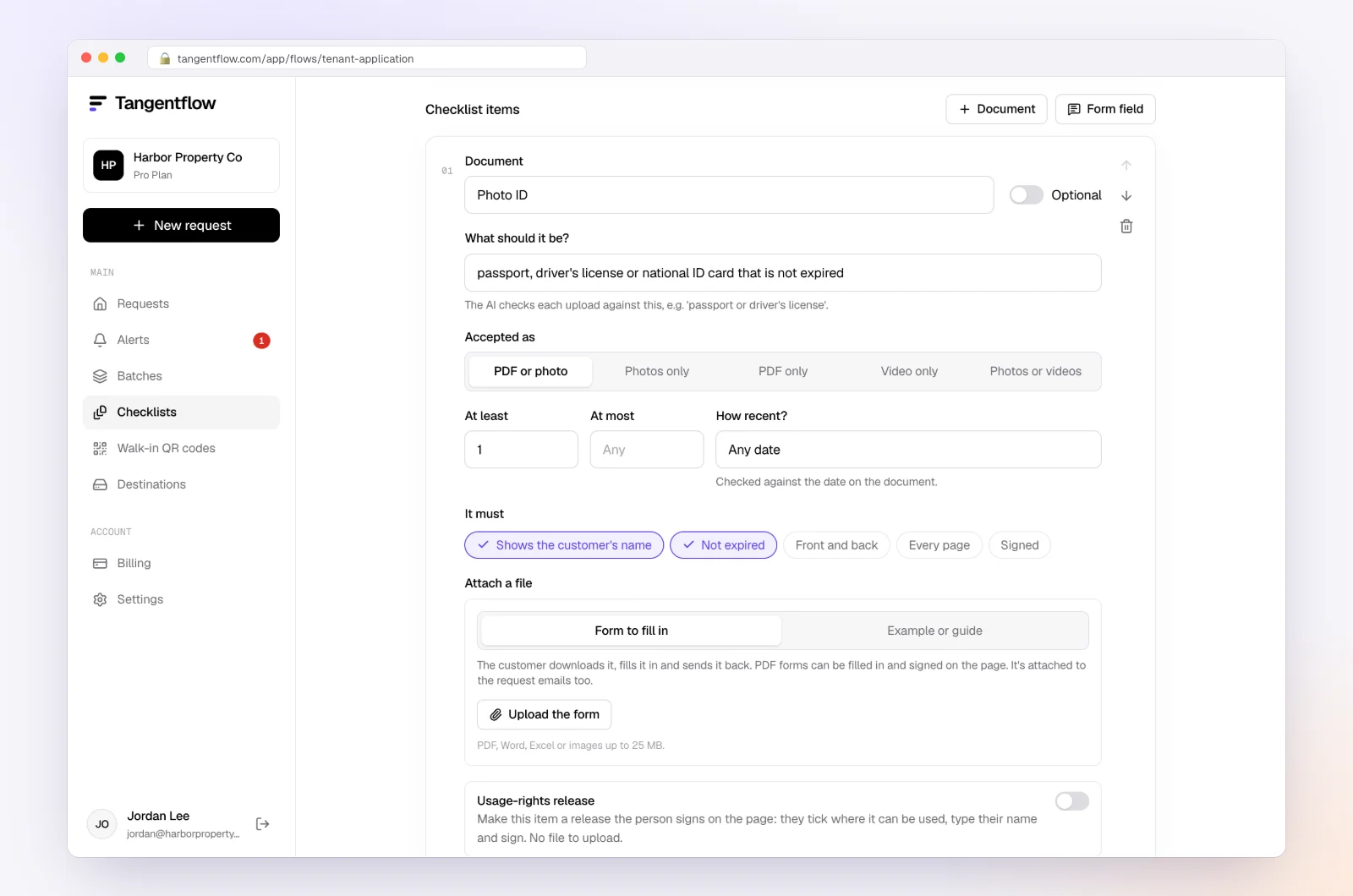
2. Add loan items with clear rules
Add a section heading, "Loans and financing," then a file item for each document. Fill in "What should it be?", for example "Lender statement showing the balance on December 31, 2026 and total interest paid for 2026." Set "Accepted as" to "PDF or spreadsheet" on schedules and payment histories and "PDF only" on statements, turn on every page for agreements, and add an "Example" and a tip like "In most lender portals this is under Documents or Statements. PDF or Excel both work for the schedule."
3. Ask about loans before asking for documents
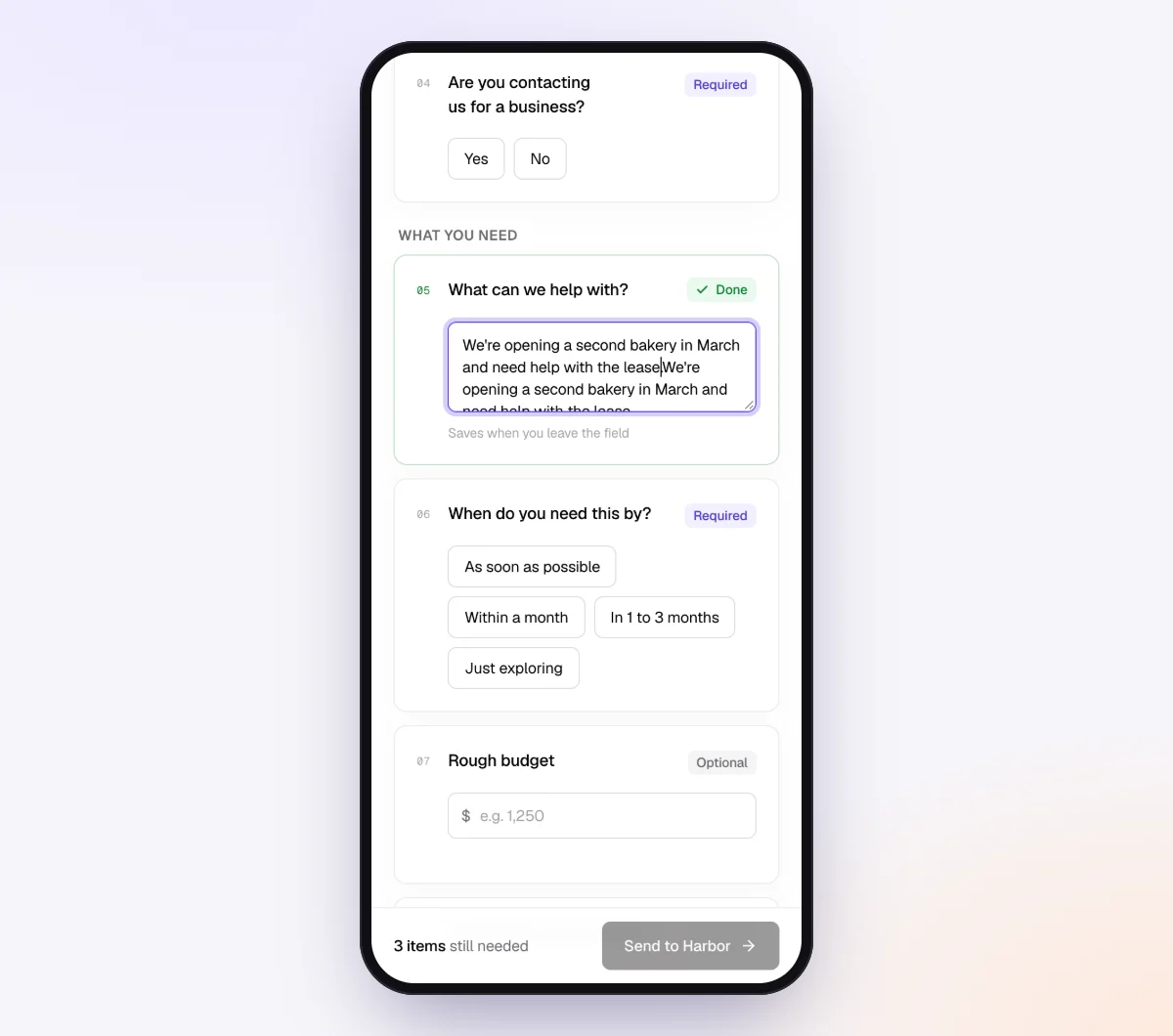
Add yes/no form fields such as "Did the business take out, refinance or pay off any loan this year?", "Do you have a line of credit?", "Did you take a merchant cash advance?" and "Did you put your own money into the business or take any out, other than payroll or draws?" Then use "Only ask if" on each follow-up item, so a client with no line of credit never sees the line of credit item.
Loan agreements carry account numbers and guarantor details, so consider "Require an email code": the client enters a 6-digit code emailed to them before the link opens. If a link went to the wrong person, use "Reset link" on the request. Once the client sends everything, the link no longer shows the files.
4. Send the request
Go to Requests, click "New request," choose the checklist, and add a reference such as "Onboarding, Northside Bakery" or "2026 year-end loans." Add a needed-by date and leave "Email the link" on. Use "Notes for the agent (private)" for context like "Two loans: bank term loan and a tractor loan through the dealer. MCA paid off in March."
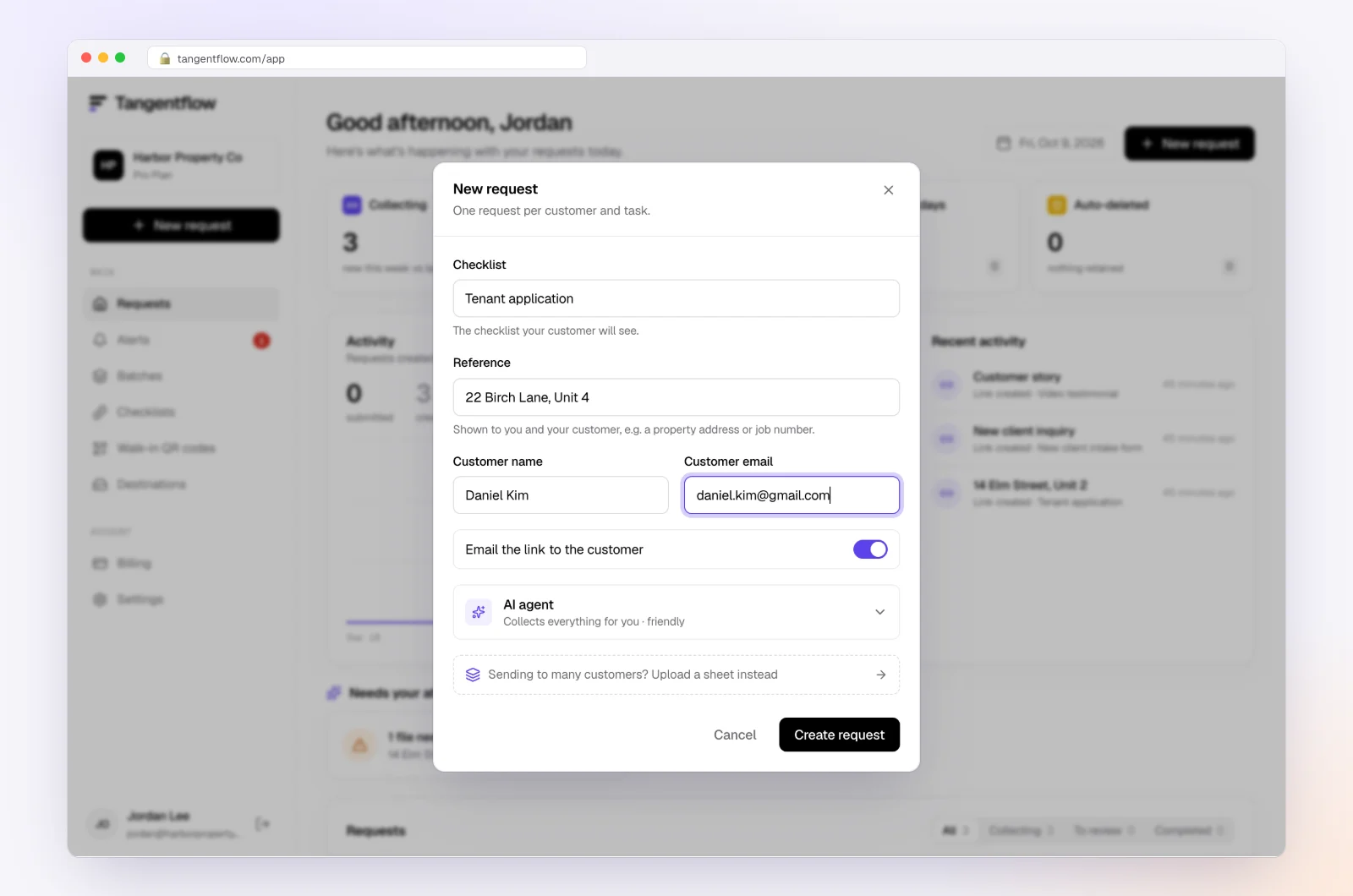
On Pro, send the year-end request to every client at once with "Batches": upload or paste your client list, and extra columns such as "Loans: SBA 504, vehicle" become context the agent uses. See bulk requests. Leave "Repeat every month" off for the year-end batch; if you want monthly line of credit statements, add that item to your monthly batch instead.
5. Wrong documents are caught at upload
Each upload is checked in seconds by document checks. If a client uploads a monthly payment notice where the year-end statement belongs, they see a note explaining what to fix while the lender portal is still open. The agent paces reminders to the needed-by date ("Chase until it's all in," set to "Paced to each request's deadline"), lists only what is still missing, and hands questions like "should this be a shareholder loan?" to you.
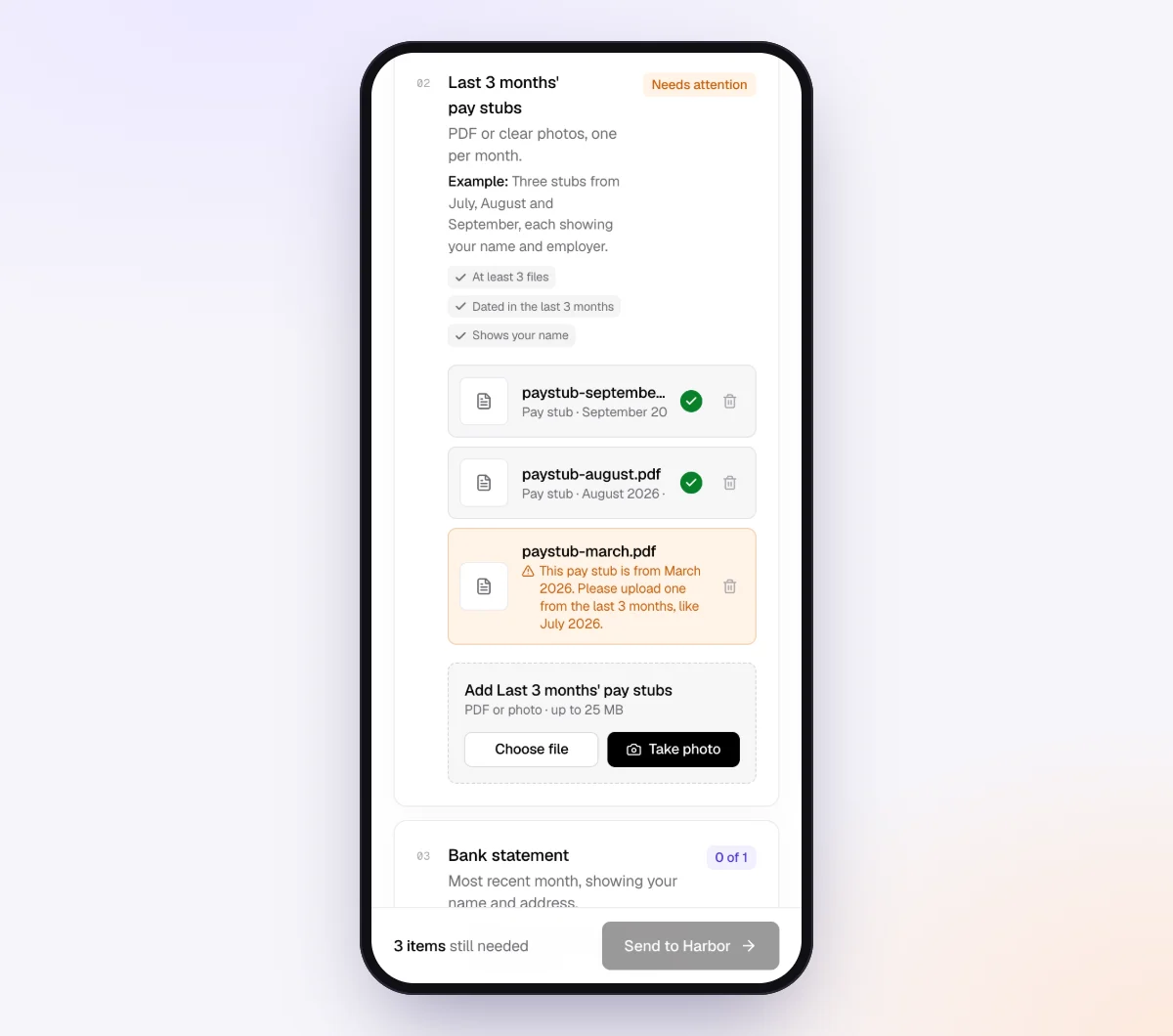
The check reads the document. It does not reconcile the balance or split interest; that part is still yours. When everything is in, download the ZIP, or on Pro deliver to Google Drive or a webhook, then mark the request complete. Files are deleted 24 hours later.
Setups by type of client
| Client type | Loan items to emphasize | Settings worth turning on | Learn more |
|---|---|---|---|
| Construction or landscaping with equipment | Equipment financing agreements, invoices, vehicle contracts | "Only ask if" on each loan type, "PDF or spreadsheet" on schedules | Accounting and tax |
| Restaurant or retail with an MCA | MCA agreement, funding statement, payment history | Notes for the agent on renewals | AI collection agent |
| Business with a line of credit | Monthly line of credit statement | Add to the monthly batch with "Repeat every month" | Monthly bookkeeping checklist |
| US client with an SBA 504 | Both lenders' notes, settlement statement, two year-end statements | Minimum count of two on year-end statements | Year-end checklist |
| Canadian client with a CSBFP loan | Agreement, registration fee handling, fiscal year-end statement | Needed-by date tied to their fiscal year-end | Document checks |
| Owner-managed corporation | Owner contributions and withdrawals, promissory note | "Require an email code," a monthly owner question | Uncategorized transaction questions |
When something goes wrong
| Problem | Likely cause | Fix |
|---|---|---|
| Whole payment booked to the loan, or to expense | No amortization schedule on file | Request the schedule or payment history, then reclassify interest by month |
| Loan balance doesn't match the lender | Fees netted on day one, or interest split guessed | Rebuild from the closing statement and year-end statement |
| No schedule exists | Online lender, MCA, or the client lost it | Ask the lender for a payment history PDF; the accountant can build a schedule from the agreement |
| Loan was refinanced | New loan paid off the old one inside the closing | Get the new closing statement and the old payoff letter; clear the old balance |
| Business loan paid from a personal card or account | Owner paid personally | Record it as a contribution or owner loan, as the accountant decides, and get the personal statement |
| Line of credit draws booked as income | Bank rule matched the deposit | Recode draws to the liability, then reconcile to the statement |
| Client uploads a CSV schedule or a portal screenshot | It was the default download | A CSV schedule uploads fine on a "PDF or spreadsheet" item; for a screenshot, ask them to print the schedule or statement to PDF |
| Client says "there's no 1098" | There usually isn't one for business loans | Ask for the lender's year-end statement or annual summary instead |
| Year-end statement isn't out yet | Requested in the first days of January | Put the date in "What should it be?" and set the needed-by date mid-January |
| Client is frustrated by reminders | Several lenders, busy season | The agent stops and hands off to you; reply personally |
Check "Alerts" for handoffs and missed dates. For clients you take over mid-year, loans are often the biggest cleanup item; see our catch-up bookkeeping documents checklist, and request records from the previous accountant, who may already have the schedules. If late lender statements hold up year-end every year, our late document policy has engagement letter wording.
Free and Pro, honestly
You can run a real request without paying anything.
| Free | Pro ($29/month) | |
|---|---|---|
| Open requests | 1 at a time | Unlimited |
| AI check on each file | Yes | Yes |
| AI autopilot (answers, reminders, follow-ups) | Your first request | Every request |
| Send to many clients at once (Batches) | No | Yes |
| Clients reply by email with attachments | No | Yes |
| Branding | Tangentflow badge | Your logo |
| Delivery to Google Drive or a webhook | No | Yes |
| Works with AI assistants (MCP) | No | Yes |
| File retention | 7 days | 60 days |
Both plans include unlimited checklists, QR codes and posters, ZIP export, AI summaries and email delivery. Pro is billed monthly with no contract, and you can cancel any time. Full details on the pricing page.
What Tangentflow does not do: SMS or text messages, a native mobile app, full legal e-signature certificates, identity verification, collecting payments, or permanent storage. If you need any of those, pair it with a tool that does. It also doesn't connect to lenders, build amortization schedules, or post loan entries to your bookkeeping software.
The loan documents checklist
- List every loan, line of credit, MCA, vehicle and equipment financing and owner loan at onboarding.
- For each, get the signed agreement, every page.
- Get the amortization schedule or payment history as a PDF.
- Get the closing or funding statement showing fees and the net deposit.
- Record day one from the closing statement, not the bank deposit.
- Split every payment into principal and interest from the schedule.
- Reconcile line of credit balances monthly, like a bank account.
- Reconcile every loan balance to the lender's statement at least quarterly.
- Ask every client in January for each lender's year-end balance and interest paid.
- Ask about new loans, refinances, payoffs and owner money every year.
- Send owner loans and fee treatment questions to the accountant.
Frequently asked questions
What loan documents does a bookkeeper need from a client?
For each loan, the signed agreement, the amortization schedule and the closing or disbursement statement at the start, then the lender's statements and a year-end statement showing the balance and interest paid. Lines of credit also need a monthly statement. Owner loans need a promissory note if one exists and a yearly confirmation from the owner.
How do I split a loan payment into principal and interest?
Use the amortization schedule, which shows the interest and principal portion of each payment. Debit interest expense for the interest, debit the loan liability for the principal and credit the bank for the full payment. On a variable rate loan, use the lender's statements instead, since the schedule changes when the rate does.
What if the client has no amortization schedule?
Ask the lender for a payment history or schedule as a PDF; most can provide one from their portal or on request. If none is available, the client's accountant can build a schedule from the agreement's rate, term and payment, and you can true it up to the lender's year-end statement.
Will my client get a Form 1098 for a business loan?
Usually not. Form 1098 reports mortgage interest of $600 or more received from an individual, including a sole proprietor, on a loan secured by real property. Lenders don't file it for interest from corporations or partnerships, and equipment loans and lines of credit generally aren't covered. Ask for the lender's year-end statement instead.
How do I reconcile a loan balance?
Compare the loan payable balance in the books to the lender's statement on the same date, at least quarterly and at year-end. Differences usually come from fees left out on day one, payments booked wholly to the loan or to interest, or lender charges you didn't record. Post a correcting entry and keep the statement with your workpapers.
What documents do I need for a shareholder loan?
A signed promissory note if one exists, proof of each transfer in or out, and a year-end confirmation from the owner. Because owner loans have tax consequences in both the US and Canada, keep the balance accurate and send treatment questions to the accountant.
Can clients upload loan schedules as spreadsheets in Tangentflow?
Yes, when the item is set to "PDF or spreadsheet" in the checklist editor. Clients can upload PDFs and photos up to 25 MB each, and on those items Excel and CSV files too, so an amortization schedule exported from the lender portal uploads as it is. The check reads the first rows to confirm what the schedule is and whether it covers the period. Lender statements are still better as PDFs, since the statement shows the balance you reconcile to.