Checklists
Mortgage Documents Checklist: What Lenders Ask For (2026)
A mortgage documents checklist for US and Canadian borrowers: ID, income, assets, gift letters, property papers, what good looks like and how to collect it.
By Bibin MathewUpdated 21 min read
The short answer
Most lenders ask for photo ID, recent pay stubs, two years of W-2s or T4s (or tax returns and Notices of Assessment if self-employed), complete bank statements showing where the down payment came from, a signed gift letter if family is helping, and the purchase agreement or current mortgage statement. Ask for a short list at pre-approval, the full package at application, and chase underwriting conditions one item at a time. Collect it all through one private link that checks dates, pages and the borrower's name on every upload.
A mortgage file rarely stalls because the borrower does not qualify. It stalls because page 3 of a bank statement is missing, the pay stubs went stale while the file sat, or the gift letter came back unsigned. Each is a small problem that costs a day or two, usually right before closing.
This guide is for mortgage brokers, loan officers and their processors in the United States and Canada who need complete borrower documents on the first request. It is also for borrowers who want to know what to gather before they apply. You'll get the core mortgage documents checklist, US and Canadian documents side by side, what a "good" copy of each looks like, common variations, a way to request documents in stages, and a step-by-step setup in Tangentflow.
The core mortgage documents checklist
These are the documents needed for a mortgage in almost every file, whether it is a first purchase or a move-up buyer. Add the variations later in this guide based on the borrower's situation.
Identity
- Government-issued photo ID for every borrower, not expired. Many Canadian lenders ask for two pieces of ID.
- Residency or immigration documents for borrowers who are not citizens, such as a green card, work permit or permanent resident card.
Income for salaried and hourly borrowers
- Recent pay stubs covering about the last 30 days, showing year-to-date earnings.
- W-2s for the last two years (US) or T4s for the last two years (Canada).
- Employment letter (common in Canada, sometimes asked for in the US) on company letterhead, showing position, start date, salary or hourly rate, guaranteed hours and whether the role is permanent or probationary.
- Tax returns if the borrower has commission, bonus, overtime, rental or other income that needs a history. In Canada, the matching Notices of Assessment from the CRA.
- Other income proof: pension or benefit award letters, support orders.
Assets and down payment
- Bank statements for every account you are using for the down payment, closing costs or reserves. US conventional purchases commonly need the two most recent monthly statements; Canadian lenders commonly want a 90-day history of the down payment funds.
- Investment and retirement account statements (401(k), IRA, RRSP, TFSA, FHSA) if those funds are being used.
- A paper trail for large deposits that are not regular payroll.
- Gift letter and proof of transfer, if family is helping with the down payment (more below).
- Sale proceeds: the sale agreement or closing statement for a home being sold to fund the purchase.
- Earnest money or deposit receipt showing the deposit cleared from the borrower's account.
Property
- Signed purchase agreement (US) or agreement of purchase and sale (Canada), with every page, every amendment and every waiver of conditions.
- The MLS listing for the property, which many Canadian lenders ask for.
- Homeowners insurance details before closing.
- Condo or HOA documents: HOA dues in the US, a status certificate in Ontario or Form B in British Columbia.
Debts and explanations
- Divorce decree or separation agreement if support is paid or received, and statements for debts not on the credit report.
- Letters of explanation for large deposits, credit inquiries or employment gaps, when the underwriter asks.
US and Canadian mortgage documents side by side
Brokers who work both sides of the border run into different names for the same idea. This table maps the common mortgage application documents. They are not exact equivalents, but the same kind of evidence usually shows up in these places.
| What it proves | United States | Canada |
|---|---|---|
| Identity | Driver's license or passport | Two pieces of ID, at least one with a photo |
| Current pay | Pay stubs, about 30 days, with YTD | Recent pay stub plus an employment letter |
| Annual employment income | W-2s, two years | T4s, two years |
| Income history (variable or self-employed) | Federal tax returns, two years, all schedules | T1 Generals and Notices of Assessment, two years |
| Tax authority confirmation | Transcripts via signed Form 4506-C | Notice of Assessment from CRA My Account |
| Down payment history | Most recent two months of statements (common for purchases) | 90-day history of the down payment funds (common) |
| Help from family | Gift letter plus proof of transfer | Gift letter plus proof of deposit |
| Purchase contract | Purchase agreement and addenda | Agreement of purchase and sale, amendments and waivers |
| Condo or association | HOA dues and contact | Status certificate (ON) or Form B (BC) |
| Refinance | Current mortgage statement, insurance declarations page | Mortgage statement, property tax bill |
What "good" looks like for each document
Most chasing starts here: the upload looks fine at a glance, and the processor finds the problem two days later. Spell out the standard in the request itself.
| Document | A good copy | Common problems |
|---|---|---|
| Photo ID | Front and back, all four corners, not expired, name matches the application | Expired license, cropped corners, glare over the photo |
| Pay stubs | Consecutive, covering about 30 days, borrower's name and employer, YTD totals | One stub only, stubs older than 30 days, cropped YTD column |
| W-2s or T4s | Both years, the borrower's own slip, readable box amounts | Spouse's slip, wrong year, a pay stub uploaded instead |
| Tax returns | Every page and every schedule, both years, signed where the lender requires | Page one only, missing Schedule C or E, last year missing |
| Notice of Assessment | The full NOA for the right tax year, downloaded from CRA My Account | A tax return summary instead of the NOA, wrong year |
| Employment letter | Letterhead, signed, dated recently, position, start date, pay and hours | Old letter, missing hours or salary, not signed |
| Bank statements | Official PDF, every page (including blank ones), name, account number, statement period | App screenshots, missing pages, an online "activity" printout |
| Gift letter | Donor name, address, phone, relationship, amount, no repayment expected, signed | Unsigned, amount left blank, missing relationship |
| Purchase agreement | Fully signed, every page, all addenda and waivers | Unsigned counteroffer, missing amendments |
| Mortgage statement (refinance) | Most recent statement, lender name, balance, payment breakdown | An old statement, an online balance screenshot |
Documents also expire. Fannie Mae's Selling Guide, for example, generally requires income and asset documents to be no more than four months old on the note date. Other programs and Canadian lenders have their own rules, but the lesson is the same: if closing moves, plan for a refresh.
Variations by borrower situation
The core list covers a salaried borrower buying a home. Most files have at least one twist.
Self-employed mortgage documents
Self-employed borrowers carry the heaviest list, because their income is not on a slip. Expect to ask for:
- Two years of personal tax returns, every page and every schedule (US), or two years of T1 Generals and Notices of Assessment (Canada). Some programs accept one year in specific cases; some Canadian lenders ask for more.
- Two years of business tax returns if the borrower owns a corporation or partnership (US Forms 1120, 1120-S or 1065 with K-1s; Canadian corporate T2 returns or financial statements).
- A year-to-date profit and loss statement, sometimes prepared or reviewed by an accountant.
- Business bank statements, often several months.
- Proof the business exists, such as a business license, articles of incorporation or an accountant's letter.
Refinance and renewal
A refinance replaces most of the purchase items with property items:
- Current mortgage statement for every mortgage on the property, including a HELOC.
- Homeowners insurance declarations page.
- Property tax bill or proof taxes are current.
- HOA or condo documents if applicable.
- Income and asset documents as above. US conventional refinances commonly need one month of statements instead of two.
Gift funds
Gifts are one of the most common sources of last-minute conditions. Fannie Mae's guidelines, for example, say a gift letter must state the donor's name, address, telephone number and relationship to the borrower, the dollar amount, and that no repayment is expected. Canadian lenders ask for similar content, typically signed by the donor and borrower, and many restrict gifts to immediate family.
On top of the letter, expect to need proof the money moved: the donor's statement showing the withdrawal and the borrower's statement showing the deposit, or a copy of the check or wire.
Rental income
If the borrower owns rental property, or is buying a property with a rental unit:
- Current signed leases for each unit.
- Tax returns showing rental income (Schedule E in the US; the rental statement in a Canadian T1).
- Mortgage statements, property tax bills and insurance for each rental property they already own.
Canadian specifics
Beyond the side-by-side table above, two items trip up Canadian files. Cash that just appeared in an account will need an explanation, because lenders verify the source of down payment funds over roughly 90 days. And if funds come from an RRSP under the Home Buyers' Plan or from an FHSA, ask for the account statements and withdrawal confirmations.
Other situations worth a question
| Ask the borrower | If yes, request |
|---|---|
| Are you self-employed or a business owner? | Personal and business returns, YTD P&L, business statements |
| Is anyone giving you money for the down payment? | Gift letter, donor's and borrower's statements showing the transfer |
| Do you own other properties? | Mortgage statements, leases, tax and insurance for each |
| Are you selling a home to buy this one? | Sale agreement or closing statement |
| Are you divorced or separated? | Decree or separation agreement, support details |
| Do you receive commission, bonus or overtime? | Two years of W-2s or T4s and possibly tax returns |
| Did you change jobs in the last two years? | Previous employer's W-2 or T4, new offer letter |
Request documents in stages, not all at once
A 30-item list on day one is a good way to get nothing back. Mortgage files have natural stages, and each needs less than you might think.
| Stage | What to ask for | Why |
|---|---|---|
| Pre-approval | ID, most recent pay stubs, last year's W-2 or T4 (or NOA), one recent bank statement for down payment funds | Enough to issue a pre-approval with confidence |
| Full application (offer accepted) | Remaining income docs, full statements for every asset account, gift letter, purchase agreement, employment letter | Everything the underwriter needs to make a decision |
| Underwriting conditions | Only what the underwriter lists: a letter of explanation, a missing page, an updated statement | Target the exact gaps, nothing else |
| Prior to closing | Refreshed pay stub or statement if the originals aged out, insurance binder, final condo or HOA items | Keeps documents within age limits on the closing date |
Keep mortgage pre-approval documents to the short list. Once an offer is accepted, the borrower is motivated, so send the full package then.
Chasing conditions without losing a week
Conditions are where good files go sideways: the borrower reads the list on a phone, sends half, and the rest sit until someone calls. A few habits help:
- Translate each condition into plain words. "LOE for 3/14 deposit of $4,200" becomes "Please write a short note explaining the $4,200 deposit on March 14, and upload the document showing where it came from."
- One item per condition. Bundle three into one line and borrowers answer the first and miss the rest.
- Set a date tied to the closing. "We need these by Thursday so we can clear to close Friday."
- Remind about only what is still missing, never the whole list again.
- Check uploads the moment they land, while the borrower still has the PDF open.
For wording you can copy, see our document request email templates, which include a short conditions request and a polite final reminder.
Ways to collect borrower documents, compared
Most brokers use more than one channel. Here is an honest look at the common options.
| Method | Setup effort | Cost | Borrower experience | Security | Reminders and checks |
|---|---|---|---|---|---|
| Email attachments | None | Free | Familiar, but files scatter | Weak, statements sit in inboxes | Manual |
| Shared folder (Google Drive, Dropbox) | Low | Free to low | Easy for some, confusing for others | Depends on sharing settings | Manual |
| LOS or point-of-sale borrower portal | Medium to high | Often bundled, often per seat | Account and password needed | Usually good | Some reminders, few quality checks |
| Collection tool with checklist and AI agent (Tangentflow) | Low | Free to start, $29/month Pro | Phone-first, no account | Private link, auto-deletion | Paced reminders, instant checks |
Email is fine for a single condition, but breaks down for a full application: nobody can see what is missing, and statements live in inboxes forever. Borrower portals in your LOS or point-of-sale software make sense if borrowers are happy to log in; many still email you instead. A dedicated collection tool fits when the chasing is what eats the week. It is not a loan origination system: it does not pull credit, price loans or submit to lenders.
How to collect mortgage documents in Tangentflow, step by step
Tangentflow sends each borrower one private link with your checklist, checks every upload in seconds, and lets an AI collection agent do the inviting, answering and reminding. Here is the setup.
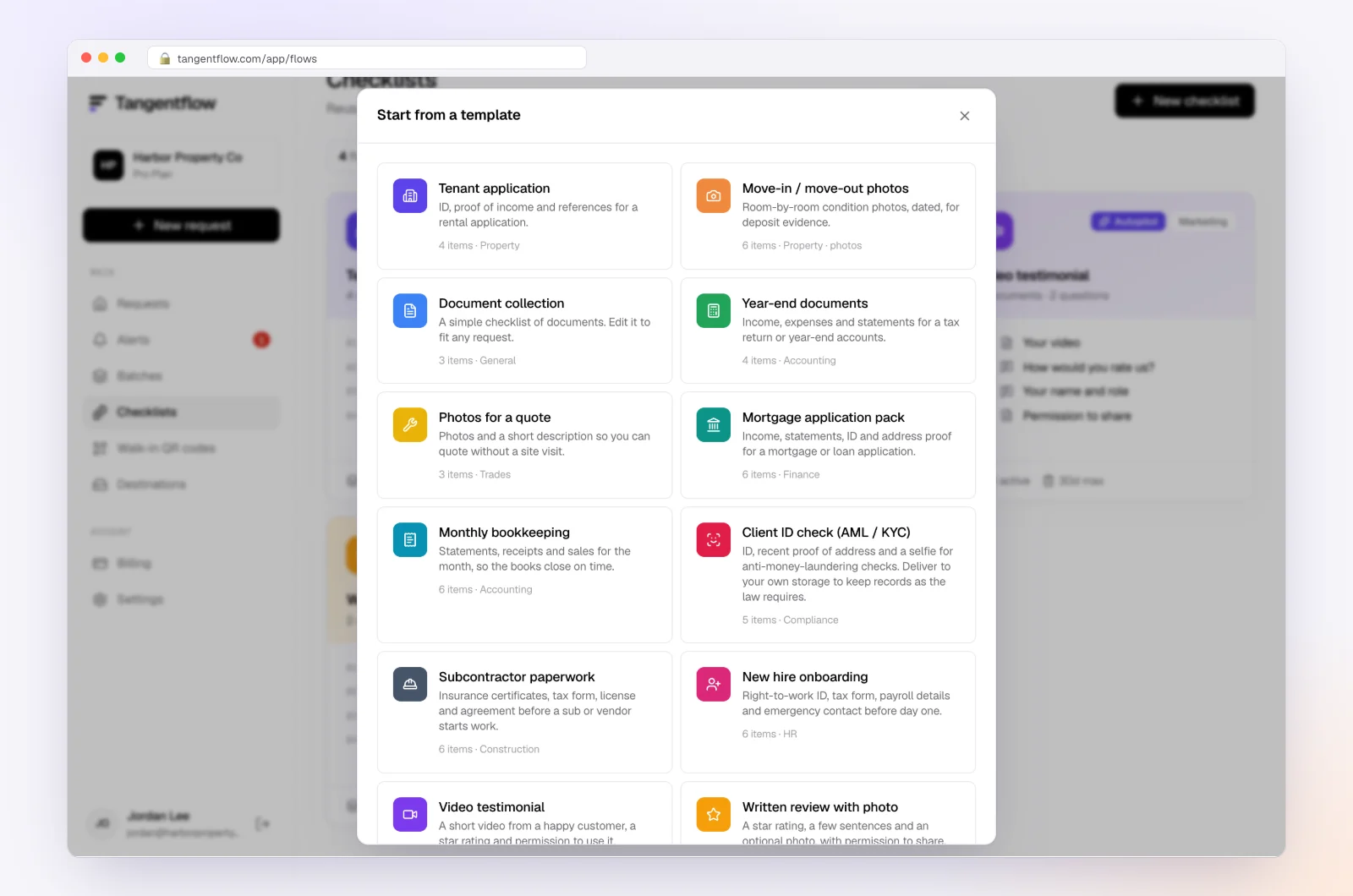
1. Start from the mortgage template
Go to Checklists, choose "Browse templates" and pick "Mortgage application pack." It starts you with photo ID, pay stubs, bank statements, proof of address, an annual income statement and a question about where the deposit is coming from. You can also describe what you need and let AI draft the items.
2. Set the rules for each document
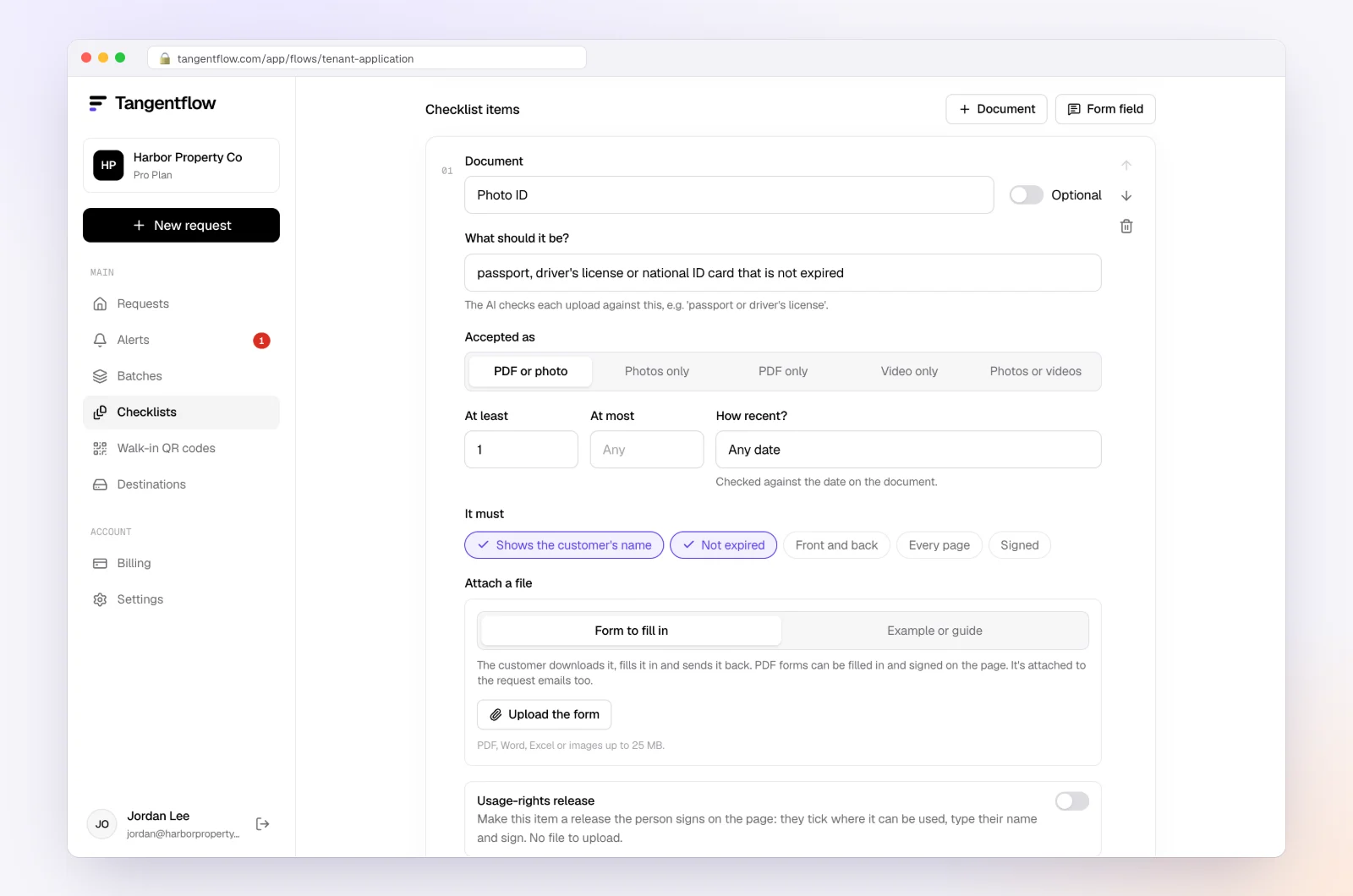
Open each item in the checklist editor and fill in:
- "What should it be?" For example, "complete bank statement PDF (not a screenshot) showing the borrower's name, account and all pages." This is what the AI check looks for.
- Count. Two pay stubs, two statements, one W-2 or T4 per year.
- A date rule such as "dated in the last 60 days" for statements and pay stubs.
- Conditions: the customer's own name, every page for statements and tax returns, front and back and not expired for IDs, signed for the gift letter and employment letter.
- An "Example" and a short tip, like "Download the PDF from your bank's website."
Add form fields for the questions in the table above, then use "Only ask if…" so the business returns item only appears when the borrower says they are self-employed, and the gift letter only appears when someone is helping with the down payment. Attach your gift letter as a fillable PDF so it can be filled in and signed online with a drawn signature. More on that in our guide to collecting signed forms online.
3. Create the request for each borrower
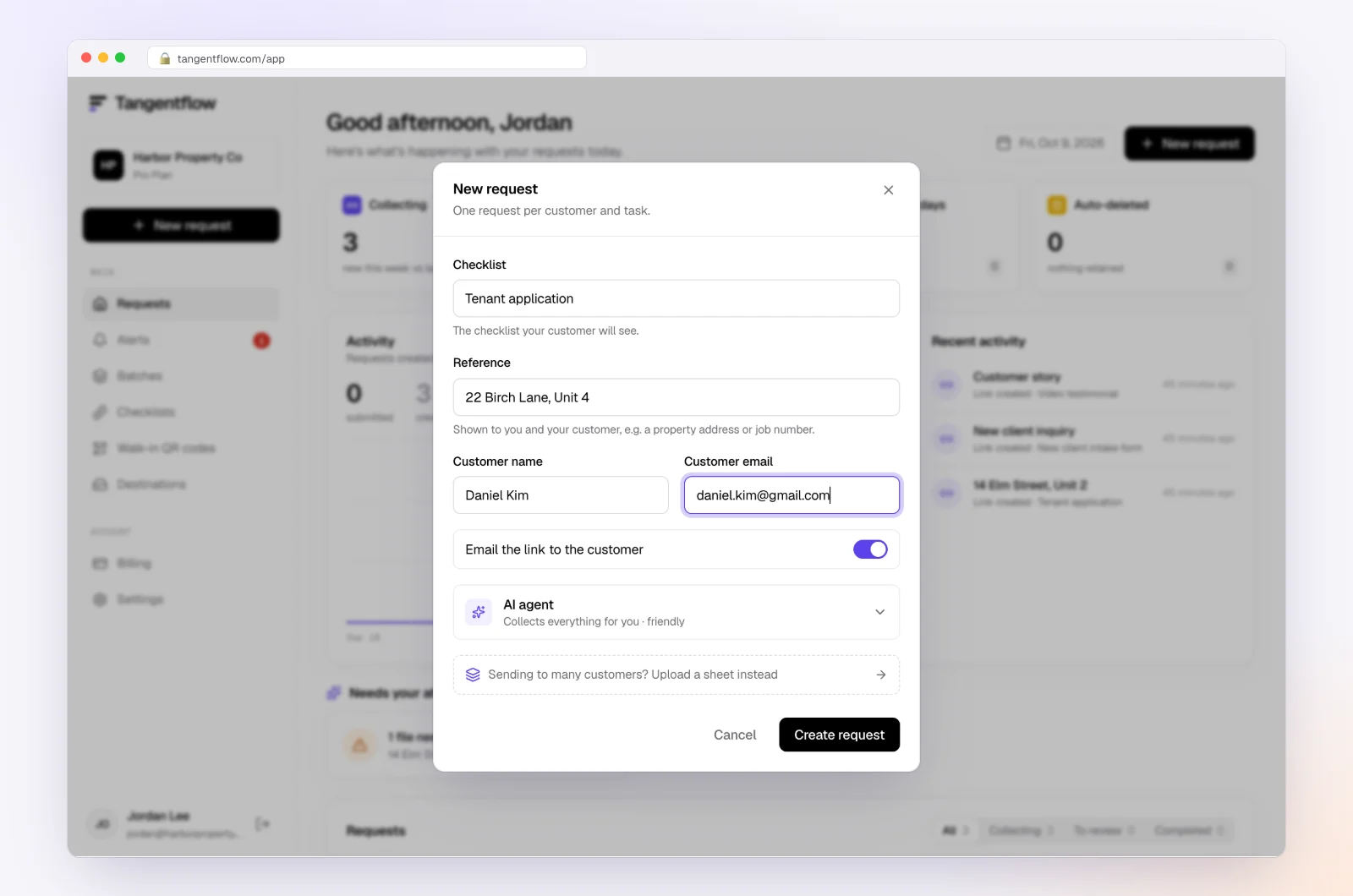
Go to Requests and click "New request." Choose the checklist, add a reference such as "Purchase, 22 Birch Lane" or "Refi, Nguyen," enter the borrower's name and email, and set a needed-by date worked back from closing. Leave "Email the link" on and the agent sends a branded invitation from your business name.
4. Problems are caught while the borrower is still on the page
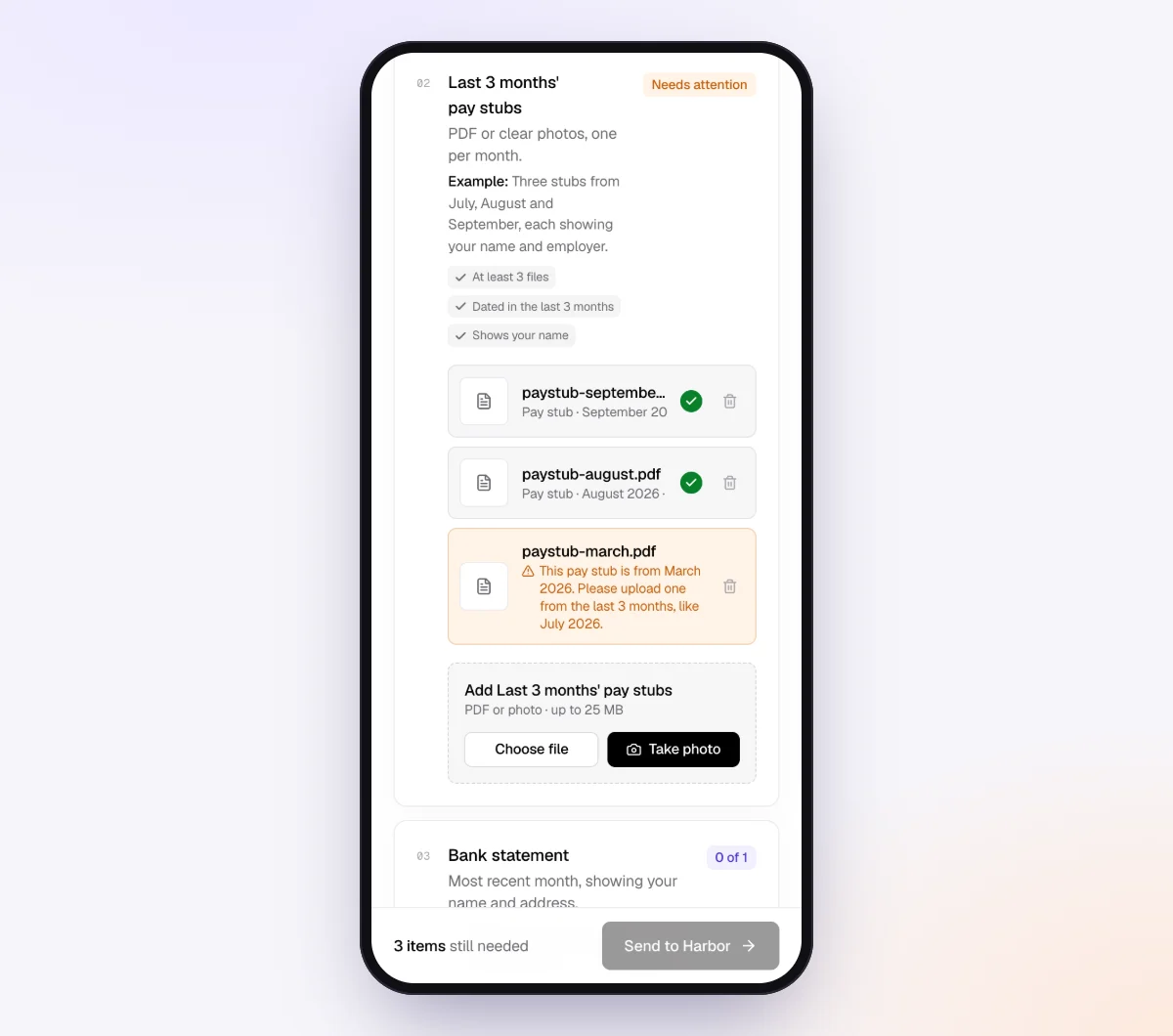
The borrower opens the link on their phone, with no account or app, and uploads straight from their files or camera. Each upload is checked by document checks in seconds: the right document, readable, recent enough, the borrower's name, every page, not expired. If page 3 of a statement is missing or a pay stub is from June, the borrower sees a friendly note explaining what to fix before they leave.
5. Review, chase conditions and deliver
Your request page shows every file with its check result, what is still missing and an activity timeline. The agent paces reminders to your needed-by date, lists only what is left, and answers questions like "Do I need my savings account too?" from your checklist and private notes. Questions about rates or approval are handed to you.
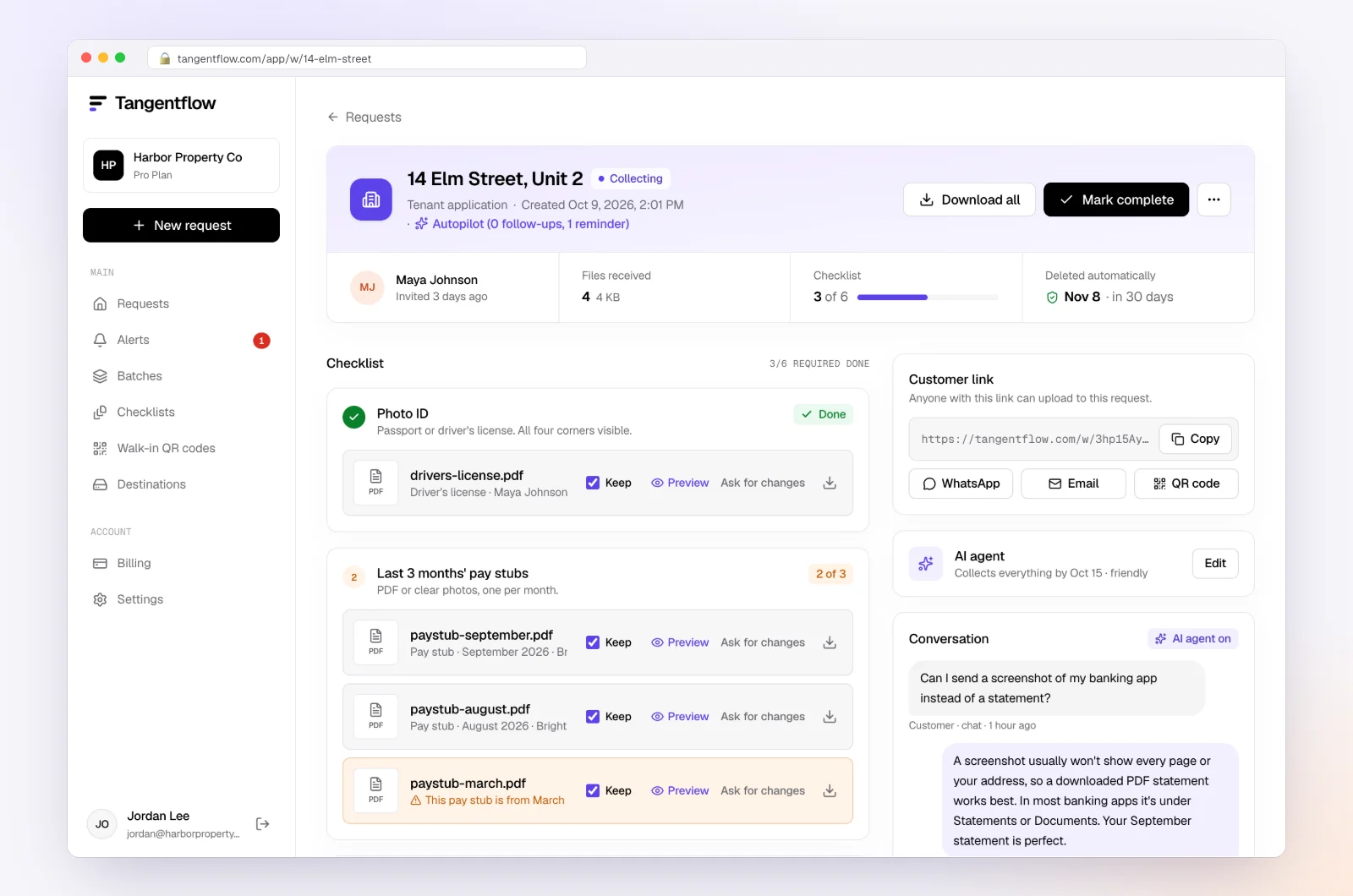
Use "Ask for changes" on a single file to have it redone. When underwriting conditions come in after the borrower has submitted, use "Request more from customer," type what else you need, and the request reopens with your message. When the file is complete, download an organized ZIP, or on Pro deliver it to Google Drive or a webhook.
Setups by borrower type
Use one base checklist and a few variants. These are starting points; your lenders' requirements come first.
| Borrower type | Checklist items | Settings worth turning on | Learn more |
|---|---|---|---|
| Salaried, first-time buyer | ID, 2 pay stubs, 2 years of W-2s or T4s, 2 months of statements, purchase agreement | "Dated in the last 60 days," "every page," name check | Mortgage lending |
| Self-employed | 2 years of personal and business returns or T1s and NOAs, YTD P&L, business statements | "Only ask if…" on a self-employed question, "every page" | Document checks |
| Gift funds | Gift letter, donor statement, borrower deposit statement | Fillable PDF with drawn signature, "signed" | Forms and e-signatures |
| Refinance | Mortgage statement, insurance declarations page, property tax bill, income docs | Shorter date window, one month of statements | Mortgage lending |
| Rental property owner | Leases, Schedule E or T1 rental statement, mortgage statement per property | Higher max count, "Only ask if…" | Document checks |
| Canadian purchase | Two IDs, employment letter, T4s, NOAs, 90 days of down payment history, MLS listing | "Every page," date rule on the letter | Mortgage lending |
If you send the same pre-approval checklist to a list of leads, "Batches" lets you upload a spreadsheet and give each borrower their own request and link. See bulk requests (Pro).
Keeping borrower documents secure
Borrower files hold IDs, Social Security or Social Insurance numbers and every account balance. In the US, many mortgage businesses fall under the FTC Safeguards Rule; in Canada, PIPEDA and provincial privacy laws apply. Your compliance team or lawyer can tell you what applies to you. Whatever tool you use, stop accepting statements and IDs by text, use a private link per borrower, never ask for online banking passwords, and delete copies once files are in your system of record.
In Tangentflow, each request has its own private link over HTTPS, files are encrypted at rest on Cloudflare, and they are deleted 24 hours after you complete a request or when retention ends (7 days on Free, 60 days on Pro). After the borrower sends everything, the link no longer shows their files. If a link went to the wrong person, you can reset it so the old link stops working. You can switch the AI check off for ID items so those files are never sent to the AI provider. More detail on our security page and in our guide to secure ways to receive sensitive documents.
When something goes wrong
| Problem | Likely cause | Fix |
|---|---|---|
| Bank statement missing pages | Borrower printed or photographed only pages with transactions | Turn on "every page" and say "include blank pages" in the item |
| Screenshot of the banking app | Borrower does not know how to get the PDF | Add a tip: "Download the statement PDF from your bank's website"; set the item to PDF only if your lenders require it |
| Pay stubs went stale | Closing moved or the file sat | Re-request with "Request more from customer"; set a date rule so old stubs are flagged |
| Wrong year of W-2, T4 or NOA | Borrower grabbed the first one they found | Name the year in "What should it be?"; the check flags the wrong year |
| Spouse's documents under the borrower's item | Joint applicants share a folder | Separate requests or separate items per person, with the name check on |
| Gift letter unsigned or incomplete | Donor never saw the instructions | Attach a fillable gift letter with required fields and a drawn signature |
| Large deposit with no explanation | Borrower did not know it mattered | Ask early with a yes/no question, then request the paper trail |
| Borrower has not opened the link | Email in spam or buried | Ask them to check spam, or copy the link and text it yourself |
Check "Alerts" daily for handoffs and missed dates. For pacing ideas, see our client reminder schedule guide.
Free and Pro, honestly
You can run a real request without paying anything.
| Free | Pro ($29/month) | |
|---|---|---|
| Open requests | 1 at a time | Unlimited |
| AI check on each file | Yes | Yes |
| AI autopilot (answers, reminders, follow-ups) | Your first request | Every request |
| Clients reply by email with attachments | No | Yes |
| Branding | Tangentflow badge | Your logo |
| Delivery to Google Drive or a webhook | No | Yes |
| Works with AI assistants (MCP) | No | Yes |
| File retention | 7 days | 60 days |
Both plans include unlimited checklists, QR codes and posters, ZIP export, AI summaries and email delivery. Pro is billed monthly with no contract, and you can cancel any time. Full details on the pricing page.
What Tangentflow does not do: SMS or text messages, a native mobile app, full legal e-signature certificates, identity verification, collecting payments, or permanent storage. If you need any of those, pair it with a tool that does. It also does not integrate directly with a loan origination system; deliver files by ZIP, Google Drive or webhook.
The whole process as a checklist
- Build a short pre-approval checklist and a full application checklist.
- Add yes/no questions for self-employment, gifts, rental property and other situations.
- Hide items that do not apply with "Only ask if…".
- Spell out what good looks like: every page, recent dates, the borrower's name, signed.
- Attach the gift letter as a fillable form from day one.
- Set a needed-by date worked back from the closing date.
- Send one private link per borrower, with an email code for sensitive files.
- Check each upload as it arrives and ask for fixes right away.
- Translate underwriting conditions into plain words, one item each.
- Refresh anything that will age out before closing.
- Deliver the package to your system of record and delete every other copy.
Frequently asked questions
What documents do I need for a mortgage?
Most lenders ask for photo ID, recent pay stubs, two years of W-2s or T4s, bank statements for the accounts funding your down payment and closing costs, and the signed purchase agreement. Self-employed borrowers add tax returns or Notices of Assessment, and anyone receiving help from family adds a gift letter. Your lender's list is the final word.
What documents are needed for mortgage pre-approval?
Usually a shorter list: ID, recent pay stubs, last year's W-2 or T4 (or tax return and Notice of Assessment if self-employed) and a recent statement showing your down payment funds. The full package comes after an offer is accepted.
How many months of bank statements do mortgage lenders want?
For US conventional purchases, the two most recent monthly statements are common, and one month is common for refinances. Canadian lenders commonly ask for a 90-day history of the down payment. Every page should be included, even blank ones.
What self-employed mortgage documents will I need?
Expect two years of personal tax returns with all schedules (US) or T1 Generals and Notices of Assessment (Canada), business returns if you own a company, a year-to-date profit and loss statement, and business bank statements. Some programs accept less and some lenders ask for more, so confirm with your lender.
What should a gift letter for a mortgage include?
Typically the donor's name, address, phone number and relationship to the borrower, the gift amount, and a statement that no repayment is expected, signed by the donor. Lenders also usually want proof that the money moved from the donor to the borrower.
Can Tangentflow send documents straight to my LOS?
No. There is no direct LOS integration. You can download an organized ZIP, or on Pro deliver files to Google Drive or a webhook that posts to your own system.
Can borrowers upload documents without creating an account?
Yes. Each borrower gets a private link that opens in any phone or computer browser, with no account or app. You can require a 6-digit email code before the link opens for extra protection. Try it free with your next borrower.