Templates
Missing Receipt Form Template for Small Businesses (2026)
A free missing receipt form template to copy, with IRS and CRA rules on lost receipts, better alternatives, and when a signed declaration is not enough.
By Bibin MathewUpdated 21 min read
The short answer
A missing receipt form is a short signed statement that records the date, vendor, amount, what was bought and the business purpose of an expense when the receipt is gone. It is a fallback, not a replacement: first ask the vendor for a duplicate, then pair the bank or card statement line with an order confirmation, and only then use the form. Neither the IRS nor the CRA promises to accept a self-prepared statement, so it never guarantees a deduction or an input tax credit, and the client's tax advisor decides how to treat it.
Short answer: a missing receipt form records the details a receipt would have shown (date, vendor, amount, what was bought) plus the business purpose, signed by the person who made the purchase. Use it last, after asking the vendor for a duplicate and pulling the bank or card statement line and any order email. It is supporting evidence, not proof. The IRS and the CRA can still disallow an expense that is not properly supported, so treat the form as a way to document what you know, and let the client's tax advisor decide what it is worth.
Every bookkeeper knows the moment. You are reconciling the card statement and there is a $214.60 charge at a hardware store with nothing behind it. You ask the client. The answer is "I lost it," or "it was a cash thing," or silence for three weeks.
This guide is for independent bookkeepers, small firms and business owners in the US and Canada who need a consistent way to handle those gaps. You get a copyable missing receipt form, honest guidance on when a declaration is enough, what the IRS and CRA actually say, a message to send clients, and a setup that collects the signed form and the statement line together.
What a missing receipt form is (and what it is not)
The same document goes by many names: missing receipt form, lost receipt affidavit, missing receipt declaration, substitute receipt, lost receipt statement or no-receipt memo. They all do one job: put the details of an expense in writing when the original receipt cannot be produced.
It is a written record, made by the person who knows the facts, that ties a statement line to a business purpose. What it is not:
- Not an official IRS or CRA form. Neither agency publishes one for small businesses. Most forms online are employer or university expense forms.
- Not a guarantee. A self-prepared statement is one piece of evidence. Whether it supports a deduction depends on the expense and the other evidence around it.
- Not usually a true affidavit. An affidavit is sworn in front of a notary or commissioner for oaths. Most small businesses use a signed declaration instead.
- Not a fix for input tax credits. In Canada, an ITC claim needs documentation with specific information from the supplier.
When a declaration is enough, and when it is not
The requirements change with the type of expense. Treat this as a starting point, not a ruling.
| Situation | Is a signed declaration likely to help? | What else to get |
|---|---|---|
| Small office supplies, US, statement line exists | Often useful as supporting evidence | Card or bank statement line, ideally an order email |
| Business meal under $75, US | No receipt required under $75 (lodging excepted), but you still need a record | Amount, date, place, business purpose and who attended |
| Hotel or lodging, any amount, US | Weak. The $75 exception does not apply to lodging | Ask the hotel for a folio copy; most can email one |
| Travel, gifts or car expenses, US | Must meet the stricter Publication 463 rules | Statement, written log, calendar entries, mileage log |
| Large equipment or asset purchase | Weak. Expect the advisor to want an invoice | Duplicate invoice, warranty registration, delivery slip |
| Receipt lost in a fire, flood or other casualty | The IRS allows reconstructing records in these cases | Statements, vendor copies, anything that rebuilds the record |
| Canadian expense where you want the ITC | Not enough on its own for the ITC | A receipt or invoice from the supplier with the required information |
| Cash purchase with no statement line | Weakest case | Any outside evidence: a photo of the item, a delivery slip |
The stricter the rules, the larger the amount and the less outside evidence exists, the less a declaration can carry alone.
Try these before you use the form
A missing receipt form should be the last step. Most "lost" receipts can be replaced in minutes.
| Option | How to get it | How strong it is |
|---|---|---|
| Duplicate receipt from the vendor | Ask the vendor to reprint or re-send it. Many can look up a card purchase by date and amount | Strongest. It is the real document |
| Online order history | Download the invoice from the vendor's account | Strong. Usually shows items, tax and date |
| Emailed receipt or order confirmation | Search the client's inbox for the vendor name or amount | Strong, especially when it lists items and tax |
| Bank or card statement line plus order confirmation | Pair the two so one shows payment and the other shows what was bought | Good together. Either alone is weaker |
| Statement line plus a signed missing receipt form | Use the template below | A fallback. Better than nothing, not always enough |
| Signed form alone, no statement line | Cash purchases with no other trace | Weakest. Raise it with the tax advisor |
Why the pairing matters: IRS Publication 583 says proof of payment, by itself, does not establish that you are entitled to a deduction. You also need something that shows what was bought, and why.
The missing receipt form template
Copy this into a Word document, a fillable PDF, an email or a form tool. Keep it to one page, one form per missing receipt.
The fields, and why each one is there
| Field | Example | Why it matters |
|---|---|---|
| Business name | Northside Plumbing LLC | Ties the expense to the right entity |
| Name of the person who made the purchase | Dana Ruiz | The person with first-hand knowledge signs |
| Date of purchase | September 14, 2026 | The IRS and CRA both expect the date |
| Vendor name | Westside Lumber | Matches the payee on the statement |
| Vendor address or website | 1200 Harbor Rd, or westsidelumber.com | Helps identify the vendor; the CRA expects the supplier's name and address on records |
| Amount paid, including tax | $214.60 | Matches the statement line |
| Sales tax or GST/HST paid, if known | $15.80 | Useful for the books; does not create an ITC on its own |
| Payment method | Business Visa ending 4471 | Links the form to the statement |
| Description of what was bought | 2x4 lumber and fasteners for the Elm St job | Shows the essential character of the expense |
| Business purpose | Materials for client repair job #1182 | The part a statement never shows |
| For meals: who attended and their business relationship | Client J. Park, owner of Park Dental | Helps show the business purpose of a meal |
| Why the receipt is missing | Receipt faded and unreadable, thrown out | Explains the gap honestly |
| Steps taken to get a duplicate | Called store Sep 30, no record of cash sales | Shows a good-faith effort |
| Attached supporting evidence | Card statement line, photo of materials on site | What backs up the declaration |
| Declaration and signature | Signed and dated by the purchaser | Makes it a statement, not a note |
| Date signed | October 2, 2026 | Shows how close to the purchase it was written |
Plain-text version to copy
MISSING RECEIPT DECLARATION

Business name: ______________________________
Person who made the purchase: ______________________________

PURCHASE DETAILS
Date of purchase: ______________________________
Vendor name: ______________________________
Vendor address or website: ______________________________
Amount paid (including tax): $______________
Sales tax / GST/HST / QST paid, if known: $______________
Payment method (card or account, last 4 digits): ______________

WHAT AND WHY
Description of what was bought: ______________________________
______________________________________________________________
Business purpose: ______________________________
______________________________________________________________
For meals or gifts only, who was present or received it, and
their business relationship: ______________________________

THE MISSING RECEIPT
Why the receipt is not available: ______________________________
What I did to get a copy from the vendor: _______________________
Supporting evidence attached (tick all that apply):
[ ] Bank or card statement line   [ ] Order or email confirmation
[ ] Contract, quote or delivery slip   [ ] Photo of the item
[ ] Other: ______________________________

DECLARATION
I declare that this expense was paid for the business purpose
described above, that the information on this form is true and
complete to the best of my knowledge, and that I have not
claimed or been reimbursed for this expense elsewhere. I
understand this declaration does not guarantee that the expense
can be deducted or that a tax credit can be claimed.

Signature: ______________________________
Name: ______________________________
Date signed: ______________________________

Reviewed by (optional): ________________  Date: ____________
The last sentence of the declaration matters. It sets expectations in writing, so a client does not assume a signed form makes everything deductible.
Tips for filling it in well
- Fill it in soon. Publication 463 notes that a record made at or near the time of the expense has more value than a statement prepared later.
- Be specific. "Supplies" says nothing. "Printer toner and 10 reams of paper" does.
- Copy the amount from the statement line, to the cent.
- Write the real reason. "Faded thermal paper" is fine. Vague reasons look worse than honest ones.
- The purchaser signs, not the bookkeeper.
What the IRS says about lost receipts
Publication 463: travel, gifts and car expenses
Publication 463 covers travel, gift and car expenses, which have stricter substantiation rules than most business expenses:
- Documentary evidence. You generally need receipts, canceled checks or bills to support these expenses, along with a record of the details.
- The $75 exception. Documentary evidence is not needed if the expense, other than lodging, is less than $75. You still need to record the details. Lodging needs documentary evidence at any amount.
- What adequate evidence shows. Documentary evidence is ordinarily adequate if it shows the amount, date, place and essential character of the expense.
- Incomplete records. If records are incomplete, you must prove the element with your own written or oral statement containing specific information, plus other supporting evidence sufficient to establish it. For the cost, time, place or date of an expense, that supporting evidence must be direct or documentary evidence.
- Destroyed records. If you cannot produce a receipt for reasons beyond your control, such as fire, flood or other casualty, you can prove a deduction by reconstructing your records.
| Expense type | What the record needs to show (simplified from Pub. 463) |
|---|---|
| Travel | Cost of each separate expense (travel, lodging, meals), dates away and days on business, destination, business purpose |
| Gifts | Cost, date, description, business purpose and the recipient's business relationship |
| Transportation and car | Cost of each expense; for a car, mileage for each business use and total miles for the year, date, destination and business purpose |
A missing receipt form that captures these elements can serve as your written statement, but it still needs other supporting evidence for the amount and date. That is why the statement line belongs with it.
Publication 583: everyday business expenses
Publication 583 is the general recordkeeping guide for small businesses. It lists supporting documents such as canceled checks, cash register tapes, account statements, credit card sales slips and invoices. A card statement used as proof of payment should show the amount charged, the payee's name and the transaction date, but proof of payment alone does not establish a deduction.
The Cohan rule, briefly
You may see the "Cohan rule" mentioned. It comes from a 1930 court case and has, in some situations, let courts allow a reasonable estimate when there is credible evidence an expense was incurred. Do not plan around it. It is applied case by case, usually in a dispute, and generally does not apply to the travel, gift and car expenses above. That is a conversation for a tax professional.
What the CRA says about missing receipts
Records and supporting documents
The CRA expects businesses to keep records that support their income and expense claims. Its keeping records pages list supporting documents such as purchase receipts, invoices, contracts, bank statements, cancelled cheques, credit card receipts, delivery slips and email correspondence. They also state the risk plainly: if your records do not support your claims, they could be disallowed.
On its business records page for sole proprietors and partnerships, the CRA says that if a seller does not give you a receipt, you should write the seller's name and address, the amount paid, the date of payment and the details of the transaction in your expense journal. A missing receipt form captures those details plus the business purpose, but it is still a record the business made itself, not a document from the supplier.
GST/HST input tax credits need more
To claim an ITC, the business needs supporting documentation with the information the regulations require, which depends on the amount. From $100 up, that includes the supplier's GST/HST registration number, which a client's declaration cannot supply. For the thresholds, see our guide to GST/HST receipt requirements for input tax credits.
In practice: use the form to support the expense, ask the supplier for a replacement invoice if the client wants the ITC, and if none is possible, flag it for the advisor rather than claiming the credit by default.
A missing receipt policy for your bookkeeping clients
Put a short policy in your engagement letter or onboarding packet so every client hears the same rules:
- Receipts are due with the monthly request. A receipt collected the same month is rarely lost. Our guide to getting clients to send receipts covers the routine.
- Unmatched transactions get one question. At month end, list the statement lines with no receipt and ask the client about each. The uncategorized transactions guide has wording.
- Replacement first. For anything over an amount you set with the client's advisor, the client asks the vendor for a duplicate before using the form.
- Form second. If no duplicate exists, the client fills in and signs a missing receipt form, attached to the statement line.
- Flag, do not decide. Declaration-only expenses are tagged and listed for the tax advisor at year end.
A running "missing receipts" log per client (date, vendor, amount, what was tried, whether a form was signed) makes the year-end handoff quick. Our year-end bookkeeping client checklist shows where it fits.
A message to send a client who lost a receipt
Subject: One receipt we need help with: Westside Lumber, $214.60
Hi Dana,
Your September card statement shows $214.60 at Westside Lumber on September 14, and we do not have a receipt for it.
Could you ask Westside Lumber for a copy (many stores can look up a card purchase) or check your email for an e-receipt? If neither works, fill in and sign the short missing receipt form at the link below.
A signed form helps, but it does not guarantee the expense can be deducted, so we will note it for your tax advisor.
Thanks, Priya
For reminders and a final notice, see our document request email templates.
Missing receipt forms in Tangentflow, step by step
Tangentflow collects documents, photos and signed forms from clients through one private link, and an AI collection agent does the inviting, reminding and answering. For missing receipts, the signed form and the statement line arrive together under the same request, instead of in separate emails. More on how it fits a practice on our bookkeepers page.
1. Start from the "Monthly bookkeeping" template
Open "Checklists," choose "Browse templates" and pick "Monthly bookkeeping." It already includes "Bank statements for the month," "Credit card statements," "Receipts and bills you paid," "Sales or invoices you issued," "Payroll report" and the question "Anything unusual this month?" You will add a missing receipt section that only shows up when needed.

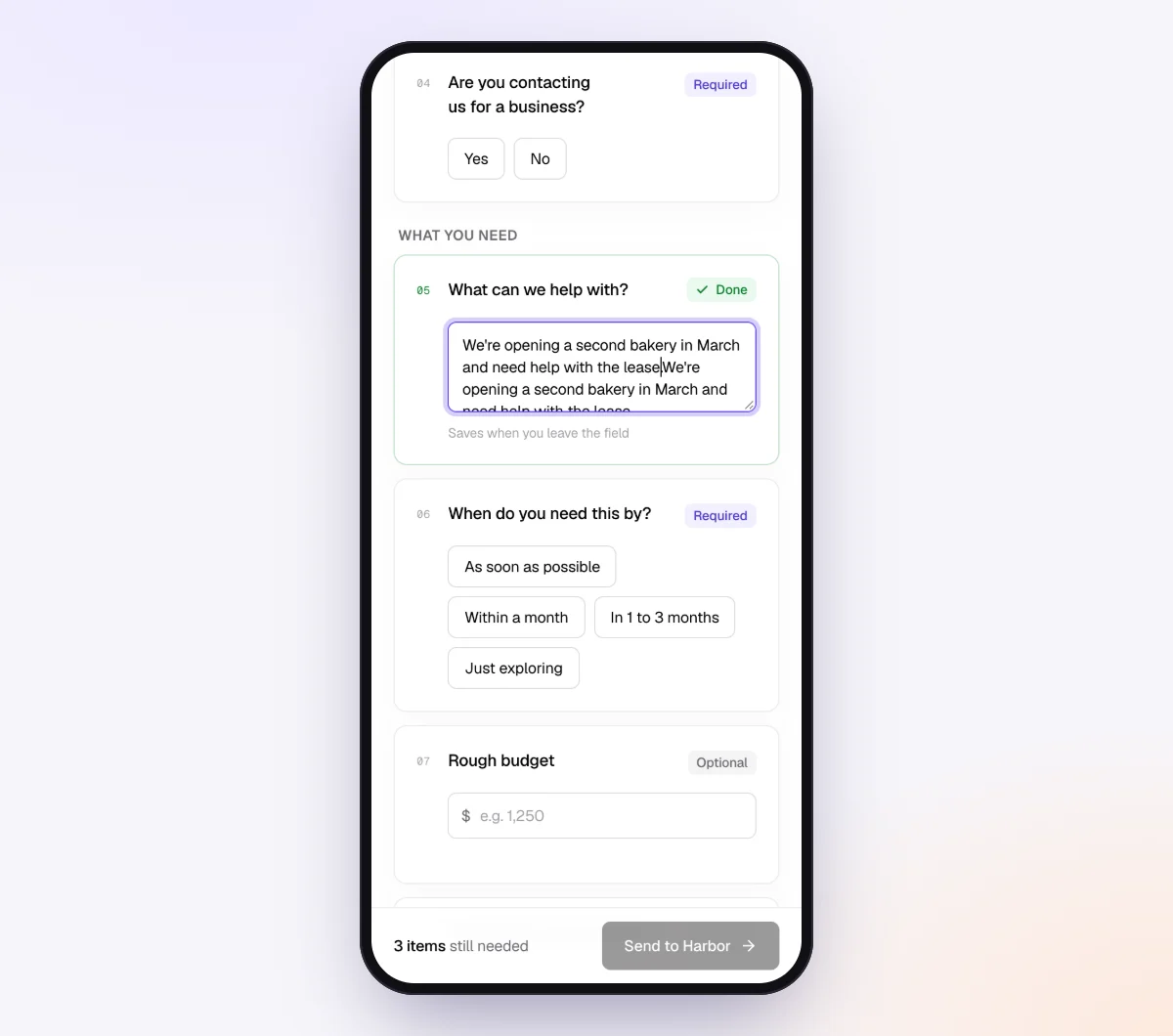
2. Add a yes/no question and the declaration fields
Add a "Form field" with the yes/no answer type, such as "Is there a purchase this month you have no receipt for?" Then add the declaration details as form fields, each set to "Only ask if…" the answer is yes:
- Date of purchase as a date field.
- Vendor name as short text.
- Amount paid, including tax as a dollar amount field.
- What was bought and Business purpose as long text.
- Why the receipt is missing as a single choice: "Lost," "Faded or unreadable," "Vendor did not give one," "Other."
Give the group a section heading like "Missing receipt" so it reads as one form on the client's phone. Typed answers are quick to copy into the books.
3. Attach the declaration as a form to sign
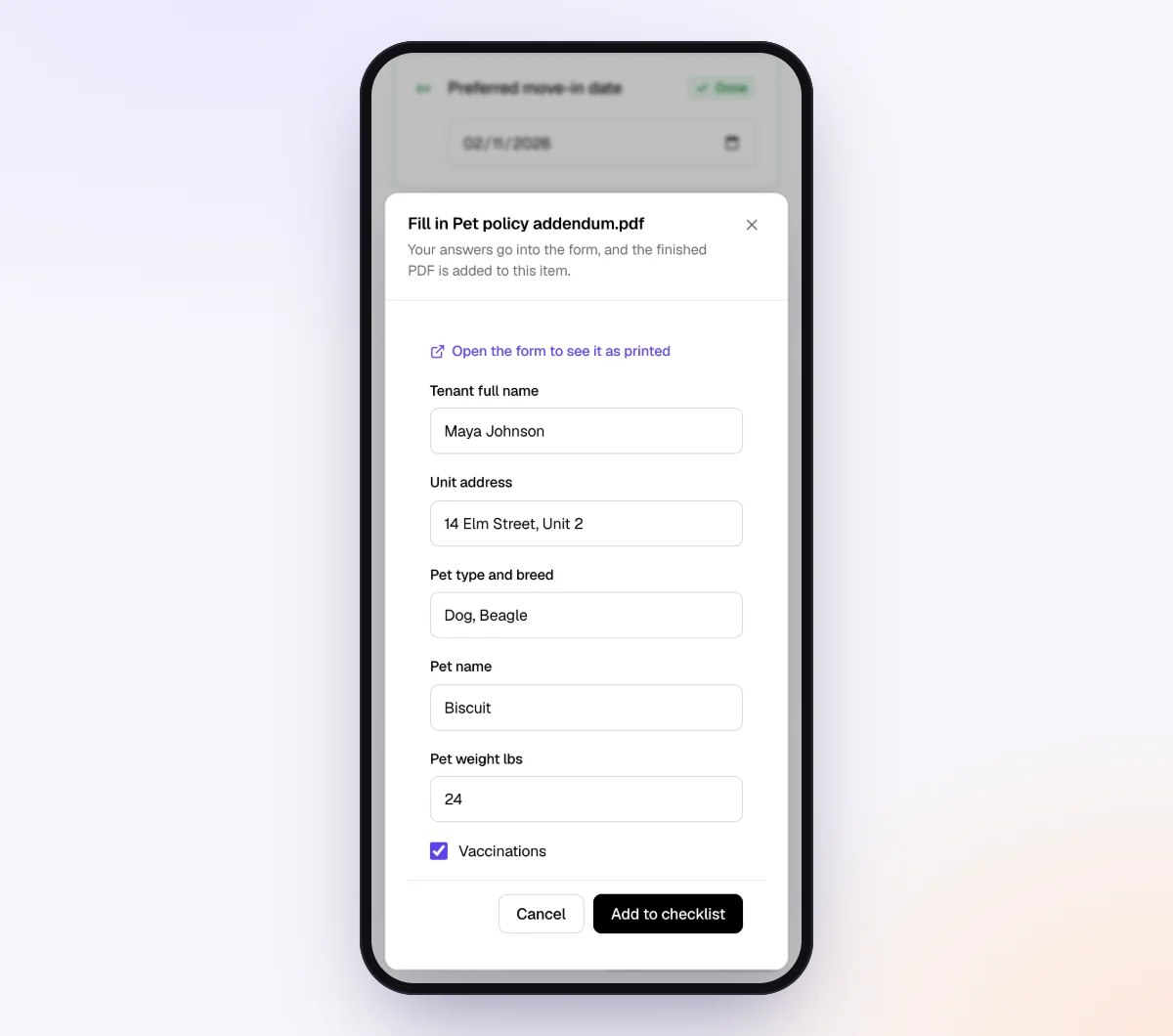
Form fields do not take a signature. For that, add a file item such as "Signed missing receipt declaration," also set to "Only ask if…" the answer is yes. Under the attachment option, choose "Form to fill in" and upload the template above as a fillable PDF. Tick signed under the conditions and add an "Example" like "One page, all fields filled in, signed and dated."
The client fills in the PDF on their phone, draws a signature with a finger and types their name. The PDF is stamped "Signed electronically by" with their name, the date and time, and filed under the item. More on this in forms and e-signatures.
4. Ask for the statement line and any other evidence
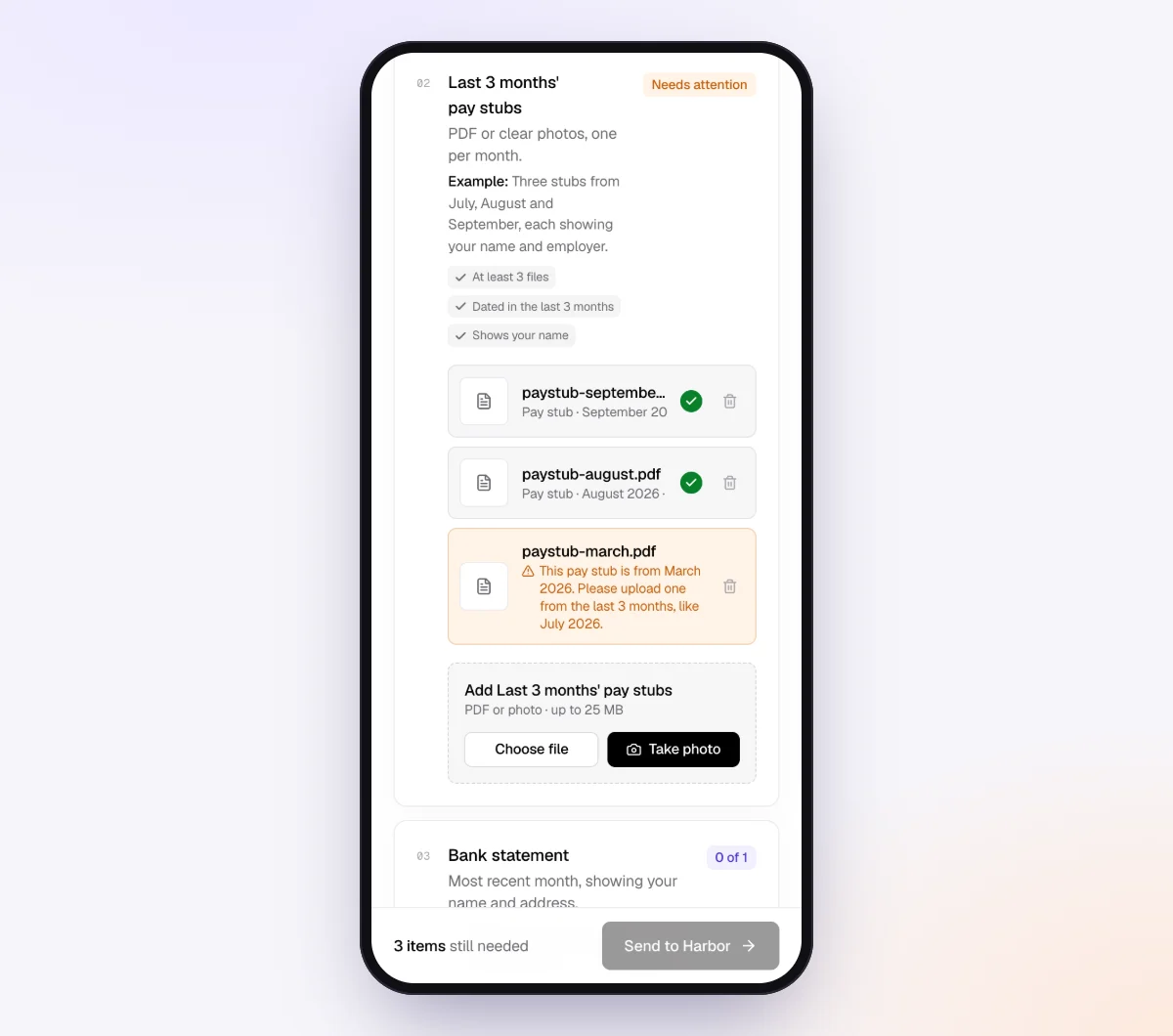
Add one more file item, "Statement line or order confirmation for the missing receipt," set to "Only ask if…" the answer is yes. In "What should it be?" write "bank or card statement, or an order confirmation, showing the purchase," and add a hint: "A screenshot of the single transaction is fine." If the full statement already came in under "Credit card statements," make this item optional.
Each upload goes through document checks in seconds. A blurry or cut-off photo, or an unsigned declaration, gets a friendly note so the client can fix it before leaving the page.
5. Send it, let the agent chase, and review
For one client, click "New request," choose the checklist, add a reference like "Northside Plumbing, September 2026," and set a needed-by date. In "Notes for the agent (private)" add context such as "Missing receipt: Westside Lumber, $214.60, Sep 14." The agent uses it if the client asks.
For your whole client list, use "Batches" on Pro: up to 100 clients per sheet, scheduled up to 30 days ahead. Turn on "Repeat every month" and the same clients get a new request on the same day each month, with the same gap to the needed-by date, until you stop it from the batch page. Details on bulk requests.
The agent reminds clients on a schedule paced to the needed-by date, listing only what is still missing. When everything is in, review each file and answer on the request page, use "Ask for changes" on any single file, then download a ZIP or, on Pro, deliver to Google Drive or a webhook.

For an extra step before the link opens, turn on "Require an email code" for the checklist, so the client enters a 6-digit code sent to their email first. If a link went to the wrong person, you can reset it.
Variations by type of client
| Client type | Typical missing receipts | Adjust the template | Learn more |
|---|---|---|---|
| Trades and contractors | Lumber yard and hardware store receipts, faded or lost on site | Add a job or project number field; ask for a site photo of the materials | Home services |
| Consultants and sole proprietors | Client meals, parking, transit | Make "who attended" required for meals | Accounting and tax |
| Businesses with staff who buy things | Employee card purchases with no receipt | Add "Reviewed by" for a manager, and one form per purchase | Monthly bookkeeping checklist |
| Canadian GST/HST registrants | Receipts needed for ITCs | Keep the form for the expense, and add an item for a replacement supplier invoice | GST/HST receipt requirements |
| Catch-up clients | Months or years of gaps | Use a log instead of one form per item, and agree a threshold with the advisor | Catch-up bookkeeping checklist |
When something goes wrong
| Problem | Likely cause | Fix |
|---|---|---|
| Client fills in forms for everything | Thinks the form replaces receipts | Explain in writing that it is a last resort and ask for duplicates first |
| Form says "supplies" and nothing else | No guidance on detail | Add an "Example" with a good description and purpose |
| Amount on the form does not match the statement | Written from memory | Ask them to copy the amount from the statement line, to the cent |
| Dozens of missing receipts from one client | No monthly routine | Move them to a monthly request and a fixed due date |
| Client wants the GST/HST back on a declaration-only expense | Assumes the form covers the ITC | Ask the supplier for a replacement invoice; otherwise flag for the advisor |
Check "Alerts" daily during close week. That is where handoffs and missed dates show up. Our month-end close checklist covers where reviewing unmatched transactions fits.
Free and Pro, honestly
You can run a real request without paying anything.
| Free | Pro ($29/month) | |
|---|---|---|
| Open requests | 1 at a time | Unlimited |
| AI check on each file | Yes | Yes |
| AI autopilot (answers, reminders, follow-ups) | Your first request | Every request |
| Send to many clients at once (Batches) | No | Yes |
| Clients reply by email with attachments | No | Yes |
| Branding | Tangentflow badge | Your logo |
| Delivery to Google Drive or a webhook | No | Yes |
| Works with AI assistants (MCP) | No | Yes |
| File retention | 7 days | 60 days |
Both plans include unlimited checklists, QR codes and posters, ZIP export, AI summaries and email delivery. Pro is billed monthly with no contract, and you can cancel any time. Full details on the pricing page.
What Tangentflow does not do: SMS or text messages, a native mobile app, full legal e-signature certificates, identity verification, collecting payments, or permanent storage. If you need any of those, pair it with a tool that does. It also does not decide whether an expense is deductible, verify GST/HST numbers, connect to bank feeds or replace your bookkeeping software.
The missing receipt process as a checklist
- Collect receipts monthly so fewer go missing in the first place.
- At month end, list statement lines with no receipt and ask about each one.
- Ask for a duplicate from the vendor, order history or an email confirmation first.
- Only then send the missing receipt form, one per purchase.
- Capture date, vendor, amount, what was bought and business purpose, plus attendees for meals.
- Have the purchaser sign and date it soon, with the statement line attached.
- For Canadian ITCs, get a replacement supplier invoice; the form alone is not enough.
- Tag declaration-only expenses for the tax advisor, and never promise they are deductible.
Frequently asked questions
What should a missing receipt form include?
The date of purchase, vendor name and address, amount paid including tax, payment method, a description of what was bought, the business purpose, and why the receipt is missing. For meals, add who attended and their business relationship. It should be signed and dated by the person who made the purchase, with the bank or card statement line attached.
Does the IRS accept a lost receipt statement?
There is no official IRS lost receipt form, and a signed statement does not guarantee a deduction. Publication 463 lets you support some elements of travel, gift and car expenses with your own written statement plus other supporting evidence, and allows reconstructing records lost to fire, flood or other casualties. Check specific expenses with a tax professional.
What is the $75 receipt rule?
Under Publication 463, documentary evidence such as a receipt is not required for a travel, meal, gift or car-related expense under $75, except for lodging, which needs documentary evidence at any amount. You still need a record of the amount, date, place and business purpose. It is not a general rule that any expense under $75 needs no records.
What should I do if I lost a business receipt?
Ask the vendor for a duplicate, check order history and your email, and pull the statement line. If nothing replaces the receipt, sign a missing receipt declaration with the full details, attach the statement line, and tell your bookkeeper or tax advisor.
Can I claim a business expense in Canada without a receipt?
The CRA expects records that support every expense, and claims that are not supported can be disallowed. If a seller does not give a receipt, the CRA says to record the seller's name and address, the amount, the date and the details in your expense journal. For GST/HST input tax credits, you need supplier documentation with the required information, so a self-written note is not enough for the credit.
Is a bank or credit card statement enough without a receipt?
Usually not on its own. IRS Publication 583 accepts a statement as proof of payment when it shows the amount, payee and date, but says proof of payment alone does not establish a deduction. Pair the statement with an order confirmation, invoice, contract or a signed declaration that shows what was bought and why.
Can clients fill in and sign a missing receipt form on their phone?
Yes. In Tangentflow you can attach the form as a fillable PDF to a checklist item, and the client fills it in and draws a signature on their phone with no account. You can also show the form only when the client answers "yes" to a question about missing receipts, and ask for the statement line in the same request.