Guides
How to Collect Sales Tax Exemption Certificates (2026)
How to collect sales tax exemption certificates from customers before the first untaxed sale. Validity checklist, request email, renewal tracker, Canada note.
By Bibin MathewUpdated 22 min read
The short answer
Collect a fully completed, signed and dated exemption certificate on the right state form from every exempt customer before the first untaxed sale, and keep it where you can find it in an audit. Check the purchaser's name, permit or exemption number, the reason for exemption and the signature on the day it arrives, because an untaxed sale with no valid certificate behind it is tax you owe. Track expiration dates where states set them, request renewals in a batch each year, and keep a register of what is on file.
A wholesaler ships a pallet to a new retail customer and does not charge sales tax, because the buyer said "we're a reseller" on the phone. The invoice goes out, the money comes in, and nobody thinks about it again. Three years later a state auditor pulls that invoice, asks for the resale certificate, and there isn't one. The tax, interest and penalty on that sale, and on every untaxed sale like it, land on the seller.
This guide is for the people who have to stop that from happening: bookkeepers, small-business owners who sell wholesale, suppliers to contractors and manufacturers, and e-commerce sellers with exempt buyers such as resellers, nonprofits and government agencies. You will get a validity checklist, a table of certificate types, a collection process with a request email, a comparison of ways to collect, a renewal and audit-prep routine, troubleshooting, a short Canada section and a step-by-step setup in Tangentflow.
Why the certificate matters: the seller carries the risk
Sales tax is the seller's job to collect. When a customer asks you not to charge it, the state does not take their word for it, and it does not take yours either. It expects you to hold documentation that the sale qualified for an exemption, and in almost every state that documentation is a certificate the customer completes and signs.
Without it, the default is simple: the seller owes the tax. In an audit, untaxed sales with no certificate on file are generally assessed to you, with interest and often a penalty, and you are left trying to collect the tax from a customer years after the fact, or eating it.
The flip side is why collection is worth doing properly. Many states relieve a seller of liability when it accepts a fully completed certificate in good faith. States that follow the Streamlined Sales and Use Tax Agreement spell out a time frame: a seller that obtains a fully completed certificate at the time of sale or within 90 days of it is generally relieved of liability if the exemption turns out to be improper, and the purchaser becomes liable instead. Those states also give sellers a window, typically 120 days after an audit request, to produce certificates for untaxed sales. Outside Streamlined states the rules vary, so check the states you sell into.
Two things follow. Get the certificate before or at the first untaxed sale, not at year end and not when the auditor calls. And "fully completed" is doing a lot of work: a certificate with a blank permit number, no signature or the wrong state's form may not protect you at all.
What makes an exemption certificate valid
Forms differ by state, but the fields an auditor looks for are consistent. Use this as your acceptance checklist for every certificate that comes in.
- The correct form. The state's own certificate for the state where the sale is sourced, or a multistate form that state accepts. A customer's home-state certificate is usually not valid for a sale in another state.
- Purchaser's legal name and address, matching your customer account and invoices.
- Seller's name and address. Yours. A blank seller line is a common incomplete-form finding.
- Purchaser's permit, registration or exemption number where the state requires one. For resale, usually the buyer's sales tax permit number in that state. For nonprofits and government, often a state-issued exemption number or letter. A federal EIN or a 501(c)(3) letter is not, by itself, a sales tax exemption in most states.
- The reason for exemption, with the right box checked: resale, manufacturing, agriculture, nonprofit, government, and so on.
- A description of what is being bought, or a blanket statement covering all purchases of a type. Know whether you hold a blanket or a single-purchase certificate.
- Signature, printed name and title of someone authorized to sign for the purchaser.
- Date. An undated form is hard to defend and makes renewal tracking impossible.
- Plausibility. A hair salon buying a forklift "for resale" is the kind of thing auditors notice. Good faith means the exemption makes sense for the customer's business.
The main certificate types and who uses each
| Certificate type | Who gives it to you | What it covers | Notes |
|---|---|---|---|
| State resale certificate | Retailers, wholesalers and distributors buying inventory to resell | Goods bought for resale, and in some states components of products to be resold | The buyer usually needs a sales tax permit in that state. Florida issues it annually; Texas uses a form with no set expiration |
| State exemption certificate for nonprofits, schools, churches and government | Qualifying organizations buying for their own use | Purchases for the organization's exempt purpose | Many states require a state-issued exemption number or letter. Not every state exempts nonprofits |
| Direct pay permit | Large purchasers approved by the state | The buyer pays tax directly to the state on its own purchases, so you do not charge it | Keep a copy of the permit on file. Only some states issue them, and eligibility is narrow |
| Streamlined Sales Tax Certificate of Exemption (SSTGB Form F0003) | Buyers claiming any listed exemption in a Streamlined member state | Multiple exemption reasons; the buyer fills in the state, the reason and the ID number | Accepted by all 24 Streamlined member states. Some non-member states accept it for exemptions valid in their state; check each one |
| Multistate Tax Commission Uniform Sales & Use Tax Certificate (Multijurisdiction) | Resellers buying in several states | Resale, and in some states components or ingredients of products to be resold | Not accepted everywhere, and some states require the buyer to be registered there. The MTC itself says it cannot guarantee acceptance; read the footnotes |
The multistate forms save a reseller who buys from you in six states from filling in six forms. They do not change the underlying rule: the exemption has to be valid in the state where the sale is sourced, and that state has to accept the form. Confirm on the state's website, and when in doubt ask for that state's own certificate.
The collection process
When to ask
- Before the first untaxed sale. Set the customer account to taxable until a valid certificate is on file. This one rule prevents most audit exposure.
- At onboarding, alongside the credit application and signed terms, and for trade customers you also pay, the W-9 and certificate of insurance. One request, once. Bookkeepers who run this for a client's wholesale customers will find more on the bookkeepers page.
- When something changes: a new state, legal name or entity, or a change in what they buy or why they are exempt.
- On renewal, where the state sets an expiration or your own policy says to refresh.
- When a sale looks off. A reseller suddenly ordering office furniture, for example. Ask, and charge tax if it is not for resale.
The request email
Be specific, because "send me your tax exempt form" produces a photo of a permit card about half the time. Say which form, for which state, and what "complete" means. More wording for reminders is in our document request email templates.
Subject: Exemption certificate needed before we can ship tax-free

Hi [First name],

Thanks for setting up an account with [Business name]. To sell to you
without charging sales tax, we need a completed exemption certificate
on file before your first order ships.

Please fill in and sign the [State] resale/exemption certificate
(or the Streamlined / MTC multistate form, if you buy for resale in
several states) and upload it here:

[private link]

A few things to check before you sign:
- Your legal business name and address, as they appear on your permit
- Your [State] sales tax permit or exemption number
- The reason for exemption, with the box checked
- Signature, printed name, title and date

A photo of your permit card is not a certificate, so please use the
form itself. We need it by [date] so your first order isn't delayed.
Until it is on file, orders are charged sales tax.

Thanks,
[Your name]
[Business name]
When a customer sends a photo of their permit instead
This is the most common wrong upload. The sales tax permit (or seller's permit, or certificate of registration) shows that the customer is registered to collect tax. It says nothing about your sale to them. The exemption certificate is the customer's signed statement that this purchase qualifies, and it is the document the state wants from you.
Reply with something like: "Thanks, that's your permit, which registers you to collect tax. What we need is the exemption certificate itself, which you fill in and sign. Here's the form: [link]. The permit number from the card goes in the box labeled [field]." Keep the account taxable until the form arrives.
Ways to collect exemption certificates, compared
| Method | Customer effort | Shows what is missing | Catches an incomplete form | Secure | Reminders | Cost |
|---|---|---|---|---|---|---|
| Email attachments | Low | No, you build a spreadsheet by hand | Only if you read each one promptly | Weak; permit numbers and signatures sit in inboxes | Manual | Free |
| Google Form with file upload | Low to medium; usually needs a Google sign-in | Partly, in the responses sheet | No | Depends on Drive settings | Manual | Free |
| Tax engine with certificate management (Avalara, TaxJar and similar) | Medium; often an email request or portal | Yes, inside the tax tool | Some validate fields and numbers | Good | Built in | Subscription, usually priced for larger sellers |
| Private upload link with a checklist (Tangentflow) | Low; no account, works on a phone | Yes, per customer | Yes, the check flags an unsigned form or a permit card photo | Private link, email code option, auto-deletion | Paced to a due date | Free to start, $29/month Pro |
Email is fine for one customer you know well; it fails at forty exempt customers across five states, because nothing tells you which certificates are missing, expired or unsigned. A tax engine's certificate module is the right choice if you already calculate tax with that engine. A dedicated collection tool fits when the problem is getting a complete, signed form out of each customer and chasing the ones who stall. For the security side of collecting forms that carry permit numbers and signatures, see secure ways to receive sensitive documents.
How to collect exemption certificates in Tangentflow, step by step
Tangentflow sends each exempt customer a private link with a short checklist, lets them fill in and sign the certificate on their phone, checks the upload as it arrives, and has an AI collection agent send the invitation, answer questions and remind until it is in.
1. Build an "Exemption certificate" checklist
Go to Checklists and create a new one. Describe what you need in a sentence and let AI draft the items, or choose "Add your own items one by one." A practical checklist:
- A question: "Which state will we ship to or where will you pick up?" (single choice, listing the states you sell into).
- A question: "Do you buy for resale in more than one state?" (yes/no).
- "[State] exemption or resale certificate," as a "Form to fill in" with that state's fillable certificate PDF attached and signed ticked.
- "Streamlined or MTC multistate certificate," also a "Form to fill in," shown with "Only ask if" the multistate answer is yes.
- A question: "Reason for exemption" (single choice), which gives you a register column and a cross-check against the form. Add a plain file item, "State exemption letter or direct pay permit," with "Only ask if" the reason is nonprofit, government or direct pay.
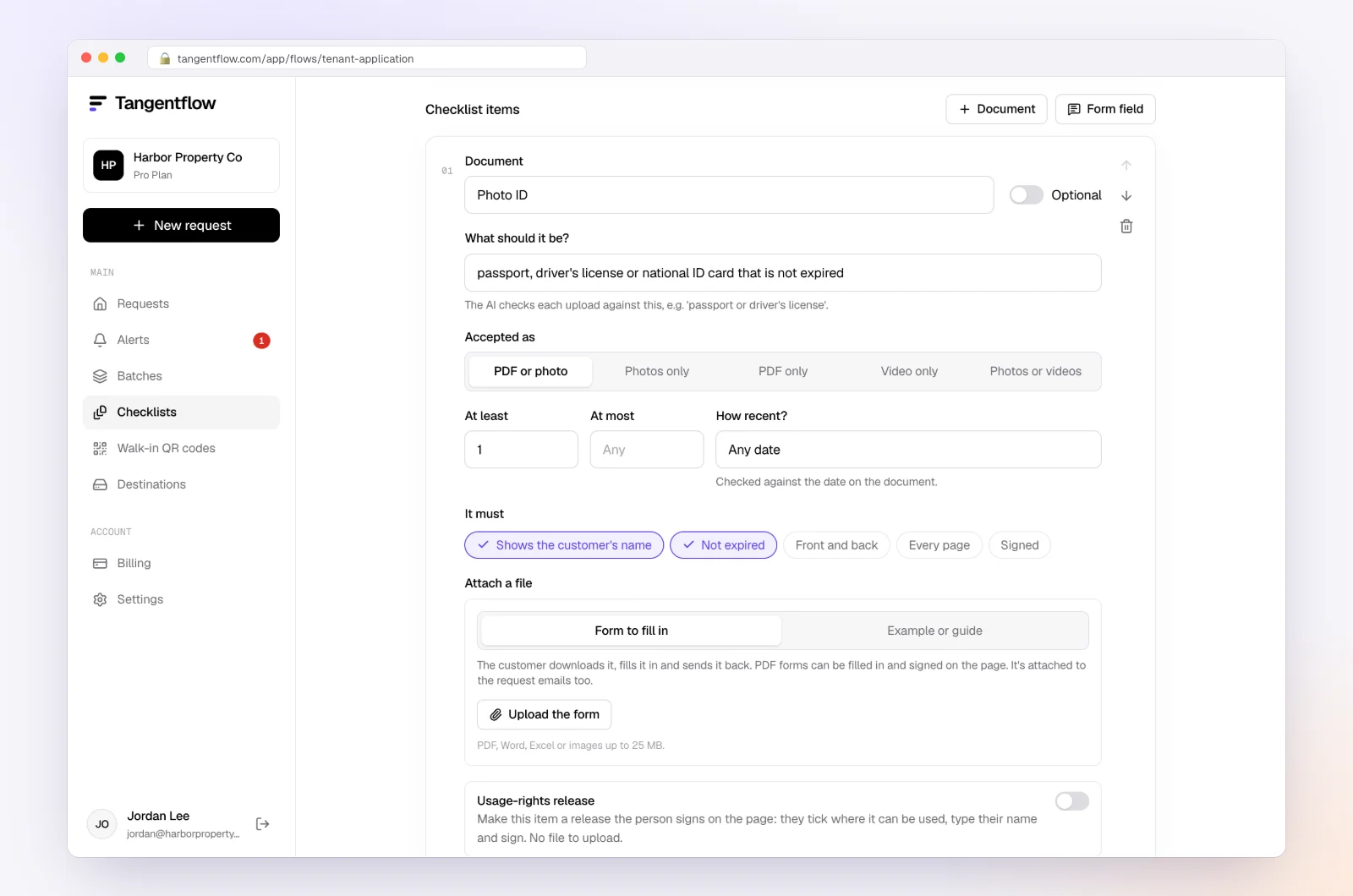
2. Tell each item what "good" looks like
Open the certificate item. In "What should it be?" write something like "[State] sales tax exemption certificate, fully completed with permit number and reason for exemption, signed and dated." Turn on signed. Add a tip in the customer's words: "This is the form you fill in and sign, not a photo of your permit card. Your permit number goes in the box labeled [field]."
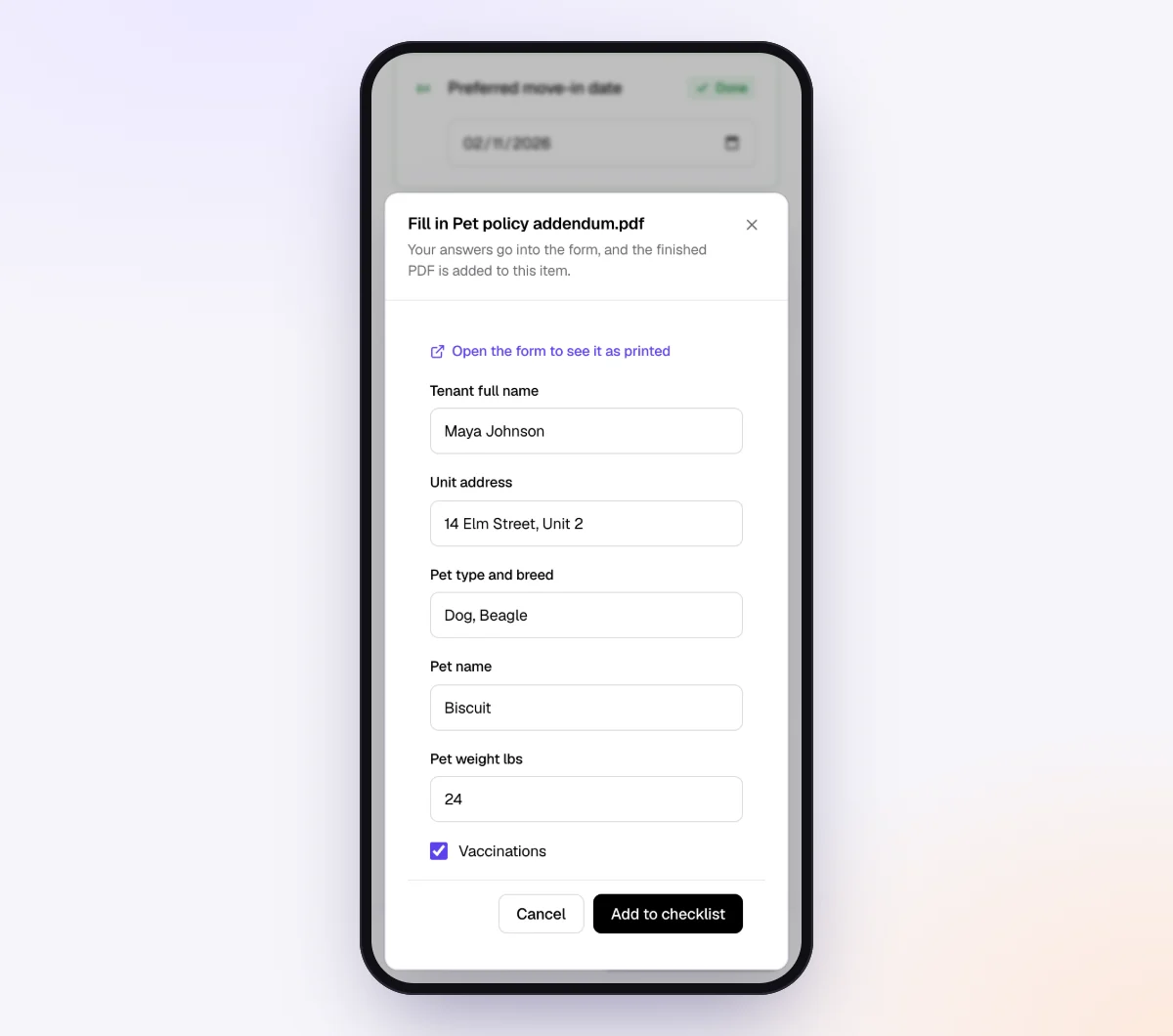
Because the official certificate is attached as a fillable PDF, the customer fills in the boxes and draws their signature on the page, and the completed, signed PDF is what you get back. See forms and e-signatures and our guide to collecting signed forms online.
Under "Notes for the agent (private)", add the answers customers ask for most, such as "A 501(c)(3) letter is not enough; we need the state exemption certificate or the state's exemption letter." The agent answers from your checklist and notes, and hands anything else to you.
3. Create the request
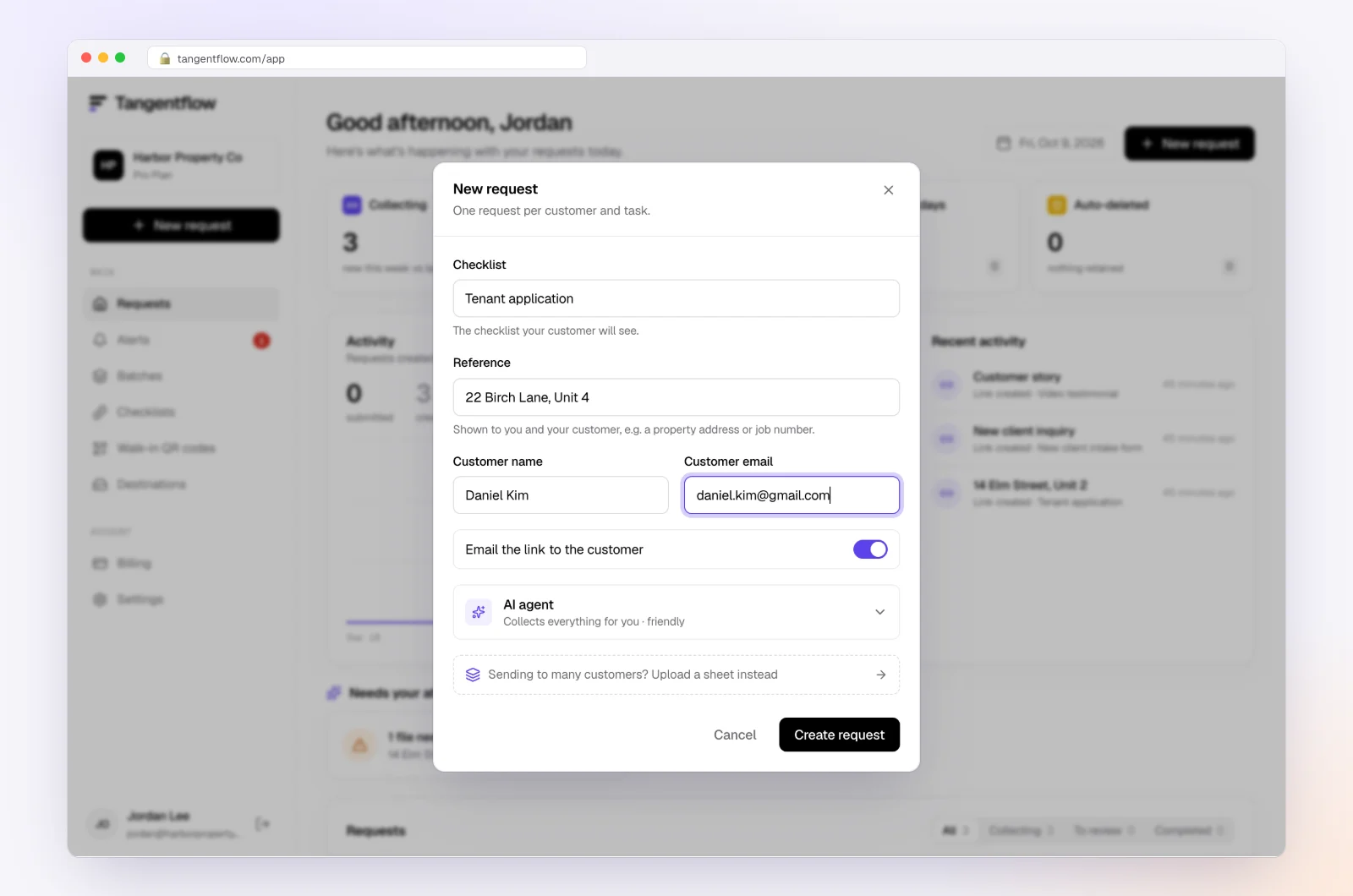
Go to Requests and click "New request." Choose the checklist, add a reference such as "Riverside Garden Center, TX resale," the customer's name and email, and a needed-by date before their first order ships. Leave "Email the link" on so the agent sends the invitation from your business name. Consider "Require an email code" on the checklist, so the link opens only after the customer enters a 6-digit code sent to their email.
4. Problems are caught while the customer is still on the page
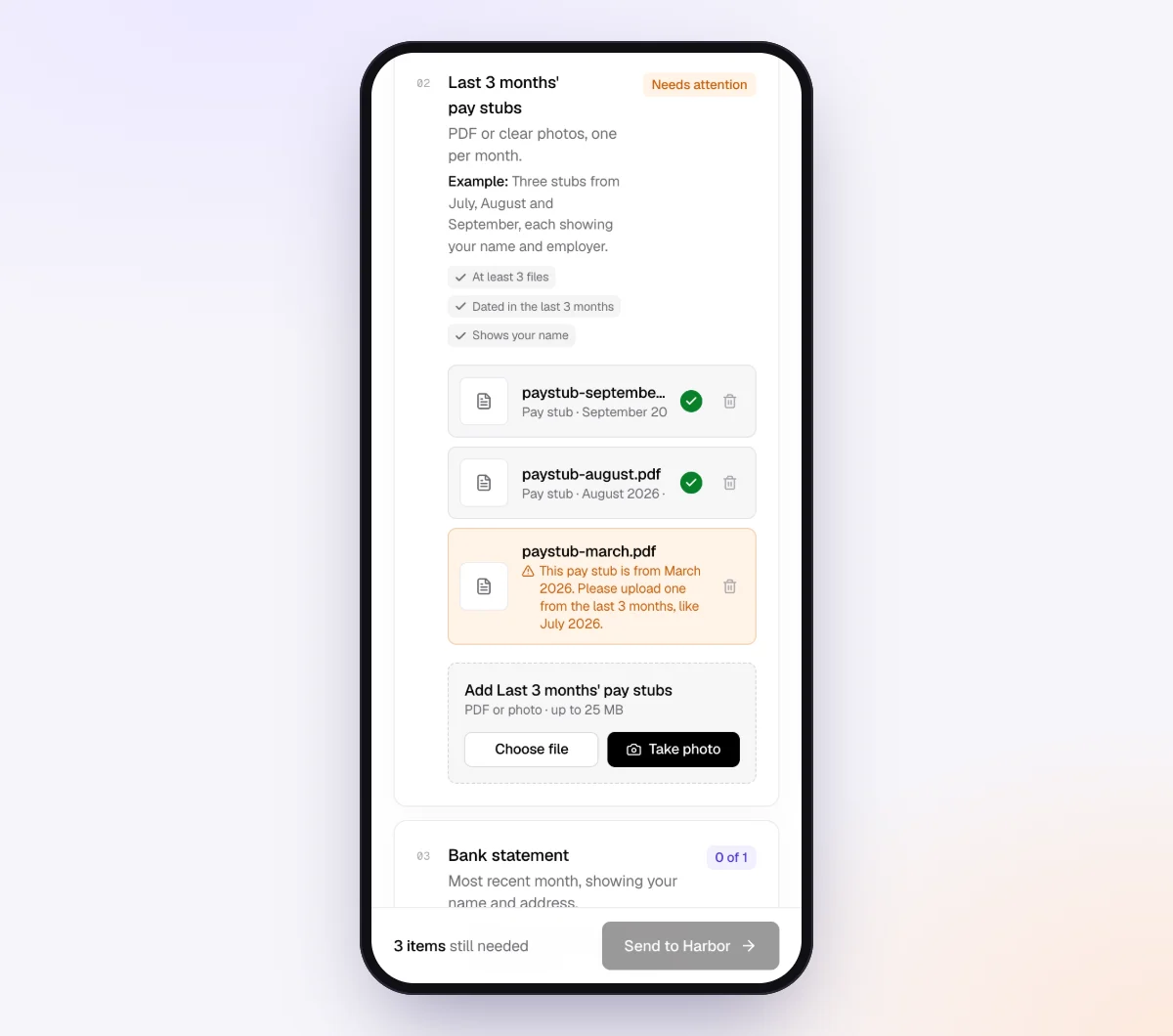
The customer opens the link on a phone, answers the questions, and fills in and signs the form. Document checks compare each upload with your description. A photo of a permit card instead of the certificate, an unsigned form or a file that does not look like the state's certificate gets a friendly note explaining what to fix, and the customer can correct it before leaving.
5. Review, record and let the copy disappear
Your request page shows every file with its check result, what is missing and an activity timeline. Read the certificate against the validity checklist above, and use "Ask for changes" if, say, the reason box is blank. When everything is in, download the ZIP package, or on Pro deliver to Google Drive or a webhook, and file the certificate in your accounting or tax system against the customer account. From the request's menu, download the "Evidence index (CSV)": one row per item and file, with the status, time received, check result and the customer's answers. Paste those rows into your certificate register. Then flip the customer to exempt, mark the request complete, and the collection copies are deleted 24 hours later.
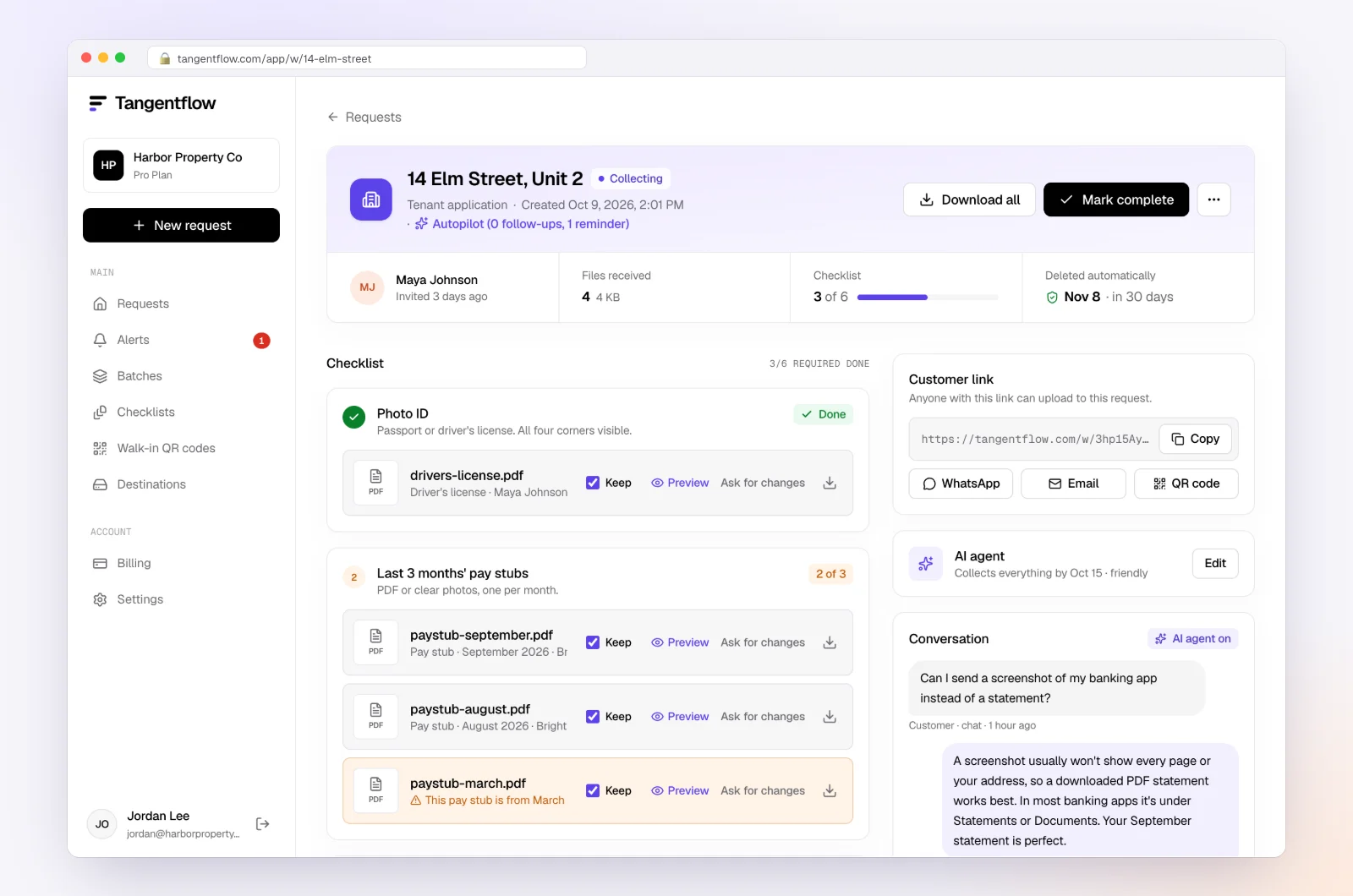
The agent paces reminders to the needed-by date, at most one automatic email a day, each listing only what is still missing, and hands off to you in "Alerts" when a deadline passes or a customer asks something outside your checklist. On Pro, customers can reply to the email with the signed form attached, accepted only from their address on file. If a link went to the wrong contact, use "Reset link" so the old one stops working, and after the customer sends everything the link no longer shows the files.
Renewals and audit prep
Getting the first certificate is the easy part. The register is what saves you in an audit, and it only works if someone owns it.
When certificates expire
It varies by state, and the differences are large, so check each state you sell into. Two verified examples:
- Florida issues an Annual Resale Certificate that expires every December 31. New certificates are available each November for the following year, and sellers can verify a customer's certificate through the Department of Revenue.
- Texas uses Form 01-339, which the buyer completes. It has no set expiration as long as the buyer's permit stays active and nothing on the form changes.
Streamlined member states generally treat a blanket certificate as valid until it is revoked or the information on it changes, and the MTC's notes say some states require periodic replacement of the multijurisdiction certificate. Where a state sets no expiration, many sellers refresh certificates every three to five years as a matter of policy, so names and permit numbers on file are not a decade old. Set that cycle with your advisor.
The tracking table
Keep one row per customer per state. A spreadsheet is fine.
| Customer | State | Certificate type | Reason | Permit or exemption number | Signed date | Expires or refresh by | Blanket or single | Where filed | Status |
|---|---|---|---|---|---|---|---|---|---|
| Riverside Garden Center | TX | 01-339 resale | Resale | 1-XXXXXXX-X | 2026-02-14 | Refresh 2029-02 | Blanket | Accounting system, customer file | Valid |
| Harbor Bay Retail LLC | FL | Annual Resale Certificate | Resale | XX-XXXXXXXXXX-X | 2026-01-05 | 2026-12-31 | Blanket | Accounting system, customer file | Renewal due |
Names, numbers and states are illustrative. The "Expires or refresh by" column is the one you sort by.
A monthly and annual routine
- Monthly: sort the register by "Expires or refresh by" and pull everything due in the next 60 days. Send one request per customer, due two weeks before the expiration.
- Each November: for calendar-year states such as Florida, send a batch to every affected customer with a mid-December needed-by date, so the new certificate is in before January sales.
- Each quarter: reconcile the register with your sales data. Any customer with untaxed sales and no row gets a request the same day, and their account goes back to taxable until the form is in.
- Before any audit: export the register, pull the certificates it points to, and check each against the validity checklist. If your state allows a window to obtain missing certificates after an audit request, use it immediately.
In Tangentflow, the annual renewal is a Batch: in "Batches," choose "Send to many customers," paste the rows for the customers due (name, email, state, due date), and each gets their own link and reminder schedule. See bulk requests.
A note for Canadian businesses
Canada works differently, and a shorter process applies.
- GST/HST has no resale certificate system. A registered business charges GST/HST on taxable sales to other businesses, and the buyer recovers it through input tax credits on its own return. The everyday "reseller" exemption US sellers know does not exist for GST/HST. Our post on GST/HST receipt requirements for ITCs covers what a buyer needs from you instead.
- Provincial sales tax is where certificates show up. British Columbia, Saskatchewan and Manitoba each run their own PST, and each lets registered resellers buy goods for resale without PST. In BC, a registered buyer generally provides its PST number, and a buyer not required to register can complete a Certificate of Exemption, General (FIN 490). Saskatchewan and Manitoba generally require the buyer's vendor or registration number on the invoice or a provincial exemption form. The forms and how long they are good for differ, so check the province's PST bulletins or ask your accountant.
- Indigenous purchasers. GST/HST and provincial relief for status Indians and bands depends on the purchaser holding a Certificate of Indian Status and, for goods, on delivery to a reserve, with the vendor keeping specific records. The conditions differ between federal and provincial rules, so follow CRA guidance and check the province.
A Canadian seller using Tangentflow can attach the province's exemption form as a "Form to fill in" and add a question for the PST number, the same way a US seller attaches a state certificate.
When something goes wrong
| Problem | Likely cause | Fix |
|---|---|---|
| Certificate names a different state | Customer sent their home-state form for a sale sourced elsewhere | Ask for the correct state's form, or a multistate form that state accepts; keep the account taxable until it arrives |
| Missing signature | Customer filled in the fields and skipped the bottom | The check flags it at upload; otherwise use "Ask for changes" and point to the signature line |
| Permit number blank, "applied for," or shown as expired in the state's lookup | New business, or a lapsed registration | Charge tax until a completed form carries an active permit number |
| Customer sends a photo of the permit card | They think the card is the certificate | Reply with the form link and a one-line explanation; the AI check flags this on upload |
| Customer sends a 501(c)(3) letter | They assume federal status equals sales tax exemption | Ask for the state exemption certificate or the state's exemption letter; in most states the federal letter is not enough |
| Customer refuses to provide a certificate | Does not want to share the number, or is not actually exempt | Charge tax on every sale. They can apply to the state for a refund if they were entitled to the exemption |
| Link went to the wrong contact | Typo in the email, or a shared mailbox | "Reset link" on the request so the old one stops working, then resend |
Check "Alerts" daily during onboarding season and the November renewal batch. That is where handoffs and missed deadlines show up, so you only spend time on the customers who need a person.
Free and Pro, honestly
You can run a real request without paying anything.
| Free | Pro ($29/month) | |
|---|---|---|
| Open requests | 1 at a time | Unlimited |
| AI check on each file | Yes | Yes |
| AI autopilot (answers, reminders, follow-ups) | Your first request | Every request |
| Customers reply by email with attachments | No | Yes |
| Branding | Tangentflow badge | Your logo |
| Delivery to Google Drive or a webhook | No | Yes |
| Works with AI assistants (MCP) | No | Yes |
| File retention | 7 days | 60 days |
Both plans include unlimited checklists, QR codes and posters, ZIP export, AI summaries, the Evidence index and email delivery. Pro is billed monthly with no contract, and you can cancel any time. The annual renewal batch to many customers is really a Pro workflow. Full details on the pricing page, and how files are protected on our security page.
What Tangentflow does not do: SMS or text messages, a native mobile app, full legal e-signature certificates, identity verification, collecting payments, or permanent storage. If you need any of those, pair it with a tool that does. It also does not calculate sales tax, validate permit numbers with a state, track certificate expiration dates or integrate with a tax engine.
The whole process as a checklist
- Set every new customer account to taxable until a valid certificate is on file.
- Decide which forms you accept for each state you sell into, including the Streamlined and MTC multistate forms, and confirm on the state's website.
- Request the certificate at onboarding, before the first untaxed sale, with the right form attached and "complete" spelled out.
- Send one private link per customer, not "email me your tax exempt form."
- Check each certificate on arrival: correct state form, names, permit or exemption number, reason box, signature, date, plausibility, and verify the number through the state's lookup where one exists.
- Record every certificate in a register with its expiration or refresh date and where it is filed, then let the collection copy delete.
- Review the register monthly, batch renewals each November for calendar-year states, and reconcile it with untaxed sales each quarter.
- Charge tax on anything that does not fit the certificate, and on any customer who will not provide one.
- In Canada, charge GST/HST as usual and collect PST numbers or provincial exemption forms only where BC, Saskatchewan or Manitoba rules call for them.
Frequently asked questions
Do I need an exemption certificate for every tax-exempt customer?
Yes, for every customer you sell to without charging sales tax, in every state where you make untaxed sales to them. A blanket certificate covers repeat purchases of the same kind, so you usually need one per customer per state rather than one per invoice. Without a certificate on file, the state generally treats the sale as taxable and assesses the tax to you.
What happens in a sales tax audit if I do not have a certificate?
Untaxed sales with no valid certificate behind them are generally assessed to the seller, with interest and often penalties. Some states, including those that follow the Streamlined agreement, give sellers a window after an audit request to obtain missing certificates, but you cannot count on customers from three years ago responding.
Is a sales tax permit the same as an exemption certificate?
No. The permit shows that the customer is registered to collect sales tax. The exemption certificate is the customer's signed statement that a purchase, or all purchases of a type, qualifies for an exemption, and it is what you must keep. The permit number usually goes on the certificate, but the certificate is the document.
How often do exemption certificates need to be renewed?
It depends on the state. Florida's annual resale certificate expires every December 31, while Texas's resale certificate has no set expiration as long as the buyer's permit stays active and the details on the form are unchanged. Where no expiration is set, many sellers refresh certificates every few years as a matter of policy. Keep the expiration or refresh date in your register for every certificate you hold.
Is a 501(c)(3) determination letter enough to sell tax-free to a nonprofit?
In most states, no. Federal income tax exemption and state sales tax exemption are separate, and many states require the nonprofit to hold a state-issued exemption certificate or number, which some states do not grant to nonprofits at all. Ask for the state's exemption certificate or exemption letter and check the state's rules for that type of organization.
Does Tangentflow validate the permit number or calculate tax?
No. Tangentflow collects the completed, signed certificate through a private link, flags uploads that are unsigned or that look like a permit card photo instead of the form, reminds the customer until it is in, and gives you an Evidence index of what arrived and when. It does not verify numbers with a state, decide whether an exemption applies, or connect to a tax engine. You verify and decide.
Is there a free way to try this?
Yes. The Free plan gives you one open request at a time with the full AI agent on your first request, including the fillable certificate and the on-upload check. Try it free with one new wholesale customer.