Guides
How to Collect Certificates of Insurance From Subcontractors (2026)
How to collect certificates of insurance from subs and vendors: what to require, what to check on every ACORD 25, endorsements, renewals and a request email.
By Bibin MathewUpdated 19 min read
The short answer
Write your insurance requirements down before you ask, then send every subcontractor or vendor one specific request with a needed-by date before they start work. Check each certificate the day it arrives: the named insured, policy dates, limits, certificate holder and description of operations, and ask for the actual endorsements when your contract requires additional insured status. Keep a list of expiration dates and request a fresh certificate before each policy renews.
Nobody gets into contracting or property management because they love paperwork. But a single missing certificate of insurance can turn a small accident on site into your problem instead of your subcontractor's. Most businesses still end up with the same mess: a folder of PDFs, some expired, some made out to the wrong company, a few promised "by Friday" that never came.
This guide is for anyone who hires other businesses to do work on their property or under their contract: general contractors, property managers, event venues and facilities teams. If roofers, electricians, cleaners, caterers or landscapers need to prove insurance before they set foot on site, it is for you.
You will get what a certificate of insurance (COI) is and is not, what to require, a review checklist, a renewal routine, a request email to copy, an honest comparison of tools and a step-by-step setup in Tangentflow.
What a certificate of insurance is (and what it is not)
A certificate of insurance is a one or two page summary, issued by the subcontractor's insurance agent or broker, that says which policies they have, with which insurers, for which dates and with which limits. It exists so you do not have to read the full policy.
In the US, the standard form for liability coverage is the ACORD 25, Certificate of Liability Insurance. It lists the producer (the agent or broker), the insured, the insurers lettered A, B, C, one row per policy (general liability, auto, umbrella, workers' comp) with policy numbers, dates and limits, the ADDL INSD and SUBR WVD boxes, a free-text description of operations, the certificate holder (that should be you) and a short cancellation statement.
In Canada, you will usually see a certificate on a CSIO form (the Canadian insurance industry standards body whose forms many brokers use) or on the broker's or insurer's own letterhead. The information is similar: named insured, insurer, policy numbers, dates, limits, additional insureds and the certificate holder. Workers' compensation works differently in Canada, so it is usually proven separately with a clearance from the provincial board rather than on the certificate itself (more on that below).
The most important thing on the form is the small print
The ACORD 25 says, near the top, that the certificate is issued as a matter of information only and confers no rights upon the certificate holder. It also says that if the certificate holder is an additional insured, the policy must be endorsed, and that a statement on the certificate does not confer rights in place of that endorsement.
In plain English: the certificate is a snapshot that says "this coverage exists." It is not the coverage. A ticked "ADDL INSD" box does not, on its own, make you an additional insured. The endorsement attached to the policy does. Canadian certificates typically include a similar disclaimer.
COI vs. endorsement: what each one proves
| Document | What it is | What it proves | When to ask for it |
|---|---|---|---|
| Certificate of insurance (ACORD 25 or CSIO form) | Summary issued by the agent or broker | That policies exist, for these dates and limits, as of the day it was issued | Every sub or vendor, before work starts and at every renewal |
| Additional insured endorsement | A page that changes the policy itself | That your business is covered under their policy for claims arising from their work | When your contract requires additional insured status |
| Waiver of subrogation endorsement | A page that changes the policy | That their insurer gives up the right to recover from you after paying a claim | When your contract requires it |
| Primary and non-contributory wording | Endorsement or policy language | That their policy pays first and does not expect your policy to share the loss | When your contract requires it |
Additional insured status means the sub's insurer may defend and cover you for claims arising from their work. In the US, you will often see standard ISO forms such as CG 20 10 (ongoing operations) and CG 20 37 (completed operations), or a blanket endorsement that covers anyone "where required by written contract." Blanket forms can be fine, but you then need a written contract that requires it and a copy of the endorsement to read.
A waiver of subrogation means the sub's insurer agrees not to try to recover a paid claim from you. Primary and non-contributory wording means their policy pays first and does not ask yours to share the loss. In each case, the contract asks for it and the endorsement delivers it.
What to require from subcontractors and vendors
Put your requirements in the subcontract or vendor agreement before you ask, or every agent will send whatever they usually send. The limits below are examples of what you may see in contracts, not a recommendation; set yours with your broker or lawyer.
| Coverage | What it covers | Example requirement you may see | Who usually needs it |
|---|---|---|---|
| Commercial general liability (CGL) | Injury to others and damage to property caused by their work | $1M per occurrence / $2M aggregate in the US; $2M to $5M per occurrence is common in Canadian contracts | Almost every sub or vendor on site |
| Commercial auto liability | Accidents involving their vehicles | $1M combined single limit | Subs with work vehicles, movers, delivery |
| Workers' comp and employers' liability (US) | Injuries to their own employees | Statutory workers' comp; employers' liability limits such as $500K or $1M | Subs with employees |
| Workers' comp clearance (Canada) | Proof of registration and good standing with the provincial board | A current clearance for the contract | Contractors in covered industries, per province |
| Umbrella or excess liability | Extra limits above GL, auto and employers' liability | $1M to $5M, higher for big or risky jobs | Larger or high-risk jobs |
| Liquor liability | Claims arising from serving alcohol | Often matches the GL limit | Caterers and bar services at events |
Workers' comp in the US and Canada
In the US, workers' compensation rules are set by each state. Most employers with employees must carry it, but who is exempt (sole proprietors, owners, very small employers) varies by state, and some states issue exemption certificates. If a sub says they have no employees, ask for your state's exemption document if one exists, and check with your own carrier, since premium audits can charge you for uninsured subs.
In Canada, workers' compensation is run by provincial and territorial boards, and the proof is usually a clearance issued by the board, not a line on the certificate. In Ontario it is a WSIB clearance certificate, which the WSIB describes as valid for up to 90 days and renewable. In British Columbia it is a WorkSafeBC clearance letter, and in Alberta a WCB-Alberta clearance letter. The idea is similar everywhere: if a contractor does not pay premiums, the board can in some cases look to the business that hired them, and a valid clearance protects you for its validity period. Rules vary, so check your board's official page.
What to check on every certificate of insurance
Most COI problems are on the face of the form, and they get missed because nobody looks until there is a claim. Read every certificate against this list the day it arrives.
| Check | What to look for | Common problem |
|---|---|---|
| Named insured | The exact legal name of the company you contracted with | A personal name, a DBA or a sister company that is not the one on your contract |
| Policy dates | Effective dates that cover the work, expiration dates in the future | A certificate from last year, or a policy that expires mid-job |
| Coverage types | Every coverage your contract requires has its own row | Auto or workers' comp missing entirely |
| Limits | Each limit meets or exceeds your requirement | Aggregate too low, umbrella missing |
| Insurer | A real insurer listed for each policy | Blank insurer letters, or a policy number with no insurer |
| ADDL INSD and SUBR WVD | Ticked for the lines where your contract requires them | Boxes ticked but no endorsement provided |
| Certificate holder | Your exact business name and address | Another GC's name, a generic "To whom it may concern" |
| Description of operations | Your project, property or event, and references to the endorsements | Empty, or describing a different job |
Two habits help: compare against the contract, not memory, and call the producer listed on the certificate when anything looks off, including mismatched fonts or odd dates. Agents confirm certificates all the time.
Expiration dates and renewal chasing
Getting the first certificate is the easy part. Every policy expires, usually yearly, and each sub's policies renew on different dates. A routine that works with or without software:
- Record every expiration date when you approve a certificate: company, coverage, policy end date. One row per coverage, because GL and workers' comp often expire on different days.
- Review the list once a month. Pull every policy expiring in the next 30 to 45 days.
- Request the renewed certificate early. Agents can usually issue a new certificate once the renewal is bound, which is often a few weeks before the expiration date.
- Set a needed-by date a week before expiration, so a slow agent does not leave you uncovered.
- Decide what happens if it does not arrive. Many contracts let you hold payment or stop work until current proof is provided. Say so in the request, politely.
The certificate's cancellation box usually says notice will be delivered "in accordance with the policy provisions." Do not count on being told if a sub's policy is canceled mid-term; on long jobs, a mid-job check is reasonable.
For pacing the follow-ups themselves, our client reminder schedule has example schedules for short and long deadlines.
COI request email template
The fastest certificates come from requests that say exactly what you need, who it should name and by when. Copy this and adjust it to your contract.
Subject: Certificate of insurance needed by [date] for [project or property]

Hi [First name],

Before your team starts at [project or property] on [start date], we need
current proof of insurance. Please ask your insurance agent to send:

1. A certificate of insurance (ACORD 25 in the US) showing:
   - Named insured: [their legal company name, as on our agreement]
   - General liability: [limits from your contract]
   - Auto liability: [limits from your contract]
   - Workers' comp and employer's liability: [requirement]
   - Umbrella / excess: [limits, if required]
   - Certificate holder:
     [Your legal business name]
     [Your address]
   - Description of operations: [project or property name]
2. The additional insured endorsement naming [your business and the
   owner, if required], plus waiver of subrogation and primary and
   non-contributory wording if our agreement requires them.
3. [Canada: a current workers' comp clearance from your provincial board]

Please send everything by [date, a few days before the start date].
Upload it here: [link]

Not sure? Forward this email to your insurance agent.

Thanks,
[Your name]
[Business name]
For renewal nudges and thank-you notes, adapt our our document request email templates.
Three ways to collect and track COIs, compared
| Approach | Best for | Cost | Getting COIs in | Review | Expiration tracking |
|---|---|---|---|---|---|
| Email and a spreadsheet | A handful of regular subs | Free | Manual requests and follow-ups | You read every certificate | Manual, as good as the person updating it |
| Dedicated COI tracking software | Dozens to thousands of vendors, strict compliance programs | Usually priced per vendor or by quote | Often includes outreach to vendors and agents | Some offer coverage review, sometimes by people | Built in, with renewal requests |
| A document collection tool with checklists (such as Tangentflow) | Small and mid-size teams who need COIs plus other paperwork before work starts | Free to start, $29/month Pro | Private link, paced reminders, instant document checks | An AI check flags expired or wrong documents; you review coverage | Not built in; you keep the dates and send a new request at renewal |
A spreadsheet is honestly fine for ten regular subs. COI tracking software is the right choice if you manage hundreds of vendors or an owner or lender audits your compliance. A collection tool shines at the front of the process: getting the COI, endorsement, W-9 and agreement from a new sub in one go, without chasing by hand.
How to collect certificates of insurance in Tangentflow, step by step
Tangentflow sends each subcontractor or vendor one private link with a checklist of exactly what you need, checks every upload in seconds, and lets an AI collection agent send the invitation, answer questions and remind them until everything is in.
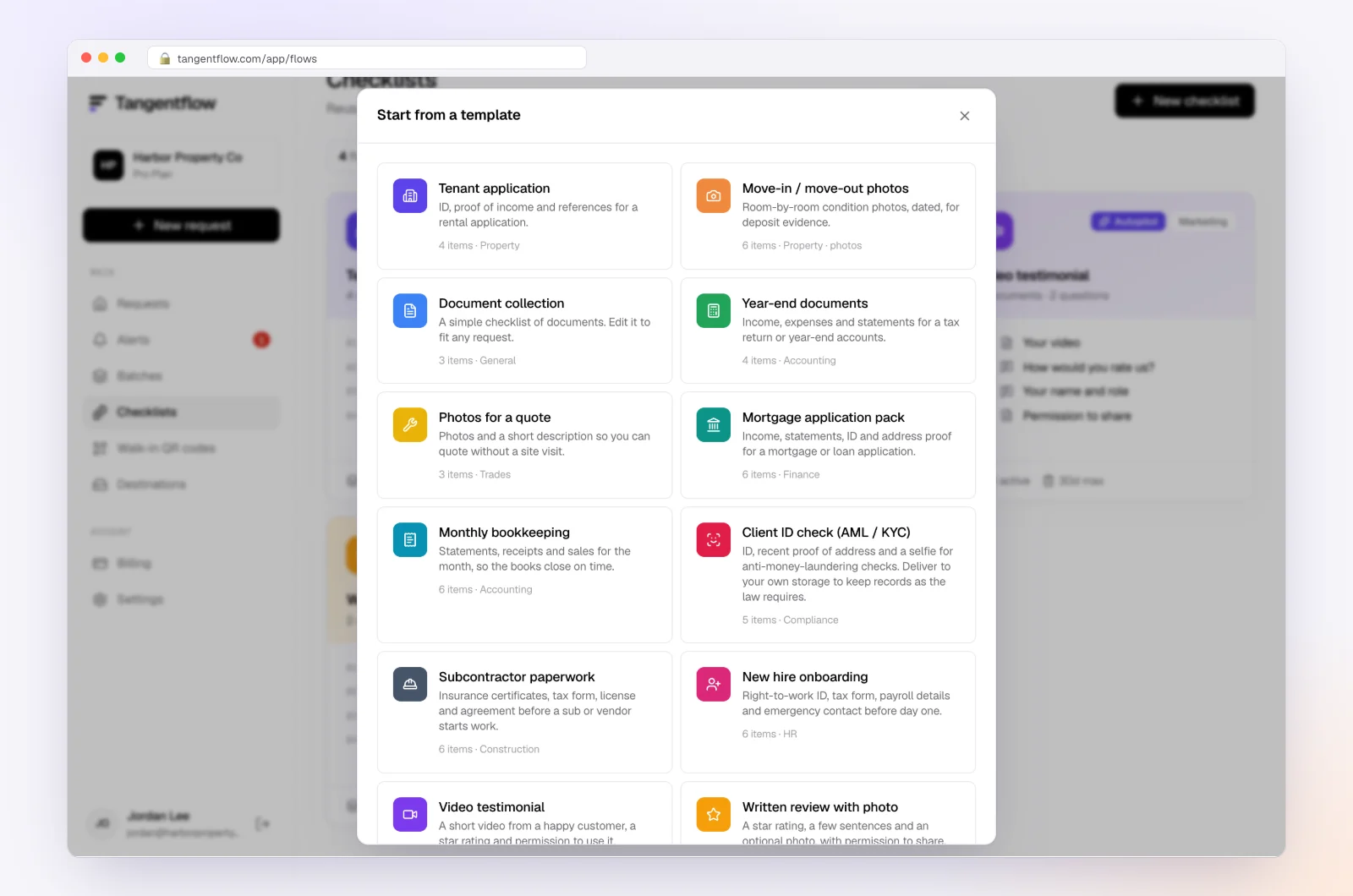
1. Start from the Subcontractor paperwork template
Go to Checklists, choose "Browse templates" and pick "Subcontractor paperwork." It comes with items for a certificate of insurance, workers' comp or employer's liability, a tax form (W-9 in the US), a trade license, a signed agreement and a company and site contact question.
2. Match the items to your contract
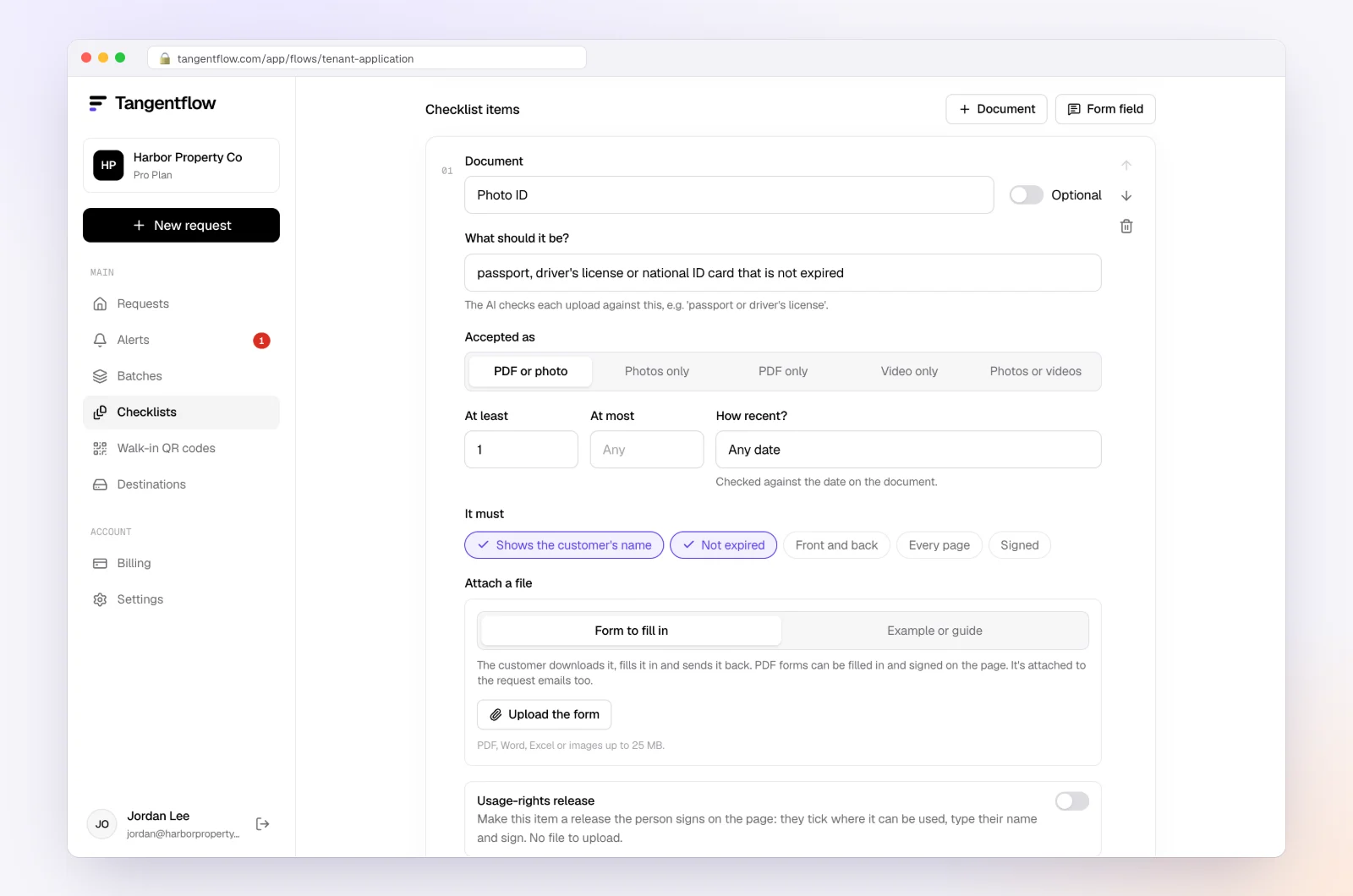
Open each item in the checklist editor and make it specific:
- In "What should it be?" for the certificate, describe what good looks like: "certificate of liability insurance with future expiration dates, general liability at least [your limit], certificate holder [your business name]."
- Keep "Not expired" on, so a certificate with expired policy dates gets flagged.
- Keep "Shows your name" on. It checks for the customer's own name, so enter the subcontractor's legal company name as the customer name when you create the request.
- Add a separate item for the additional insured endorsement, and one for waiver of subrogation if your contract needs it. Mark them optional if only some jobs require them.
- In Canada, rename the workers' comp item to your provincial clearance and describe it.
Use a "Form field" with "Only ask if…" to skip what does not apply, for example requesting workers' comp proof only when "Do you have employees on site?" is yes. Your own vendor form can be attached and signed online; see forms and e-signatures.
3. Create the request with a needed-by date before work starts
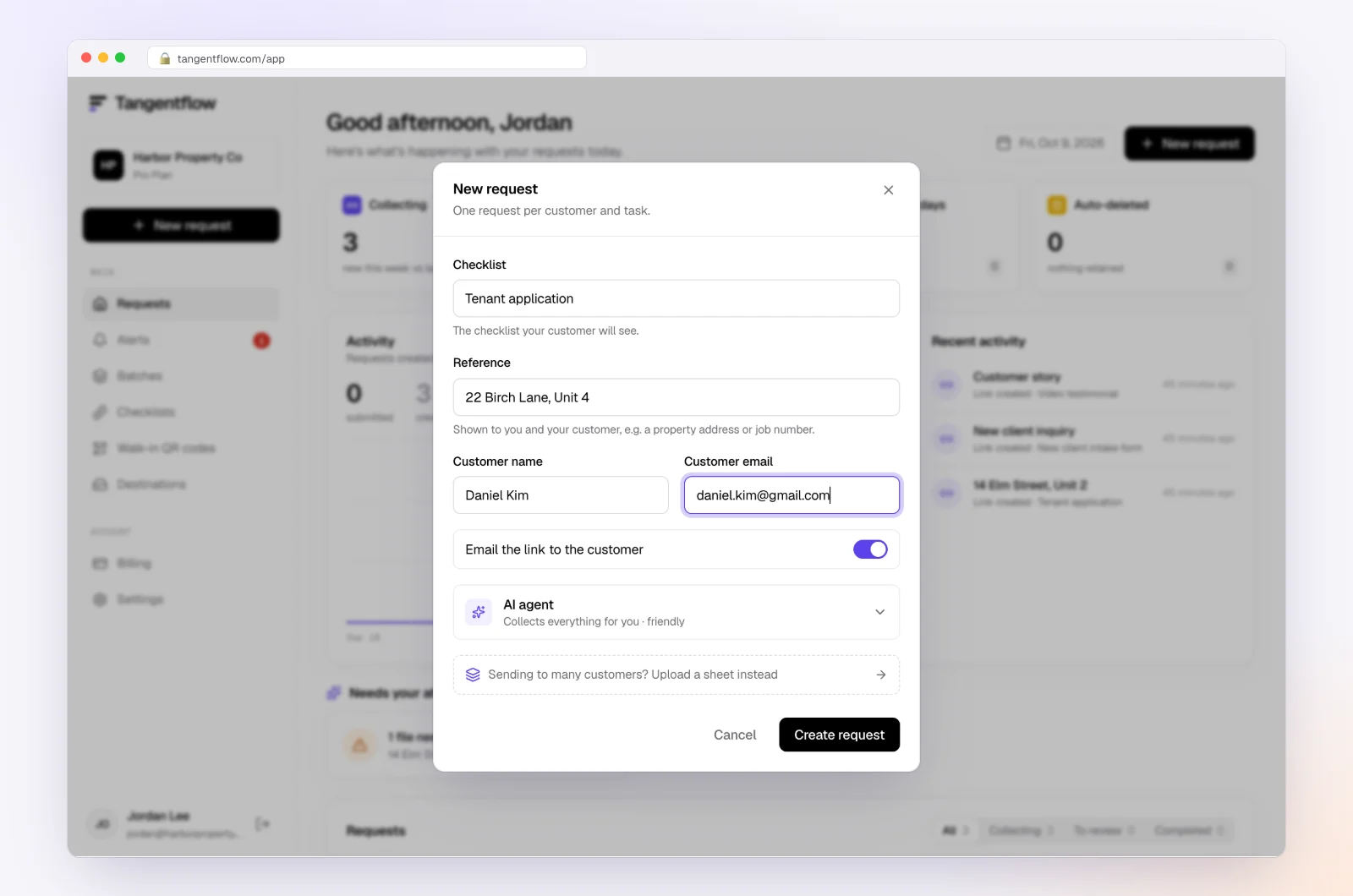
Go to Requests and click "New request." Choose the checklist, add a reference like "Maple Court roof," enter the sub's company name and email, and set a needed-by date a few days before they start. Leave "Email the link" on and the agent sends the invitation from your business name.
Many subs simply forward the request to their insurance agent. If you would rather deal with the agent directly, put the agent's email on the request and the sub's company name as the customer name.
4. The sub or their agent uploads, and problems are caught on the spot
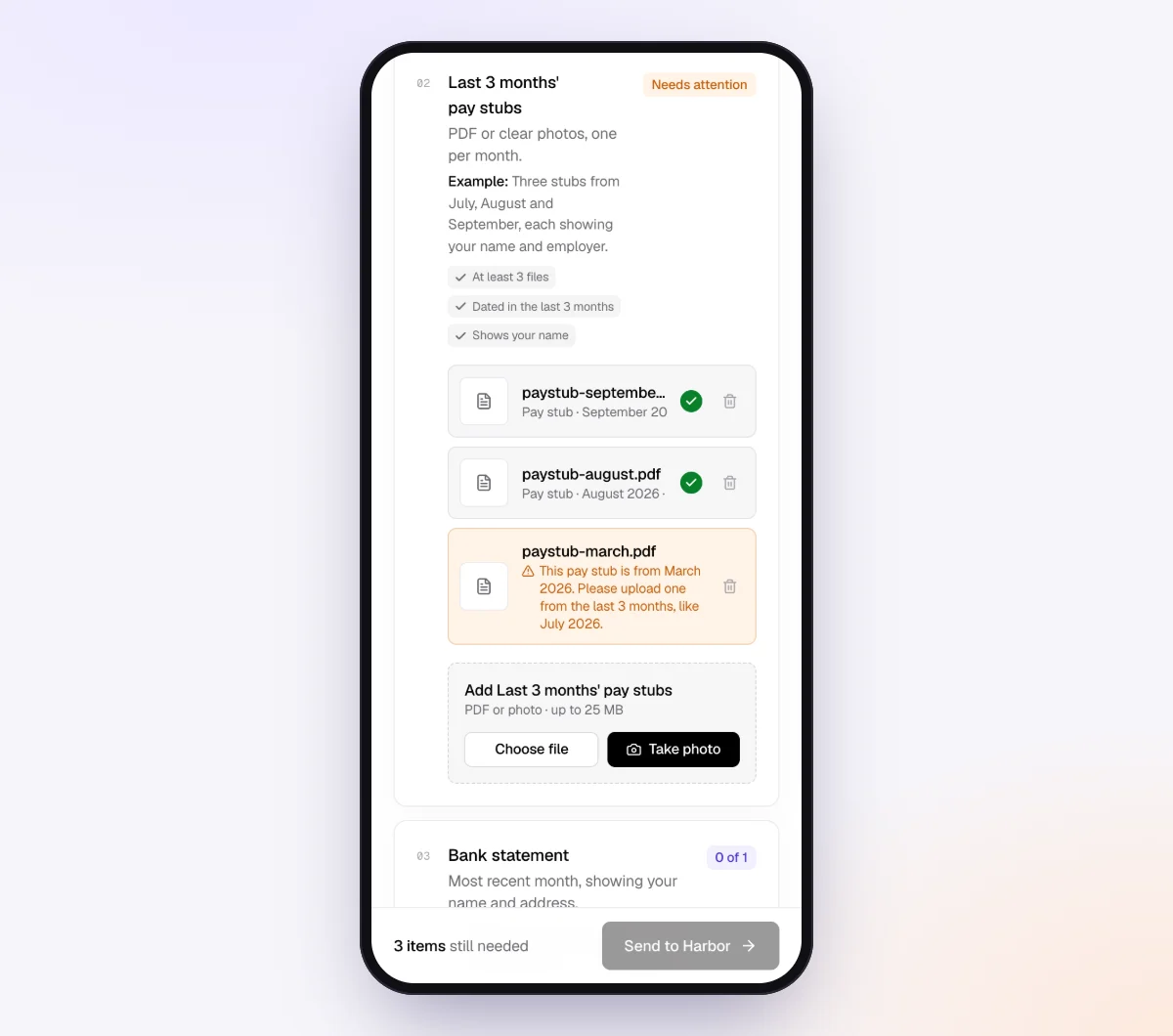
The link opens on any phone or computer, with no account or app. Each upload is checked in seconds by document checks: right document, readable, not expired, right name. If something is off, the uploader sees a friendly note and can fix it before leaving.
On Pro, subs and agents can also reply to the email with the PDF attached. Each file is checked and filed under the right item, and only replies from the address on file are accepted.
5. Review the coverage and record the expiration date
Your request page shows every file with its check result, what is missing and an activity timeline. Now do the part software should not do for you: read limits, certificate holder, description of operations and endorsement wording against your contract. Use "Ask for changes" on a single file if, say, the certificate holder is wrong.
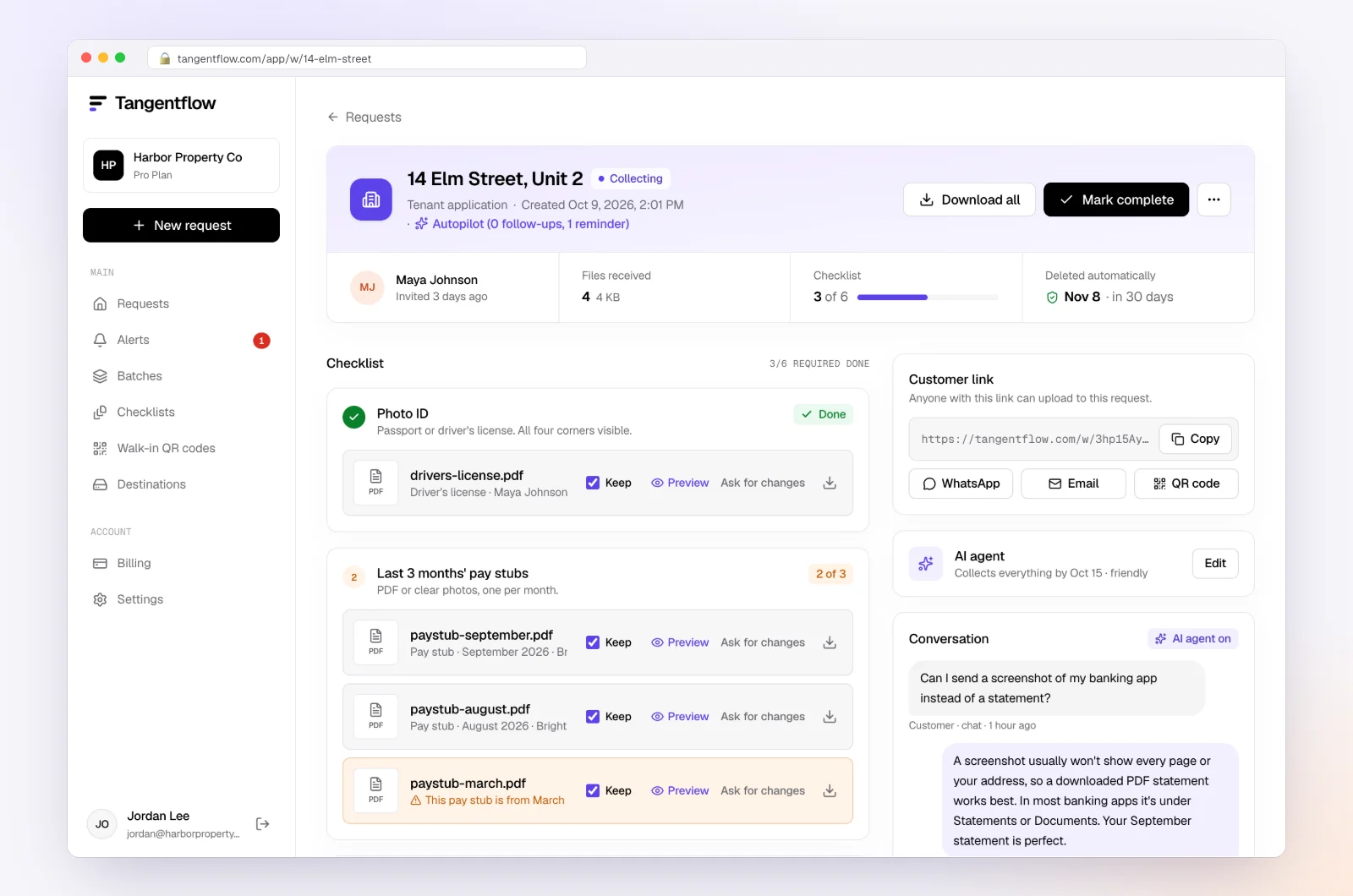
When it is all in, download the ZIP package or, on Pro, deliver it to Google Drive or a webhook, and write the policy expiration dates into your vendor list. Then mark the request complete.
What Tangentflow does and does not do for COIs
It sends each sub one private link, paces reminders to your needed-by date, answers questions from your checklist and notes, flags certificates that look expired or show the wrong name, and hands off to you in "Alerts" when a deadline passes. "Batches" sends the same checklist to many vendors at once, each with their own link and due date (see bulk requests).
A practical renewal workflow: once a month, filter your vendor spreadsheet for policies expiring in the next 30 to 45 days, paste those rows into "Batches" with a due date for each, and let the agent chase. Extra columns, like the project, become context the agent can use.
If you also collect W-9s with tax ID numbers, consider "Require an email code" on the checklist: the vendor enters a 6-digit code sent to their email before the link opens. You can reset a link sent to the wrong person, and once everything is sent the link no longer shows the files.
Setups by business
Use these as starting points for the Subcontractor paperwork template.
| Business | Items to add or change | Settings worth turning on | Learn more |
|---|---|---|---|
| General contractor | Additional insured endorsement (ongoing and completed operations), waiver of subrogation, umbrella certificate | "Not expired" on every certificate, needed-by date 3 to 5 days before mobilization | Collect documents from clients |
| Property manager | COI naming the owner and the management company, trade license | "Shows your name," a note listing both certificate holder names | Property management |
| Event venue | COI for the event date, liquor liability for bar service, signed venue rules | "Only ask if…" for liquor liability, needed-by date two weeks before the event | Collect signed forms online |
| Home services company hiring subs | COI, workers' comp or exemption, W-9, signed subcontract | "Require an email code" when collecting W-9s | Home services |
When something goes wrong
| Problem | Likely cause | Fix |
|---|---|---|
| The certificate holder is wrong | The agent reused an old certificate | Ask for changes on that file and spell out your exact legal name and address |
| Named insured does not match the contract | Different legal entity, DBA or personal name | Ask which entity is doing the work; fix the contract or the certificate before work starts |
| ADDL INSD is ticked but no endorsement | The agent thinks the box is enough | Ask the agent for the additional insured endorsement itself, or the blanket form with "where required by written contract" wording |
| Limits are too low | The sub's policy does not meet your contract | Ask whether an umbrella policy brings them up to the requirement; otherwise talk to your broker before approving |
| Sub says "I have no employees" | Owner-operator | Ask for the state exemption document or your contract's alternative, and check with your carrier |
Free and Pro, honestly
You can run a real request without paying anything.
| Free | Pro ($29/month) | |
|---|---|---|
| Open requests | 1 at a time | Unlimited |
| AI check on each file | Yes | Yes |
| AI autopilot (answers, reminders, follow-ups) | Your first request | Every request |
| Subs and agents reply by email with attachments | No | Yes |
| Branding | Tangentflow badge | Your logo |
| Delivery to Google Drive or a webhook | No | Yes |
| Works with AI assistants (MCP) | No | Yes |
| File retention | 7 days | 60 days |
Both plans include unlimited checklists, QR codes and posters, ZIP export, AI summaries and email delivery. Pro is billed monthly with no contract, and you can cancel any time. Full details on the pricing page.
What Tangentflow does not do: SMS or text messages, a native mobile app, full legal e-signature certificates, identity verification, collecting payments, or permanent storage. If you need any of those, pair it with a tool that does.
The whole process as a checklist
- Write your insurance requirements into every subcontract and vendor agreement.
- List each required document separately: COI, endorsements, workers' comp proof or clearance, W-9, license.
- Send each sub one request with your exact legal name and address for the certificate holder.
- Set a needed-by date a few days before work starts, and say what happens if it is missing.
- Remind on a schedule, listing only what is still missing.
- Check every certificate the day it arrives: named insured, dates, coverages, limits, insurer, certificate holder, description of operations.
- Read the endorsements, not just the boxes.
- Save the certificate with the job and record every expiration date.
- Review expiring policies monthly and request renewals 30 to 45 days ahead.
- Keep Canadian clearances current through long jobs.
Frequently asked questions
What is the best way to collect certificates of insurance from subcontractors?
Put your requirements in the contract, then send each sub one specific request with your exact certificate holder details and a needed-by date before work starts. Check every certificate the day it arrives, and ask for the endorsements separately when your contract requires them.
Does being listed on a COI make me an additional insured?
Not on its own. The ACORD 25 itself says it confers no rights on the certificate holder and that additional insured status requires the policy to be endorsed. Ask for the additional insured endorsement and read it, or have your broker review it.
What insurance should I require from subcontractors?
Most contracts ask for general liability, commercial auto liability, workers' compensation and employers' liability (or a provincial clearance in Canada), and often umbrella coverage for larger jobs. The right limits depend on your contract, owner or lender requirements and the risk of the work, so set them with your broker or lawyer.
Do Canadian contractors use the ACORD 25?
Often not. Many Canadian brokers use a CSIO certificate form or their own letterhead. Workers' compensation is generally proven with a clearance from the provincial board, such as a WSIB clearance certificate in Ontario or a WorkSafeBC clearance letter in British Columbia.
Does Tangentflow track COI expiration dates?
No. Tangentflow flags a certificate that looks expired when it is uploaded, but it does not track policy expiration dates over time or send renewal requests on its own. Keep expiration dates in your own list, and send a new request with a needed-by date before each renewal.
Is there a free way to try this?
Yes. The Free plan gives you one open request at a time with the full AI agent on your first request, so you can collect a real certificate from a real sub. Try it free.