Templates
Bookkeeping Engagement Letter Template (2026)
A plain-English bookkeeping engagement letter template for US and Canadian bookkeepers: scope, exclusions, client duties, fees, data and how to get it signed.
By Bibin MathewUpdated 19 min read
The short answer
A bookkeeping engagement letter says what you will do, what you will not do, what the client must provide and by when, what it costs, how data is handled and how either side can end the arrangement. The clauses that prevent most disputes are a specific scope, a clear list of exclusions (no audit, review or compilation reports, and no tax or legal advice unless you offer it), a client responsibilities clause with a document due date, and a termination clause. Use the template below as a starting point, have a lawyer in your state or province review it, and get it signed before any work starts.
Most bookkeeping disputes are not about the bookkeeping. They are about expectations. The client thought "monthly bookkeeping" included their sales tax filing. They thought you would catch the duplicate vendor payment. They expected lender reports on the 5th, even though the statements arrived on the 22nd. And when you part ways, nobody is sure how much notice is fair or who keeps the QuickBooks file.
An engagement letter settles those questions before they come up. It says, in writing the client signed, what you do, what you don't do, what they owe you in documents and money, and how either of you can walk away.
This guide is for independent bookkeepers in the US and Canada, especially those who aren't CPAs. You'll get a plain-English template, why each clause matters, optional clauses, and how to get the letter signed online.
What a bookkeeping engagement letter is
An engagement letter is a short contract, usually two to five pages, covering monthly work, a one-time cleanup or both. Many bookkeepers combine it with the proposal so the client accepts and signs in one step. That works if the signed version holds the full terms, not just a price.
What to include in a bookkeeping engagement letter
Every clause in the template below falls under one of these headings.
| Clause | What it answers | What goes wrong without it |
|---|---|---|
| Scope of services | Exactly what you do, how often, by when | "I thought that was included" |
| Services not included | What you don't do | Assumed tax filing, audits or advice |
| Client responsibilities | Documents by a date, accuracy, decisions | Late statements become your problem |
| Fees and payment | Amount, timing, method, changes | Unpaid invoices, surprise disputes |
| Late documents and catch-up work | What late documents cost | Unpaid rush and catch-up work |
| Documents and access | How files and access are shared | Passwords and statements in email |
| Confidentiality and data security | How you protect client information | Privacy complaints, weak footing after a breach |
| Records and retention | Who owns records, how long you keep copies | Fights over files at the end |
| Term and termination | How long it lasts, how to end it | Messy exits, unpaid final work |
| Limitation of liability | The cap on what you can owe | Claims larger than your fees |
| General terms and signatures | Governing law, changes, agreement | Arguments about which promise counts |
The bookkeeping engagement letter template
Copy this, replace everything in brackets and delete what doesn't apply. It is written for an ongoing monthly engagement with a small business; variations for other work are further down.
[Your business name]
[Address] | [Email] | [Phone]

[Date]

[Client contact name]
[Client legal business name]
[Client address]

Re: Bookkeeping engagement letter

Dear [Client contact name],

Thank you for choosing [Your business name]. This letter sets out the
services we will provide, what we need from you, our fees and the terms
of our work together. Please read it and sign below if you agree.

1. SERVICES WE WILL PROVIDE

Starting with the month of [first month and year], we will:

- Record and categorize transactions for the business bank and credit
  card accounts listed in Schedule A, in [QuickBooks Online / Xero].
- Reconcile those accounts to the statements you provide each month.
- [Enter bills and track accounts payable.] [Optional]
- [Process payroll through [provider].] [Optional]
- [Prepare and file [sales tax / GST/HST] returns for
  [jurisdictions].] [Optional, only if you offer it]
- Prepare a monthly profit and loss statement and balance sheet within
  [10] business days after we receive complete documents for the month.

Services not listed here are not included. If you ask for additional
work, we will tell you the fee and confirm it in writing before
starting.

2. SERVICES NOT INCLUDED

Unless we agree otherwise in writing, our services do not include:

- An audit, review, compilation or any other assurance report. We do
  not express an opinion or any assurance on your financial
  statements, and they should not be presented to others as audited,
  reviewed or compiled.
- Preparing or filing income tax returns, or tax advice.
- Legal, investment or valuation advice.
- Searching for fraud, theft or errors. We will tell you about
  anything unusual we notice, but our work is not designed to find
  them.
- Making management decisions or approving transactions for you.
- Bookkeeping for periods before [first month and year].

3. YOUR RESPONSIBILITIES

You agree to:

- Provide complete statements for every account in Schedule A,
  receipts, bills, sales and payroll reports, and any other documents
  we request, by the [7th] day of each month for the previous month.
- Make sure the information you give us is accurate and complete. We
  rely on it and do not verify it independently.
- Answer our questions about transactions within [5] business days.
- Tell us promptly about new accounts, loans, large purchases,
  ownership changes or new employees.
- Review the monthly reports and tell us about any errors within [30]
  days.
- Keep your own copies of your records.
- Make all management decisions and maintain your internal controls.

4. FEES AND PAYMENT

Our fee is [$amount] per month for the services in Section 1, plus
applicable taxes. We invoice on the [1st] of each month, and payment is
due within [number] days by [ACH / card / e-transfer].

The fee assumes up to [number] transactions and [number] accounts per
month. If your volume grows significantly, we will agree a new fee with
you before it applies. We may change our fees with [30] days' written
notice. If an invoice is more than [number] days overdue, we may pause
work until it is paid.

5. LATE DOCUMENTS AND CATCH-UP WORK

[Your late document clause: the due date, what happens when documents
are late, and any rush or catch-up fee.]

6. DOCUMENTS AND ACCESS

Please send documents through the secure link we provide, not by
regular email. We will never ask for your banking or software
passwords. Instead, please invite us as an accountant or read-only
user where your bank or software allows it. You agree that we may
communicate and exchange documents with you electronically.

7. CONFIDENTIALITY AND DATA SECURITY

We will keep your information confidential and use it only to provide
our services, unless you consent or the law requires disclosure. We use
reasonable administrative, technical and physical safeguards to protect
it. If a security incident affects your information, we will notify
you as required by law.

8. RECORDS AND RETENTION

Your records belong to you. We keep copies of records related to our
services for [number] years after the engagement ends, then delete
them. You are responsible for keeping your own records for as long as
tax and other laws require.

9. TERM AND ENDING THIS ENGAGEMENT

This engagement continues month to month until either of us ends it
with [30] days' written notice. We may end it immediately in writing
if fees are unpaid for more than [number] days, if documents are not
provided for [number] consecutive months, or if continuing would
require us to act unlawfully or unethically.

When it ends, you will pay for work completed to the end date, we will
return your records and remove our access to your systems, and you
will arrange for someone else to handle any filings or deadlines we
were handling.

10. LIMITATION OF LIABILITY

[Optional. Have your lawyer draft or approve this clause.]

11. GENERAL

This letter, including Schedule A, is our entire agreement about these
services. Changes must be in writing and agreed by both of us. It is
governed by the laws of [state or province]. It continues for future
months unless the terms change.

Sincerely,
[Your name], [Your business name]

Accepted and agreed:
Signature: ______________________   Date: ____________
Name and title: ______________________
For: [Client legal business name]

SCHEDULE A: ACCOUNTS INCLUDED
[Bank: account ending ____] [Card: account ending ____]
Clause by clause: why each part matters
Scope of services: be boringly specific
Most disputes start here. Name the software, the accounts, the reports and the turnaround, and tie the turnaround to complete documents, not the calendar, so a late statement doesn't make you late. Delete optional lines you don't offer rather than leaving them in brackets. The sentence "services not listed here are not included," plus a promise to quote extra work in writing, does more against scope creep than anything else in the letter.
Services not included: exclusions for non-CPA bookkeepers
If you are not a licensed CPA or public accountant, the exclusions list matters more than it looks. Audits and reviews are assurance services, and state accountancy laws in the US and provincial public accounting rules in Canada generally restrict who can provide them and who can use titles like "CPA." Some jurisdictions also regulate compilation engagements or reports meant for third parties to rely on. The details differ, so check with your state board of accountancy or provincial regulator rather than assuming.
In practice:
- Say you don't provide assurance. Your reports are internal management reports, and the client shouldn't present them as audited, reviewed or compiled.
- Say whether tax is included. If you prepare returns, a separate letter with its own fee and deadlines is usually cleaner. In the US, anyone paid to prepare federal returns needs a PTIN from the IRS.
- Say you don't give legal advice. Questions about incorporating or classifying workers go to the right professional.
- Say you're not hunting for fraud. Mention oddities you spot, but don't imply you'll catch every error.
Client responsibilities: the clause you'll point to most
This clause does three jobs. It sets a document due date ("by the 7th for the previous month" beats "promptly"), it puts accuracy on the client, since you record what you're given, and it keeps management decisions with the owner. Keep the response time for questions; unanswered questions quietly delay many closes.
Fees, late documents and catch-up fees
State the fee, what it assumes (transactions, accounts) and how it changes. A volume assumption lets you reprice a client whose business doubles without it feeling like a surprise. "Plus applicable taxes" covers GST/HST if you're registered in Canada, and any sales tax that applies to your services in your state.
Section 5 is a placeholder on purpose. Our late document policy guide compares six policies and has a copy-paste clause for it. Whatever you choose, put it in the letter; a fee that first appears in a later email is much harder to collect. If the client is behind when they sign, quote the cleanup separately, using the catch-up bookkeeping documents checklist to scope it.
Documents, access and electronic communication
Asking for accountant or read-only access instead of passwords protects both of you. The consent to communicate electronically also supports signing online: in the US, the ESIGN Act and state UETA laws, and in Canada, federal and provincial electronic commerce laws, generally recognize electronic records and signatures between parties who agree to deal electronically. Our guide to collecting signed forms online covers the basics.
Confidentiality and data security
Promise confidentiality and reasonable safeguards, then actually have them. A few rules to know about and confirm with an advisor:
- US tax preparers are covered by the FTC Safeguards Rule, which requires a written information security program. If you prepare returns, IRC Section 7216 also limits using or disclosing tax return information without the client's consent.
- Many US states have data security and breach notification laws, which can depend on where the affected people live.
- In Canada, PIPEDA and provincial privacy laws, including Quebec's Law 25, govern how you collect, use, keep and disclose personal information.
Don't promise more than you do. "Reasonable safeguards" is honest; "100% secure" isn't. See secure ways to receive sensitive documents for practical options.
Records and data retention
Say that the client owns their records and is responsible for keeping them as long as tax law requires. Then say how long you keep your copies, based on advice from your insurer, your professional body if you have one, and privacy law. Avoid "indefinitely"; old copies are a liability. What to hand back at the end is covered in our bookkeeping client offboarding checklist.
Term and termination
Month to month with 30 days' notice suits most monthly work. The template adds faster exits for unpaid fees, months of missing documents and anything unlawful or unethical; have your lawyer check these for your jurisdiction. The line requiring the client to arrange for someone to take over filings protects you from a missed sales tax return three months after you've left.
Limitation of liability and general terms
A limitation of liability clause caps what you might owe, often at fees paid over a period. Whether it's enforceable and how to word it depends on your jurisdiction, so get it from your lawyer or insurer, not a template site. "Changes must be in writing" stops a phone call from rewriting the deal.
Optional clauses for specific situations
| Optional clause | Add it when | What it says |
|---|---|---|
| Payroll authority | You run payroll or pay bills | What you may submit or pay, approvals, who funds accounts |
| Sales tax or GST/HST filing | You file indirect tax returns | Which returns, deadlines, who pays balances and penalties |
| Subcontractors | Anyone else touches client data | That confidentiality applies to them too |
| Third-party reliance | Clients share reports with lenders | Reports are for management and carry no assurance |
| Software subscription | You hold the QuickBooks or Xero subscription | Who owns it, who pays, how it transfers at the end |
| Retainer or automatic payment | You bill up front or by card on file | Amount, timing, consent to charge, refunds |
Engagement letter variations by type of work
| Engagement | Scope wording to change | Fee structure | Extra clauses |
|---|---|---|---|
| Monthly bookkeeping | As in the template | Flat monthly fee with volume assumption | Late documents |
| One-time cleanup | Specific periods and accounts, target completion date | Fixed fee or per month cleaned | Payment schedule |
| Cleanup then monthly | Two phases, each with its own scope | Project fee, then monthly | Monthly fee starts after cleanup |
| Bookkeeping plus tax prep | Separate letters or schedules | Separate fees | Tax-specific responsibilities |
How to get an engagement letter signed online
| Method | Client effort | Cost | Signature evidence | Collects first documents too |
|---|---|---|---|---|
| Email a PDF to print, sign and scan | High | Free | Wet ink copy | No |
| Email a fillable PDF | Medium, needs a PDF app | Free | Simple | No |
| Full e-signature platform | Medium | Per sender or envelope | Strong, audit certificate | No |
| Proposal or practice software | Low if they use its portal | Bundled or per seat | Varies by product | Sometimes |
| Upload link with fill-and-sign (Tangentflow) | Low, phone browser | Free to start | Simple, name and date stamp | Yes, same link |
Use a full e-signature platform when your lawyer wants an audit certificate. Otherwise the bigger problem is speed: the letter signed and the first statements in, without three emails. The rest of what to collect at the start is in our accounting client onboarding checklist.
Send your engagement letter in Tangentflow, step by step
Tangentflow doesn't draft contracts. It gets your letter signed and the first documents in through one private link, with an AI collection agent sending the reminders. There's no separate signature field; the client signs your letter itself, attached as a fillable PDF.
1. Prepare the letter as a fillable PDF
After your lawyer's review, save the letter as a PDF and make it fillable (for example with "Prepare a form" in Adobe Acrobat). Add fields for name, title and date, and a signature field on the signature line so the signature lands there.
2. Build a "New bookkeeping client" checklist
Go to Checklists, choose "Browse templates" and open "New client intake form." It starts with questions like "Full name," "Best phone number" and "Are you contacting us for a business?" Keep what you need and rename it "New bookkeeping client."

3. Attach the letter to a file item
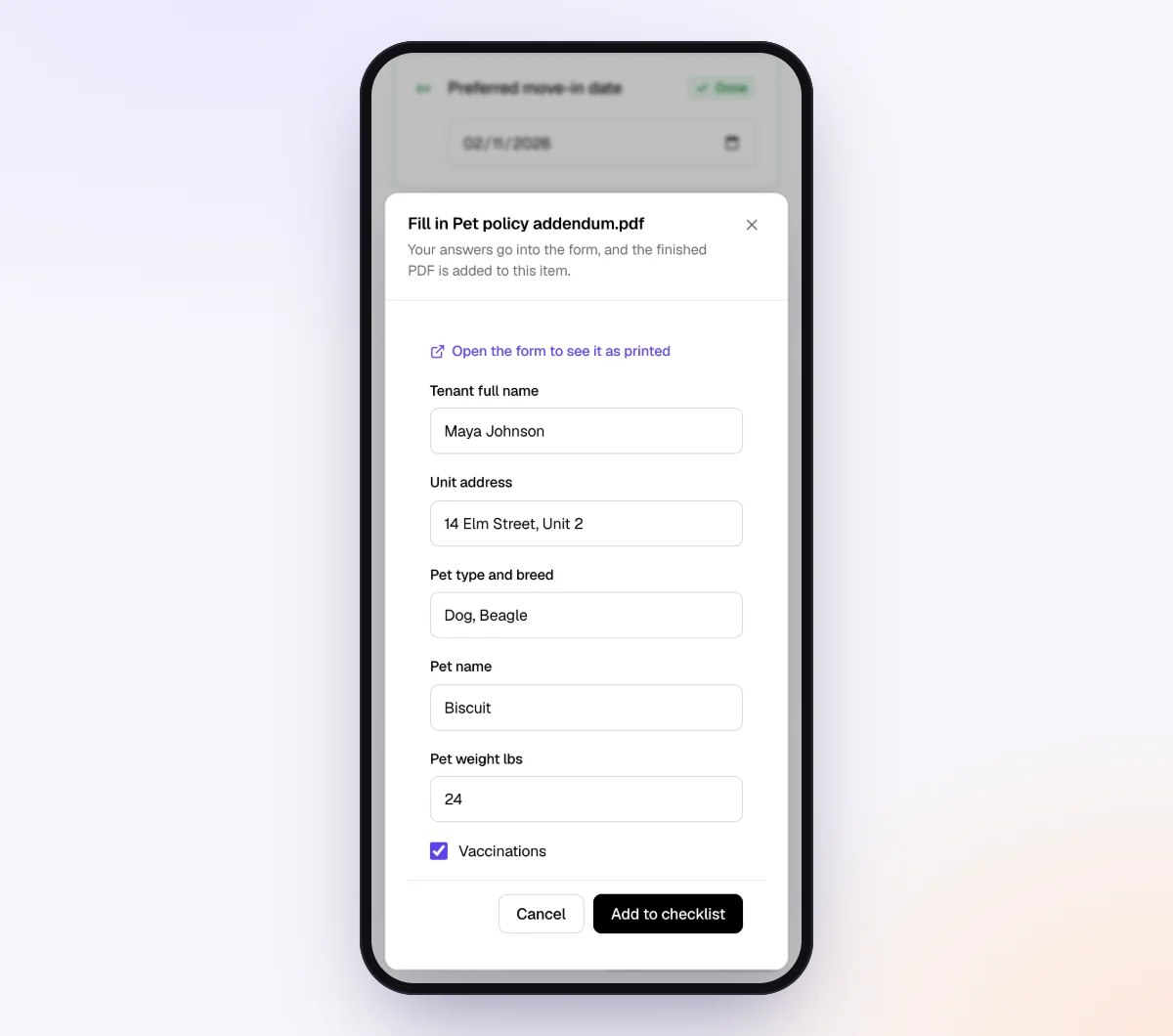
Add a file item named "Signed engagement letter." Under the attachment option choose "Form to fill in," upload your fillable PDF, and tick signed and every page. In "What should it be?" write "Our engagement letter, filled in and signed on page 4," and add an "Example."

Add the first-month items too: the latest bank and card statements, and a yes/no question such as "I've invited [your email] as an accountant user in QuickBooks Online," so nobody sends a password.
4. Send the request
Go to Requests, click "New request," choose the checklist, add a reference like "Engagement, Harbor Bakery LLC" (an illustrative name), the client's name and email, and a needed-by date before your planned start. Leave "Email the link" on and the agent sends a branded invitation with the letter attached.

Turn on "Require an email code" if you want the link to open only after the client enters a 6-digit code emailed to them. If the link went to the wrong address, reset the client's link.
5. The client fills in and signs on their phone
No account or app. The PDF's fields show as simple inputs; the client fills them in, draws a signature and types their name. The signature is stamped "Signed electronically by" with their name, date and time, and the flattened PDF is filed under its item. More on forms and e-signatures.
6. Review, save and move to monthly
The check confirms the returned form is your letter, filled in and signed. The request page shows each file, what's missing and an activity timeline of when the letter was sent, reminded and returned. Save the signed letter in your own client file, since files are deleted after the retention period.

Then move the client to the "Monthly bookkeeping" template. On Pro, a batch with "Repeat every month" on sends each client a new request on the same day every month. Our page for bookkeepers shows the setup.
When something goes wrong
| Problem | Likely cause | Fix |
|---|---|---|
| Client keeps postponing the letter | It feels like a legal document | Walk through the main clauses on a short call, then send it the same day |
| Letter returned unsigned or missing pages | Missed the signature step or photographed one page | The check flags it; if it got through, use "Ask for changes" |
| Client crosses out a clause | They disagree with a term | Don't start work; agree a change and send a revised letter |
| Client asks for out-of-scope work | Scope wasn't read, or the business changed | Point to Section 1, quote it in writing, update Schedule A |
| Existing client never signed a letter | You started before you had one | Send it now: "We're putting our terms in writing for all clients" |
| Terms need to change for everyone | New fees or policies | Send updated letters with the notice your current letter promises |
Free and Pro, honestly
You can send a real engagement letter request without paying anything.
| Free | Pro ($29/month) | |
|---|---|---|
| Open requests | 1 at a time | Unlimited |
| Forms to fill in and sign online | Yes | Yes |
| AI check on each file | Yes | Yes |
| AI autopilot (answers, reminders, follow-ups) | Your first request | Every request |
| Send to many clients at once (Batches) | No | Yes |
| Clients reply by email with attachments | No | Yes |
| Branding | Tangentflow badge | Your logo |
| Delivery to Google Drive or a webhook | No | Yes |
| Works with AI assistants (MCP) | No | Yes |
| File retention | 7 days | 60 days |
Both plans include unlimited checklists, QR codes and posters, ZIP export, AI summaries and email delivery. Pro is billed monthly with no contract, and you can cancel any time. Full details on the pricing page.
What Tangentflow does not do: SMS or text messages, a native mobile app, full legal e-signature certificates, identity verification, collecting payments, or permanent storage. If you need any of those, pair it with a tool that does. It also doesn't write or review contracts; your letter's wording is between you and your lawyer.
Your engagement letter as a checklist
- Start from the template and delete optional lines that don't apply.
- Write the scope with software, accounts, reports and turnaround.
- List exclusions: no assurance reports; tax and legal only if you offer them.
- Set a document due date and a response time for questions.
- State the fee, its volume assumption and how it changes.
- Add your late document and catch-up clause.
- Ask for access invitations, never passwords.
- Describe confidentiality, safeguards and how long you keep copies.
- Set notice periods and what happens to records, access and filings at the end.
- Have a lawyer in your state or province review it.
- Get it signed before work starts, and keep the signed copy.
Frequently asked questions
What should a bookkeeping engagement letter include?
The scope of services, services not included, client responsibilities with a document due date, fees and payment terms, how documents and data are handled, record retention, and how either side can end the engagement. Many bookkeepers add a late document clause and a lawyer-reviewed limitation of liability clause.
Do bookkeepers need an engagement letter?
There's often no rule requiring one for non-CPA bookkeepers, but it's strongly recommended and insurers commonly expect one. It's your main evidence of what you agreed to do if a client disputes a fee or blames you for something outside your scope.
Can a bookkeeper who isn't a CPA prepare financial statements?
Bookkeepers routinely prepare internal reports like a profit and loss statement and balance sheet. What's generally restricted is issuing audit or review reports, and in some jurisdictions compilations or reports meant for third parties to rely on. Rules vary by state and province, so check with your state board or provincial regulator.
What is a client responsibilities clause?
It lists what the client must do: provide complete, accurate documents by a set date, answer questions, report business changes and make management decisions. It turns "the client was late" from a complaint into a breach of agreed terms.
Can I add a late document fee for an existing client?
Usually, by sending an updated letter with notice and getting it signed before the fee applies. Our late document policy guide has wording for introducing it.
Is an electronically signed engagement letter valid?
Electronic signatures are generally recognized for business contracts in the US under the ESIGN Act and state UETA laws, and in Canada under federal and provincial electronic commerce laws. Ask your lawyer whether a simple e-signature is enough or whether you want an audit certificate.
Can Tangentflow write my engagement letter?
No. Tangentflow collects the signed letter and the documents that follow through one private link, with reminders until it's done. The wording is yours, from a template like this one, reviewed by a lawyer.