Templates
Bookkeeping Client Intake Form: 45 Questions to Ask (2026)
A bookkeeping client intake form with 45 copy-ready questions by topic, why each one matters for scoping and pricing, and a short discovery call version.
By Bibin MathewUpdated 19 min read
The short answer
A good bookkeeping intake form asks about the business, the state of the books, how many accounts and transactions there are, and whether payroll, sales tax, inventory or online sales are involved, because those answers set your price. Send a short version of about 15 questions before the discovery call and the rest after the client signs. Never ask for full Social Security or Social Insurance numbers, passwords or card numbers on an intake form; collect sensitive items later through a secure link, and ask for accountant access instead of logins.
A prospect books a discovery call. You spend thirty minutes learning they have four bank accounts, a Shopify store, two employees, sales tax in three states and books last reconciled in March. Then you send a quote that is either too low for the work or too high to win.
Most of that call could have been a form. A bookkeeping client intake form turns the scoping conversation into answers you can read before you speak to the client, so the call is about fit and priorities, not "how many credit cards do you have?"
This guide is for independent bookkeepers and small firms in the US and Canada. You'll get 45 questions grouped by topic, why each matters for scoping, a short discovery call version, what never belongs on an intake form, and a Tangentflow setup built on its "New client intake form" template.
Why a written intake form beats a long discovery call
Bookkeeping prices rest on a few facts: accounts, transactions, the starting point and extras like payroll, sales tax and inventory. Clients rarely volunteer these on a call, and they admit more in writing, like an open IRS letter. The answers also become the onboarding file, so nobody asks twice.
But 45 questions before a first call will scare prospects off, so split them in two.
Short version or long version: when to send which
| Short version | Long version | |
|---|---|---|
| When to send | When the prospect books a discovery call | Right after the engagement letter is signed |
| Purpose | Decide fit and give a price range | Set up the books and the monthly routine |
| Questions | About 15, marked (short) below | The other 30, trimmed per client |
| Sensitive data | None | Still none on the form; IDs and tax numbers go through a secure request |
The 45 bookkeeping client intake form questions
Copy the questions as written, then cut what you never use. The "why it matters" column is for you, not the client.
About the business
| # | Question | Why it matters |
|---|---|---|
| 1 | What is your business's legal name, and any other name you trade under? (short) | Statements and tax letters may show either name. |
| 2 | What type of entity is it? (Sole proprietor, LLC, partnership, S corporation, C corporation; in Canada, sole proprietor, partnership or corporation) (short) | Changes owner pay, equity accounts and which return the books feed. |
| 3 | Who owns the business, and what percentage does each owner hold? | Several owners need equity tracked per owner. |
| 4 | What does the business do, in one or two sentences? (short) | Shapes the chart of accounts and the usual headaches. |
| 5 | When did the business start? | New means setup; older may mean cleanup. |
| 6 | What is your fiscal year-end? | Sets the year-end deadline. |
| 7 | Which states or provinces do you operate in, sell into or have staff in? | Points to sales tax and payroll complexity. |
Your books today
| # | Question | Why it matters |
|---|---|---|
| 8 | What do you use for your books today? (QuickBooks Online, Xero, Wave, a spreadsheet, nothing yet, other) (short) | A migration or fresh setup is extra work to quote. |
| 9 | Who has been doing your bookkeeping so far? | Tells you whether clean records exist. |
| 10 | What is the last month you're confident your books were reconciled? (short) | Tells you whether the job starts with a catch-up. |
| 11 | Roughly how many months behind are your books, if any? | Catch-up is usually priced separately. |
| 12 | Who prepares your business tax return, and will they stay on? | You deliver books to their format and deadline. |
| 13 | When was your last business tax return filed, and for which year? | Unfiled years change scope and urgency. |
| 14 | Do you have any open letters from the IRS, CRA, or a state or provincial agency? (short) | Open notices bring deadlines you didn't plan for. |
Accounts and transaction volume
| # | Question | Why it matters |
|---|---|---|
| 15 | How many business bank accounts do you have, including savings? (short) | Each account is a monthly reconciliation. |
| 16 | How many business credit cards do you have, and how many people use them? | More cardholders, more receipts. |
| 17 | Do you have any loans, lines of credit or vehicle financing? | Each needs a statement and a principal and interest split. |
| 18 | About how many transactions go through all your accounts in a typical month? (Under 50, 50 to 150, 150 to 400, over 400) (short) | The best single predictor of monthly effort. |
| 19 | Do you ever pay business expenses from a personal account or card? | Mixed spending means extra questions every month. |
| 20 | Do you take payments through PayPal, Stripe, Square, Shopify, Amazon or another platform? (short) | Payouts net of fees need payout reports to reconcile. |
| 21 | Do you take cash, and does all of it get deposited? | Undeposited cash needs its own record. |
Sales, invoices and bills
| # | Question | Why it matters |
|---|---|---|
| 22 | How do you bill customers? (Invoices, point of sale, online checkout) | Tells you where sales data lives. |
| 23 | About how many invoices do you send a month? | Receivables work scales with invoice count. |
| 24 | Would you like us to track who owes you and follow up on late payments? | Often a separate line in the price. |
| 25 | Would you like us to schedule bills for payment? About how many a month? | Bill pay adds approvals and responsibility. |
Payroll and contractors
| # | Question | Why it matters |
|---|---|---|
| 26 | Do you have employees? If yes, how many? (short) | Payroll changes the monthly workload and filing calendar. |
| 27 | Which payroll provider do you use, if any? | Provider reports are quick to book; hand-run payroll isn't. |
| 28 | Do you pay independent contractors, and roughly how many a year? | Year-end Form 1099-NEC work in the US, T4A or T5018 slips in Canada. |
| 29 | How do the owners pay themselves? (Payroll, draws, dividends, not sure) | Recorded differently by entity type, and often messy. |
Sales tax, GST/HST and other filings
| # | Question | Why it matters |
|---|---|---|
| 30 | Do you collect sales tax, GST/HST, PST or QST? Where are you registered? (short) | Each registration adds a return and a reconciliation. |
| 31 | How often do you file those returns, and who files them now? | Monthly filers have twelve deadlines a year. |
| 32 | Do you sell to customers in other states or provinces? | Can create registration obligations the client hasn't noticed. |
| 33 | Which other filings should we handle or support? (1099s, T4s or T4As, annual reports, none) | Seasonal work to price up front. |
Inventory, assets and tracking
| # | Question | Why it matters |
|---|---|---|
| 34 | Do you hold inventory? If yes, how do you track it? (short) | Inventory and cost of goods sold are a big jump in complexity. |
| 35 | Have you bought vehicles, equipment or property for the business in the last two years? | Assets need recording for depreciation or capital cost allowance. |
| 36 | Do you need results tracked by job, project, location or class? | Adds coding to every transaction. |
Scope, timing and working together
| # | Question | Why it matters |
|---|---|---|
| 37 | Which services are you looking for? (Monthly bookkeeping, catch-up, payroll, sales tax, bill pay, reporting) (short) | The scope list for your proposal. |
| 38 | Which reports would you like, and how often? | Monthly reports with commentary take more time than a year-end package. |
| 39 | What made you start looking for a bookkeeper now? (short) | The real reason (a lender, a tax scare, growth) sets the first priority. |
| 40 | Is anything due soon, like a loan application, a tax deadline or an investor report? (short) | Sets the order of work, and whether the date is realistic. |
| 41 | Do you have a monthly budget in mind for bookkeeping? | Avoids proposals the client can't afford. |
| 42 | Who will answer questions about transactions, and who approves payments? | Wrong contacts stall every month-end. |
| 43 | How do you prefer we contact you, and how quickly can you usually reply? | Sets expectations early. |
| 44 | How did you hear about us? | Shows which referral sources work. |
| 45 | Is there anything else we should know about your business or your books? | Clients often save the key detail for an open question. |
Bookkeeping discovery call questions (the short version)
The short version is the 15 questions marked (short): 1, 2, 4, 8, 10, 14, 15, 18, 20, 26, 30, 34, 37, 39 and 40. Even if you don't do payroll or inventory, keep 26 and 34 so you know when to refer a client on.
Send it when the prospect books. On the call, don't repeat the form; ask what it can't capture:
- "You said the books were last reconciled in March. What happened after that?"
- "Walk me through a normal month. Where does money come in, and where does it go out?"
- "Which reports do you actually read today, if any?"
- "Who else should be involved: a partner, an office manager, your tax preparer?"
Questions to ask before quoting a bookkeeping client
Most quotes rest on the same factors. The table shows direction only; use your own rates.
| Pricing factor | Questions | Lower effort | Higher effort |
|---|---|---|---|
| Number of accounts | 15, 16, 17 | 1 bank account, 1 card | 5 or more accounts, loans, several cardholders |
| Transaction volume | 18, 23, 25 | Under 50 a month | Over 400 a month, many invoices and bills |
| Payroll | 26, 27, 29 | None, or a provider with clean reports | Run by hand, several states or provinces |
| Sales tax | 30, 31, 32 | Not registered, or one quarterly return | Several registrations, monthly filing |
| Inventory | 34 | No inventory | Physical inventory with cost of goods sold |
| Ecommerce | 20 | No platforms | Several platforms with fees and refunds netted out |
| Starting point | 8, 10, 11, 13 | Reconciled last month | Never reconciled, migration, unfiled years |
| Extra tracking | 36, 38 | Year-end package only | Job costing, classes, monthly commentary |
Price catch-up separately from the monthly fee, and write the volume into the proposal ("up to 150 transactions a month across 3 accounts") so you can revisit the price as the business grows. For platforms, our guide to ecommerce payout reports covers what to request from each.
Cleanup and catch-up intake questions
If question 10 or 11 says the books are behind, add these to the short version:
- What is the first month that needs catching up, and the last?
- Is there an existing QuickBooks Online, Xero or other file, and do you have admin access to it?
- Did any accounts or cards close during that period?
- Were any tax returns filed using numbers from these books?
- Is a lender, buyer or tax deadline waiting on the catch-up?
That's enough to quote. Once the client signs, the catch-up bookkeeping documents checklist has the full cleanup questionnaire, the document waves and an accounts-by-month tracking grid.
What not to ask on a bookkeeping intake form
An intake form goes to people who haven't hired you yet. Ask only what you need to scope.
| Don't ask on the intake form | Why | Instead |
|---|---|---|
| Full Social Security or Social Insurance numbers | You don't need them to quote, and a prospect form is the wrong place for them | After signing, only if the work needs it, through a secure request |
| Bank, payroll or accounting software passwords | Sharing logins often breaks the platform's terms and leaves you holding credentials | An accountant or advisor user invitation, or statement PDFs |
| Photo ID or dates of birth | Only needed if your process or rules require identity checks | After the engagement letter, through a secure link |
The principle is data minimization. Canadian privacy law (PIPEDA and provincial laws) expects you to limit collection to what you need. In the US, if you also prepare returns, the FTC Safeguards Rule and IRS Publication 4557 apply. See secure ways to receive sensitive documents for what a safe setup looks like.
Intake form tools compared
| Option | Client experience | Conditional questions | File uploads | Follow-up on blanks |
|---|---|---|---|---|
| Form builder (Google Forms, Jotform, Typeform) | Good on a phone | Yes | Varies; Google Forms uploads need a Google sign-in | Manual |
| Practice management portal | Account and password needed | Usually | Yes | Some reminders |
| Private link with checklist and AI agent (Tangentflow) | Phone-first, no account | Yes, with "Only ask if…" | PDFs and photos | Agent reminds, paced to a date |
A form builder is fine for the short version. It gets harder when the long version also needs statements, a signed engagement letter and someone to chase the client who stopped halfway.
Bookkeeping client intake in Tangentflow, step by step
In Tangentflow, the client answers and uploads through one private link on their phone, and an AI collection agent sends the invitation and reminders. Here's how to build both versions.
1. Start from the "New client intake form" template
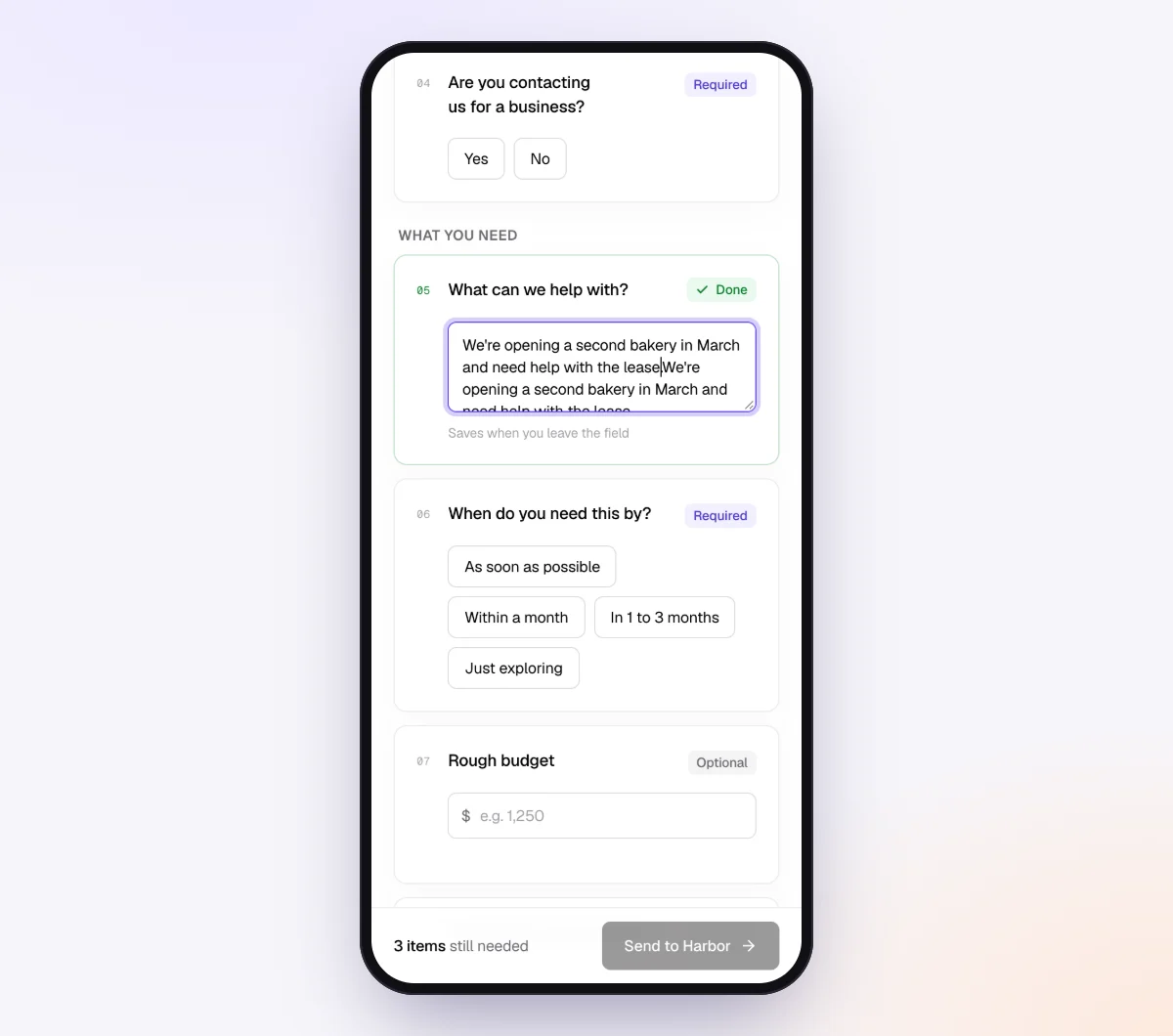
Go to Checklists, choose "Browse templates" and open "New client intake form." It ships with form fields under the headings "About you" and "What you need": "Full name," "Best phone number," "Mailing address," "Are you contacting us for a business?" (which shows "Business name and website" only when the answer is yes), "What can we help with?," "When do you need this by?," "Rough budget," "How did you hear about us?" and "Anything useful to share (optional)."

Rename it "Discovery questionnaire." Every bookkeeping prospect is a business, so delete "Are you contacting us for a business?" and keep "Business name and website" as an always-asked field. "Rough budget" is already a "Dollar amount" field, which covers question 41.
2. Add the short-version questions as form fields
Add each (short) question as a "Form field" and choose the answer type:
- "Pick from a list" for entity type (2), software (8) and transaction volume (18), using the ranges above.
- "Tick all that apply" for services (37) and payment platforms (20).
- "Yes / No" for open agency letters (14), employees (26), sales tax (30) and inventory (34).
- "Number" for bank accounts (15), "Longer text" for why now (39).
Use "Section heading" to group them ("Your business," "Your books today"). Add an "Example answer" to open questions, such as "The bank wants year-to-date financials for a line of credit." The agent uses it to ask for more when an answer is too thin.
3. Hide what doesn't apply with "Only ask if…"
"Only ask if…" works off an earlier "Yes / No," "Pick from a list" or "Tick all that apply" field:
- "How many people are on payroll?" and "Which payroll provider do you use?" only if "Do you have employees?" is Yes.
- "Where are you registered, and how often do you file?" only if the sales tax question is Yes.
- "How do you track inventory?" only if "Do you hold inventory?" is Yes.
- "How many months behind are your books?" only if the services answer includes "Catch-up."
4. Build the long version as a second checklist
Create a "New bookkeeping client" checklist with the remaining questions plus the documents from the accounting client onboarding checklist. Attach your engagement letter to a file item as a "Form to fill in" with signed ticked; the client fills in the PDF and draws a signature on their phone. See forms and e-signatures.

Turn on "Require an email code" for this checklist, so the client enters a 6-digit code emailed to them before the link opens. Switch the AI check off on items like a photo ID; those files are stored for your review and never sent to the AI provider.
5. Send it and let the agent follow up
In Requests, click "New request," choose the discovery questionnaire, add the business name as the reference, the prospect's name and email, and a needed-by date a day or two before the call. Leave "Email the link" on. The invitation goes out from your business name, and the agent reminds the prospect about only what's still blank.

You can also copy the link into your booking confirmation. Read the answers on the request page before the call, and once the client signs, send the long version as a new request.
Setups by client type
Same question bank, different emphasis. These are illustrative starting points.
| Client type | Lean on questions | Add this question |
|---|---|---|
| Solo service business | 10, 19, 29 | "Do you use one card for business and personal?" |
| Ecommerce seller | 20, 32, 34 | "Do you also sell on marketplaces?" |
| Restaurant or retail | 21, 26, 30 | "Which point-of-sale system do you use?" |
| Trades and contractors | 28, 35, 36 | "Do you track profit per job?" |
Once a client is live, move them onto the "Monthly bookkeeping" template. On Pro, a batch sends every client a request from one sheet, and with "Repeat every month" on, they get a new one on the same day each month until you stop it. More in bulk requests and on our page for bookkeepers.
When something goes wrong
| Problem | Likely cause | Fix |
|---|---|---|
| Prospect never fills in the form | It looks long | Send only the short version, as a link, due before the call |
| Volume answer is wildly off | Owner guessed | Check one month's statements after signing and adjust |
| Payroll or sales tax missed | Questions were optional | Make 26 and 30 required |
| Prospect sends a password or full SSN | No warning on the form | Delete it, reply that you never need it, add the "we never ask" line |
| Catch-up bigger than quoted | Question 10 answered optimistically | Quote the backlog in stages, most recent year first |
Free and Pro, honestly
You can run a real intake request without paying anything.
| Free | Pro ($29/month) | |
|---|---|---|
| Open requests | 1 at a time | Unlimited |
| AI check on each file | Yes | Yes |
| AI autopilot (answers, reminders, follow-ups) | Your first request | Every request |
| Clients reply by email with attachments | No | Yes |
| Branding | Tangentflow badge | Your logo |
| Delivery to Google Drive or a webhook | No | Yes |
| Works with AI assistants (MCP) | No | Yes |
| File retention | 7 days | 60 days |
Both plans include unlimited checklists, QR codes and posters, ZIP export, AI summaries and email delivery. Pro is billed monthly with no contract, and you can cancel any time. Full details on the pricing page.
What Tangentflow does not do: SMS or text messages, a native mobile app, full legal e-signature certificates, identity verification, collecting payments, or permanent storage. If you need any of those, pair it with a tool that does.
The whole intake process as a checklist
- Pick the questions from the bank of 45 that match the services you sell.
- Mark about 15 as the short version for before the discovery call.
- Use ranges for volume questions and hide what doesn't apply.
- Leave out SSNs, SINs, passwords, card numbers and IDs, and say so.
- Send the short version as a link when the call is booked.
- Quote from accounts, volume, payroll, sales tax, inventory and the starting point, with catch-up priced separately.
- After signing, send the long version with the engagement letter and onboarding documents.
- Move the client onto a recurring monthly request.
Frequently asked questions
What questions should be on a bookkeeping client intake form?
Ask about the business (name, entity type, owners, year-end), the state of the books (software, last reconciled month, open agency letters) and volume (accounts, cards, loans, monthly transactions, payment platforms). Then cover payroll, sales tax, inventory, scope, deadlines and budget.
How long should a bookkeeping new client questionnaire be?
Keep the pre-call version to about 15 questions, around five minutes of work. Send the longer questionnaire after the client signs, when you need the detail to set up the books.
What should I ask on a bookkeeping discovery call?
Start from the form answers and ask what a form can't capture: what happened since the books were last reconciled, how a normal month flows, which reports the client reads and who else should be involved.
What questions help me price bookkeeping services?
Accounts, cards and loans, monthly transaction count, payroll, sales tax, inventory, ecommerce platforms and how far behind the books are. Those drive most of the effort, so get them in writing before you quote.
Should I ask for a Social Security or Social Insurance number on an intake form?
No. You don't need it to scope the work. If the engagement needs it later, collect it after signing through a secure request, never on an open form or by email.
Can I use Tangentflow as a bookkeeping intake form?
Yes. Start from the "New client intake form" template, add the questions as form fields with "Only ask if…" conditions, and send a private link that works on a phone without an account. The agent sends the invitation and reminds the client about anything still blank.