Checklists
Property Management Owner Onboarding Checklist (2026)
A property management owner onboarding checklist for the US and Canada, by stage: agreement, W-9 or NR6, owner ACH, insurance, keys, leases and lead disclosure.
By Bibin MathewUpdated 19 min read
The short answer
Onboard every new rental owner in seven stages: a signed management agreement, tax forms (a W-9 in the US, or NR6 details for a non-resident owner in Canada), payout banking, property details and access, existing leases and tenant ledgers, insurance, and compliance documents such as the lead disclosure for pre-1978 homes. Send the owner one checklist through a private link with a real date, collect bank details through a secure channel instead of email, and take over the property only when the file is complete.
A new owner signs your management agreement on Monday. By Friday you have the agreement, a photo of one key, and a promise that "the lease is somewhere in my email." The tenant's rent is due on the first, you don't know where the security deposit is held, and you're still waiting for the owner's W-9 and bank details so you can pay them. Nobody is being difficult. The owner just doesn't know what you need, and you're asking for it one email at a time.
A clean onboarding means you can collect rent and answer a tenant on day one, and the owner gets paid on time with the right tax reporting. A messy one shows up months later as a missing 1099, a deposit dispute, or a claim with your company left off the policy.
This guide is for property managers in the United States and Canada who take on single-family homes, condos and small multifamily buildings for individual owners. You'll get the seven stages, a full checklist showing who provides what, the US and Canadian tax forms that matter, safe handling of bank details, and a step-by-step setup in Tangentflow if you want the chasing done for you.
Why owner onboarding drags on
Owner packets stall for predictable reasons. The packet is a 15-page PDF that gets saved for "this weekend." Nobody says who provides what, so the owner doesn't realize the HOA, the insurer or the outgoing manager holds half of it. Bank details arrive by plain email. And there is no takeover date, so onboarding drifts into the first month of management. The fix is a specific checklist, one place to send it, a real date, and reminders that list only what is still missing.
The seven stages of owner onboarding
Don't collect rent before the agreement is signed, and don't pay an owner before you have their tax form and verified bank details.
| Stage | Goal | Who usually provides it | Typical timing |
|---|---|---|---|
| 1. Agreement | Scope, fees and authority in writing | You draft, owner signs | Day 0 to 3 |
| 2. Tax | Correct year-end reporting and any withholding | Owner | Day 1 to 7 |
| 3. Banking | Pay the owner and hold their funds properly | Owner, then you verify | Day 1 to 7 |
| 4. Property details and access | Know the property and get in the door | Owner, HOA or condo corporation | Day 1 to 10 |
| 5. Tenants and leases | Take over existing tenancies cleanly | Owner or outgoing manager | Day 3 to 14 |
| 6. Insurance | Make sure the property and your company are covered | Owner and their insurance agent | Day 3 to 14 |
| 7. Compliance | Disclosures, registrations and safety records on file | Owner, local authority, you | Day 3 to 14 |
Stage 1: The management agreement
The management agreement sets your fees, authority and payouts. Many states and provinces that license property managers expect a written agreement, and some prescribe what it must contain. Before it goes out, confirm the scope, every fee, the repair approval limit and emergency exception, the operating reserve, the payout day, where deposits are held, and how records are handed over when management ends. Get it signed before you touch rent or tenants. Your state association, provincial regulator or lawyer often has template wording.
Stage 2: Tax forms (US and Canada)
United States: the owner's W-9. A property manager who collects rent on an owner's behalf generally reports the rent paid to the owner on Form 1099-MISC (box 1, Rents). Form W-9 gives you the owner's legal name, tax classification and taxpayer identification number. Get it before the first payout, not in January.
Note that 2025 federal legislation raised the 1099-MISC reporting threshold from $600 to $2,000 for payments made after December 31, 2025, so 2026 is the first year under the new number. Most managers still collect a W-9 from every owner. For the mechanics, see our guide to collecting W-9 forms, and confirm the current rules in the IRS instructions for Forms 1099-MISC and 1099-NEC.
Canada: non-resident owners. For a Canadian-resident owner, the tax side is light. A non-resident owner is different. Under Part XIII of the Income Tax Act, the person who pays or credits rent to a non-resident, which usually means you as the agent, must withhold 25% of the gross rent and remit it to the CRA by the 15th of the following month. The owner can file Form NR6, an undertaking to file a Canadian return under section 216, so that you withhold 25% of the net rent instead. The CRA asks for the NR6 on or before January 1 of the year, or before the first rental payment is due, and you need the CRA's approval before you switch to the net amount. You also report the rent and tax withheld on an NR4 slip after year-end.
Stage 3: Banking and owner payouts
- US: an owner ACH or direct deposit authorization with the bank name, routing number, account number and account type, plus a voided check or bank letter showing the owner's name.
- Canada: a direct deposit or pre-authorized payment form with the transit number, institution number and account number, plus a void cheque or the bank's direct deposit form from online banking.
How to collect bank details safely:
- Never ask for online banking logins, and don't accept account numbers by plain email. If one arrives, move it where it belongs and delete the email.
- Collect the form and void check through a private upload link, or have the owner enter them directly in your property management software's owner portal if it has one.
- Verify any change by phone, using a number you already have on file, before you send money to a new account.
Stage 4: Property details, access and HOA information
This is what you need to run the property day to day, and much of it is a form, not a document:
- Property basics and utilities: unit count, parking, included appliances, and which utility accounts are the owner's versus the tenant's
- Keys and access: how many keys, fobs, mailbox keys and garage remotes the owner will hand over, and when
- Vendors and warranties: preferred trades and any warranties on appliances, roof or systems
- Mortgage escrow: whether the lender pays taxes and insurance, so you know which bills to expect
- HOA or condo corporation: management contact, dues and who pays, rules or bylaws, and move-in requirements
Stage 5: Existing tenants, leases and ledgers
If the property is already rented, the owner or outgoing manager should provide:
- The current lease and every addendum, every page, signed by all parties
- The tenant ledger showing rent charged, paid and owed, with any balance at takeover
- The security deposit: the amount, where it is held, and how it will move to your trust account if you will hold it
- Move-in condition report and photos from when the tenant moved in
- Tenant contacts, notices already served and open maintenance requests
Many states and provinces regulate how deposits are held and what tenants must be told when management changes, so check local rules before your "new management" letter.
Stage 6: Insurance
Ask for the owner's current policy declarations page and check for:
- A landlord or rental dwelling policy, not a homeowner policy written for an owner who lives there
- Liability limits that meet what your management agreement requires
- The policy period, so you know when to ask for the renewal
- Your company named as an additional insured on the liability coverage, if your agreement requires it
Many management agreements ask owners to name the manager as an additional insured, so the manager has some protection if someone sues over the property. Whether to require it, and at what limits, is a question for your insurance broker. The owner's agent handles the endorsement and can issue a certificate showing it. Our guide to collecting certificates of insurance covers how to read one.
Stage 7: Compliance documents
Lead-based paint disclosure (US, pre-1978 housing). Under the federal Lead Disclosure Rule, landlords and their agents must, before a tenant signs a lease for most housing built before 1978, disclose any known lead-based paint or hazards, provide available records and reports, give the EPA pamphlet Protect Your Family From Lead in Your Home, and include the Lead Warning Statement in or attached to the lease. Signed disclosures must be kept for three years from the start of the lease. Some housing is exempt, including leases of 100 days or less and units certified lead-free. Ask the owner for the year built and any lead reports at onboarding, because the duty extends to you as the agent.
Also ask about local rental registration or licensing and any required inspection certificate, smoke and carbon monoxide alarm records, permits for converted basements or added units, and open code violations. In Canada, check provincial rules such as standard lease forms; there is no federal equivalent of the US lead disclosure rule.
The full owner onboarding checklist: who provides what
Use this as your master list, then trim it per owner. A vacant condo doesn't need a tenant ledger, and a Canadian resident doesn't need an NR6.
| Item | US | Canada | Who provides it |
|---|---|---|---|
| Signed management agreement | Yes | Yes | You draft, owner signs |
| Owner photo ID | If your trust rules or policy require it | If your trust rules or policy require it | Owner |
| Proof of ownership | Deed or recent property tax bill | Land title search, deed or property tax bill | Owner |
| Entity documents | LLC articles and operating agreement, if owned by an entity | Articles of incorporation, if owned by a corporation | Owner |
| Tax form | W-9 (or W-8ECI if foreign) | Residency confirmation; NR6 if non-resident and electing | Owner, with their CPA |
| Owner payout details | ACH or direct deposit form plus voided check | Direct deposit form plus void cheque | Owner, verified by phone |
| Property information sheet | Yes | Yes | Owner |
| Keys, fobs and remotes | Yes | Yes | Owner, in person |
| HOA or condo documents | Rules, contact, dues | Bylaws, rules, status certificate if available | Owner or association |
| Current lease and addenda | Every page, signed | Every page, signed | Owner or outgoing manager |
| Tenant ledger and deposit records | Yes | Yes | Owner or outgoing manager |
| Insurance declarations page | Landlord policy | Landlord or rental policy | Owner's insurance agent |
| Additional insured endorsement | If your agreement requires it | If your agreement requires it | Owner's insurance agent |
| Lead disclosure and reports | Pre-1978 housing | Not a federal requirement | Owner |
| Rental license or registration | Where required locally | Where required locally | Owner or city |
The owner information sheet
Half of onboarding is answers, not files. Put these on one form: legal name or owning entity, phone and mailing address, personal or LLC ownership, tax residency, whether the property is rented and when the lease ends, year built, HOA or condo, utilities, and "anything we should know before we take over?" The ownership, residency, rented, year-built and HOA answers decide which documents you need at all. An owner with a vacant home should never be asked for a tenant ledger.
Five ways to collect an owner onboarding packet, compared
| Method | Setup effort | Owner experience | Security for bank and tax details | Tracks what's missing | Reminders |
|---|---|---|---|---|---|
| Email with a PDF packet | None | Familiar, but long PDFs get postponed | Weak, numbers sit in inboxes | No | Manual |
| Shared folder (Google Drive, Dropbox) | Low | Fine if they use that service | Depends on sharing settings | No | Manual |
| Property management software owner portal | Medium | Good if the owner logs in for statements | Usually good | Some | Some |
| E-signature platform | Medium | Great for the agreement, awkward for uploads | Strong for signing | Signing only | Signing only |
| Collection tool with checklist and AI agent (Tangentflow) | Low | Phone-first, no account | Private link, automatic deletion | Yes | Paced to the needed-by date |
Your property management software is the right long-term home for owner data and payouts, and an e-signature platform is right for an agreement that needs a full audit certificate. A collection tool fits around both: it gathers the documents and answers, checks each one and chases what's missing, then you move everything into your software.
How to onboard a new owner in Tangentflow, step by step
Tangentflow handles the document side of owner onboarding: one private link with your checklist, a check on every upload, and an AI collection agent that sends the invitation and reminders. There is no owner onboarding template in the product today, so you build the checklist once and reuse it.
1. Build your owner onboarding checklist
Go to Checklists and either describe what you need in a sentence ("New rental owner onboarding: management agreement, W-9, direct deposit form and voided check, insurance declarations page, current lease, tenant ledger") and let AI draft the items, or choose "Browse templates" and start from Document collection, which already has "Photo ID," "Proof of address" and "Anything else."

Add section headings such as "Agreement and tax," "Banking" and "Current tenant" so the page stays scannable.
2. Add the owner information sheet as form fields
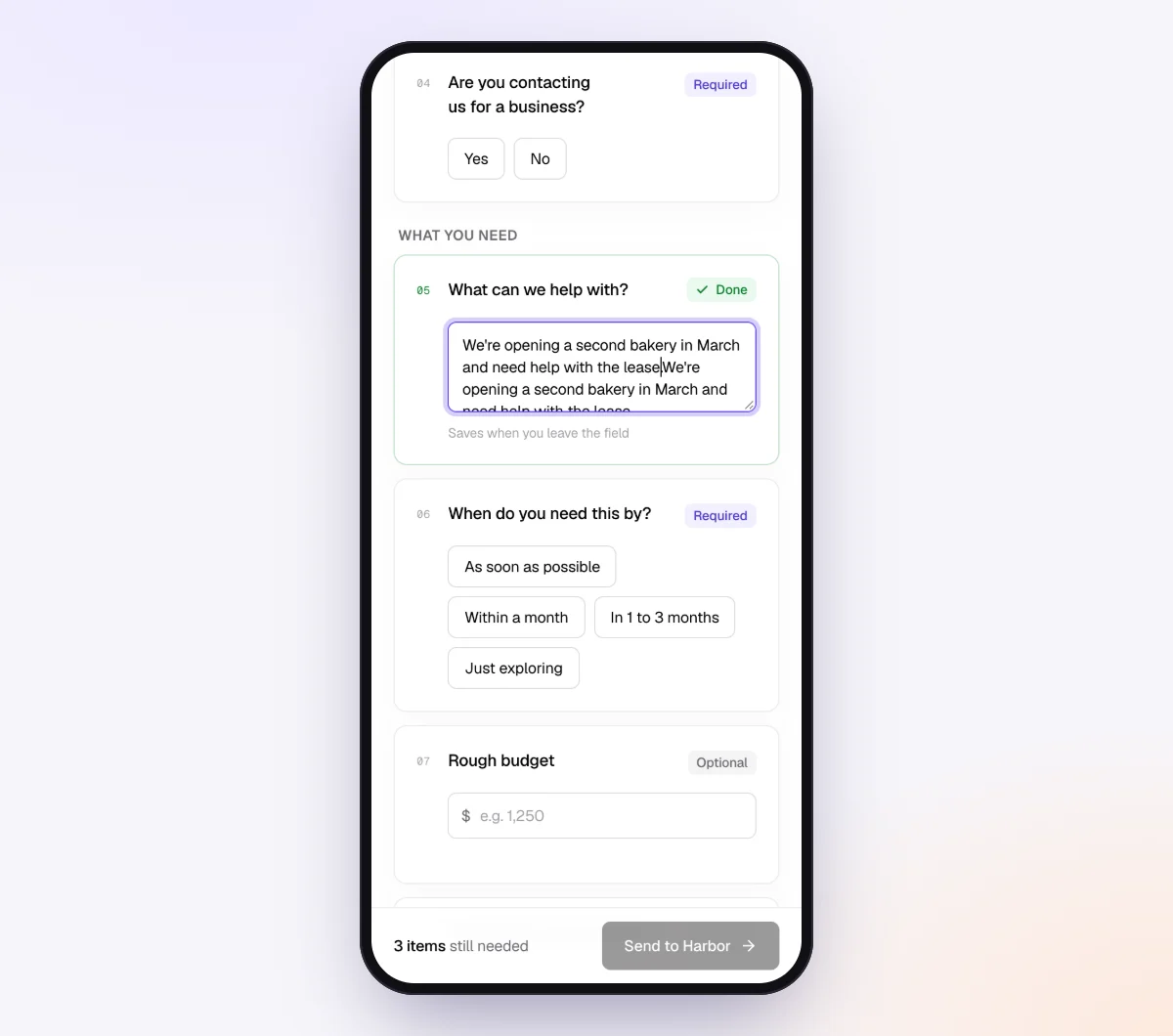
Add each owner information question as a "Form field": short text, yes/no, single choice, date, dollar amount or address. Then use "Only ask if…" so the lease and ledger appear only when "Is the property currently rented?" is Yes, the lead disclosure only when "Was the property built before 1978?" is Yes, and entity documents only for an LLC or corporation.
3. Tell each document item what "good" looks like
Open each file item in the checklist editor and fill in "What should it be?", for example "Form W-9 completed and signed by the property owner" or "landlord insurance declarations page showing the policy period and liability limit." Turn on signed for the W-9 and the agreement, every page for the lease, and "not expired" where an ID or policy period matters. Add a tip such as "Your declarations page is usually the first page of your policy."

Attach your management agreement and the W-9 as fillable PDFs on their own items. The owner fills them in online and signs with a drawn signature. See forms and e-signatures and our guide to collecting signed forms online.
4. Lock down the bank and tax items
- Switch the AI check off on the direct deposit form, voided check and W-9 items if you prefer that those files are never sent to the AI provider. They are stored and marked "Received" for a person on your team to review.
- Turn on "Require an email code" for the checklist. Before the link opens, the owner enters a 6-digit code emailed to them, so a forwarded link isn't enough.
- If a link went to the wrong person, reset the owner's link so the old one stops working. Once the owner sends everything, the link no longer shows the files.
More on the security page and in our guide to secure ways to receive sensitive documents.
5. Send the request, then review and deliver
Go to Requests, click "New request," choose your owner onboarding checklist, add a reference such as "Owner onboarding, 22 Birch Lane," the owner's name and email, and a needed-by date a week before your takeover date. Leave "Email the link" on and the agent sends a branded invitation from your business name.

Use "Notes for the agent (private)" for context, for example "Tenant in place until May 31, outgoing manager is sending the ledger directly." The agent paces reminders to your date, lists only what's missing, answers questions like "what is a declarations page?" from your checklist and notes, and hands anything outside the checklist to you.
Each upload is checked in seconds, so an owner who sends two pages of a twelve-page lease sees a note and can fix it on the spot. When everything is in, download the ZIP, or on Pro deliver it to Google Drive or a webhook, enter the details into your property management software and mark the request complete. Files are deleted 24 hours later, so your own system stays the system of record.
Onboarding setups by owner type
| Owner type | Key checklist items | Settings worth turning on | Learn more |
|---|---|---|---|
| First-time landlord, vacant home | Agreement, W-9, ACH form, insurance declarations, property sheet | "Only ask if" to hide tenant items, tips explaining each form | Property management |
| Owner with a tenant in place | Everything above plus lease, ledger, deposit records, move-in report | "Every page" on the lease, a needed-by date before the next rent day | Move-in and move-out inspections |
| Non-resident owner of a Canadian property | Residency question, NR6 details, void cheque, agreement | Require an email code, AI check off for banking | Secure document collection |
| Portfolio switching from another manager | A request per property, outgoing manager's ledger and deposit records | Batches with a unit or property column | Bulk requests |
When something goes wrong
| Problem | Likely cause | Fix |
|---|---|---|
| Owner emails their bank account number | They thought it was faster | Don't reply-all; move the details to your system, delete the email and point them to the secure link |
| Owner can't find the lease | It's with the outgoing manager or buried in email | Ask the outgoing manager directly; if none exists, sign a new lease or written tenancy confirmation with the tenant |
| Deposit amount doesn't match the ledger | Deductions or a missing transfer | Resolve it in writing with the owner before takeover, and check your local deposit rules |
| Insurance is a homeowner policy, not a landlord policy | Owner moved out and never told the insurer | Ask them to call their agent; don't take over until it's fixed if your agreement requires it |
| Link went to the wrong email address | Typo in the request | Reset the owner's link so the old one stops working, then send it to the right address |
Free and Pro, honestly
You can onboard a real owner without paying anything.
| Free | Pro ($29/month) | |
|---|---|---|
| Open requests | 1 at a time | Unlimited |
| AI check on each file | Yes | Yes |
| AI autopilot (answers, reminders, follow-ups) | Your first request | Every request |
| Clients reply by email with attachments | No | Yes |
| Branding | Tangentflow badge | Your logo |
| Delivery to Google Drive or a webhook | No | Yes |
| Works with AI assistants (MCP) | No | Yes |
| File retention | 7 days | 60 days |
Both plans include unlimited checklists, QR codes and posters, ZIP export, AI summaries and email delivery. Pro is billed monthly with no contract, and you can cancel any time. Full details on the pricing page.
What Tangentflow does not do: SMS or text messages, a native mobile app, full legal e-signature certificates, identity verification, collecting payments, or permanent storage. If you need any of those, pair it with a tool that does.
The whole owner onboarding process as a checklist
- Get the management agreement signed before you touch rent or tenants.
- Ask the owner information questions first, so the answers decide which documents you need.
- Collect a W-9 from US owners, or confirm Canadian residency and handle Part XIII withholding and any NR6 for non-residents.
- Collect payout details and a voided check securely, and verify changes by phone.
- Get keys in person, take codes by phone, then change them.
- Collect every page of the current lease, the tenant ledger, deposit records and any move-in report.
- Get the insurance declarations page and any additional insured endorsement your agreement requires.
- Collect the lead disclosure for pre-1978 US housing and any local registration or inspection documents.
- Set a needed-by date a week before takeover, and let reminders list only what's missing.
- Move everything into your property management software and delete the other copies.
Frequently asked questions
What documents does a property manager need from a new owner?
A signed management agreement, a tax form (W-9 in the US, or residency details and an NR6 for non-resident owners in Canada), payout bank details with a voided check, proof of ownership, insurance declarations, HOA details and keys. If the property is rented, add the current lease, tenant ledger and deposit records, and for US homes built before 1978, the lead disclosure.
Does a property manager need a W-9 from the owner?
In the US, generally yes. Managers who collect rent for owners usually report it on Form 1099-MISC, which needs the owner's taxpayer identification number from the W-9. For payments made in 2026 the reporting threshold is $2,000, but most managers collect a W-9 from every owner. Check the current IRS instructions with your CPA.
What happens if the owner of a Canadian rental lives outside Canada?
As the agent paying or crediting the rent, you generally must withhold 25% of the gross rent and remit it to the CRA by the 15th of the following month. If the owner files an NR6 and the CRA approves it, you can withhold on the net amount instead, and the owner files a section 216 return. Check the CRA's guide T4144 and a tax advisor.
How should owners send bank details to a property manager?
Through a secure channel, such as a private upload link or your software's owner portal, never by plain email or text. Ask for a direct deposit form plus a voided check or bank letter, and verify any later account change by phone using a number you already have.
Is the lead paint disclosure the owner's job or the manager's?
Both. The federal rule covers landlords and their agents, so make sure the disclosure, pamphlet and Lead Warning Statement are handled for pre-1978 housing before a tenant signs, and keep signed copies for three years.
Can I use Tangentflow for owner onboarding?
Yes. Build the checklist once, send each owner a private link with a needed-by date, and let the agent chase what's missing. The Free plan includes the full AI agent on your first request. See property management for tenant setups too.