Guides
How to Collect Proof of Renters Insurance From Tenants (2026)
How landlords collect proof of renters insurance from tenants: what to require, how to read a declarations page, interested party vs. additional insured, renewals.
By Bibin MathewUpdated 19 min read
The short answer
Put the renters insurance requirement in the lease, then ask every tenant for the policy's declarations page before they get the keys. Check that it names the tenant, covers your unit's address, shows a policy period that runs past move-in and meets the liability limit in your lease, and ask the tenant to list you as an interested party so the insurer can notify you about a cancellation. Record the expiration date and request a fresh declarations page a few weeks before each renewal.
Most leases say "Tenant shall maintain renters insurance." Far fewer landlords can say which tenants actually have it today. The proof came in at move-in as a screenshot, nobody wrote down when the policy ended, and a year later several policies have quietly lapsed. You find out after a kitchen fire or a dog bite.
This guide is for independent landlords and property managers in the US and Canada who require renters insurance (tenant insurance in Canada) and want a repeatable way to get real proof and keep it current, with a spreadsheet or with software.
You will get what you can require, what to check on a declarations page, interested party vs. additional insured, a sample lease clause, a renewal routine, a request email and a step-by-step setup in Tangentflow.
Can a landlord require renters insurance?
In most of the US, generally yes, as long as the requirement is written into the lease and applied the same way to every tenant. No state requires renters insurance by law; the requirement is a lease term, like a pet rule. A few caveats:
- Some states regulate how you do it. Virginia's landlord-tenant act (Va. Code § 55.1-1206), for example, allows a landlord to require renters insurance as a condition of tenancy, and sets rules for when the landlord buys the coverage and passes the premium on as rent. Other states and cities have their own rules on lease terms and fees. Check your state's law.
- New requirements usually start with a new lease. Add it at renewal, with whatever notice your state requires, not halfway through a term.
- Subsidized and regulated housing is different. If the unit is public housing, a HUD-assisted property, rented to a Housing Choice Voucher (Section 8) tenant, or rent-regulated (such as a rent-stabilized apartment in New York), the program's lease rules decide what you can add. Ask your housing authority, the program's guidance or your attorney before requiring insurance there.
- Apply it to everyone. Requiring insurance from some tenants and not others invites a fair housing complaint.
In Canada, tenant insurance is not required by law either, but it is a common lease term. In Ontario, the government's guide to the standard lease explains that in the tenant insurance section, "a landlord and tenant can agree whether the tenant must have liability insurance," and that contents insurance is up to the tenant. Other provinces have their own standard terms and residential tenancy offices; check yours before adding a clause.
Why landlords care about a tenant's policy
A renters policy (often an HO-4 form in the US) mostly protects the tenant: their belongings, their hotel bills if the unit becomes unlivable. The part that helps you is personal liability. If a tenant's cooking fire damages the unit next door, or their dog bites a visitor, their policy can respond instead of only yours. It does not insure your building, appliances or rent; that is your landlord or dwelling policy.
What counts as proof of renters insurance
A screenshot of a payment, a quote or an app's home screen shows that the tenant looked at insurance, not that a policy is in force for your unit.
| What the tenant sends | Is it proof? | Notes |
|---|---|---|
| Declarations page ("dec page") | Yes, the best option | Lists the insured, address, policy period and limits on one or two pages |
| Proof of insurance letter from the insurer | Yes | Ask that it shows the address, policy period and liability limit |
| Quote or application | No | A quote is not a policy |
| Payment receipt or bank charge | No | Does not show the address, dates or limits |
The declarations page is the policy's summary page. Layouts differ by insurer, but it usually shows the named insured, insurer and policy number, the policy period, the insured address, the limits for personal property, personal liability, medical payments and loss of use, the deductible, and any interested parties the tenant has listed.
What to check on every declarations page
Read it against this list the day it arrives. Most problems are visible on the face of the page.
| Check | What to look for | Common problem |
|---|---|---|
| Named insured | Every adult on the lease, or each roommate's own policy | Only one roommate is covered; the others assume they are included |
| Address | Your property and unit number | The tenant's old address, or the building without the unit |
| Policy period | Starts on or before move-in, ends in the future | A policy that starts a week after move-in, or last year's page |
| Personal liability limit | Meets or exceeds the minimum in your lease | $50,000 when your lease says $100,000 |
| Interested party | Your company name and mailing address, if you require it | Missing, or listed under the wrong name |
Interested party vs. additional insured
Leases and property managers use these two terms loosely, but they mean different things. For renters insurance, most landlords want the first one.
| Interested party (also "additional interest" or "party of interest") | Additional insured | |
|---|---|---|
| What it does | The insurer typically notifies you if the policy is canceled, not renewed or changed | Gives you some coverage under the tenant's policy, within that insurer's terms |
| Coverage for you | None | Limited, depends on the policy and endorsement |
| Cost to tenant | Usually free | May cost more, and not every renters insurer offers it |
| What most landlords ask for | Yes, this is the common request | Less common, and worth discussing with your broker first |
Interested party status is a notice arrangement: no rights to claim, but you may hear about a cancellation instead of finding out at renewal. Notice practices vary by insurer, so treat it as an early warning, not a guarantee.
Additional insured status sounds better, but on a renters policy it can be hard to get, and making you an insured can interact with exclusions. Many policies, for example, exclude claims by one insured against another. If you want more than notice, ask your broker before copying "additional insured" from a commercial lease template.
If you already collect certificates of insurance from vendors and subcontractors, the vocabulary there is different and the additional insured endorsement really matters. Our guide to collecting certificates of insurance covers that side.
How much liability coverage to require
There is no legal standard amount. What you will commonly see:
- $100,000 of personal liability is a common minimum in US residential leases, and a common starting limit on renters policies.
- $300,000 or more is asked for by some properties, often larger communities.
- Personal property coverage is usually left to the tenant, since it protects their belongings, not yours.
Canadian tenant policies are often sold with $1,000,000 or more of liability, so Canadian leases may name a higher figure. Either way, set your number with your broker and use it for every unit.
Sample renters insurance lease clause
This is a starting point to discuss with your attorney, not a clause to drop into a lease as written. State and provincial rules, and your own policy, may require different wording.
Renters Insurance

1. Tenant shall obtain and maintain, at Tenant's own expense, a renters
   (tenant) insurance policy for the entire term of this Lease and any
   renewal, including personal liability coverage of at least
   [$100,000] per occurrence.

2. Each adult Tenant shall be a named insured on a policy that meets
   this requirement.

3. Tenant shall list [Landlord or Management Company legal name,
   mailing address] as an interested party (or additional interest)
   on the policy, so that Landlord may receive notice of cancellation
   or non-renewal where the insurer provides it.

4. Tenant shall provide the policy declarations page showing the
   named insured, the Premises address, the policy period and the
   liability limit before receiving keys, and again within [14] days
   of each policy renewal or upon Landlord's request.

5. Failure to maintain the required insurance is a breach of this
   Lease. [Describe your remedy, as permitted by local law.]
The landlord workflow: from move-in to every renewal
Here is a routine that works for a single duplex or two hundred units.
1. Ask at approval, collect before keys
Mention the requirement in your listing, then send the request right after approval, with a needed-by date a few days before move-in. If you collect application documents first, our rental application documents checklist covers that stage.
2. Check the declarations page the day it arrives
Use the table above: named insured, address, policy period, liability limit, interested party. Ask for a corrected page right away if anything is wrong. The tenant still has their insurer's app open; a week later they won't.
3. Record the expiration date
The step almost everyone skips. For each policy, write down the unit, tenant, insurer, policy number, expiration date and whether you are an interested party. Roommates may have different dates, so use one row per policy.
4. Re-request before each renewal
Once a month, filter the list for policies ending in the next 30 to 45 days and send each tenant a short request for the renewed declarations page, due a few days before the old policy ends. Most renters policies renew automatically, so this takes the tenant two minutes if you ask clearly.
If you get a cancellation notice or a renewal request goes unanswered, contact the tenant the same week. Many lapses are a failed card payment, not a decision to go uninsured. For pacing follow-ups, see our client reminder schedules.
A request email you can copy
Subject: Renters insurance needed before move-in on [date]

Hi [First name],

Welcome! Your lease requires renters insurance with at least
[$100,000] of personal liability coverage. Before we hand over keys on
[move-in date], please send the policy's declarations page. It is
usually the first page of your policy, and you can download it from
your insurer's app or website.

Please make sure it shows:
- Your name (each adult on the lease needs to be covered)
- [Property address, Unit #]
- A policy start date on or before [move-in date]
- Personal liability of at least [$100,000]

Please also list us as an interested party:
[Legal name], [mailing address]

Upload it here by [date]: [link]

Thanks,
[Your name]
For the renewal request, keep it to two lines: the policy renews on [date], please upload the new declarations page by [date], and list us as an interested party if you changed insurers.
Ways to collect and track renters insurance, compared
| Approach | Best for | Cost | Getting proof in | Checking | Renewal tracking |
|---|---|---|---|---|---|
| Email and a spreadsheet | A few units | Free | Manual requests and follow-ups | You read every page | Manual, only as good as the spreadsheet |
| Property management software tenant portal | Managers already using it for rent | Often bundled | Tenant uploads in the portal, if they log in | Varies; often a person reviews | Some track expiry dates |
| Insurance tracking or landlord-sponsored insurance programs | Larger portfolios | Varies; sometimes funded by tenant fees | Some get policy data from insurers directly | Built in | Built in, sometimes with automatic enrollment for lapses |
| Document collection tool with checklists (such as Tangentflow) | Independent landlords and small managers | Free to start, $29/month Pro | Private link, no tenant account, paced reminders | An AI check flags the wrong document, wrong name or an expired policy period; you confirm limits | Not built in; you keep dates and send a new request at renewal |
Tracking programs are worth a look for hundreds of units, but check how they are funded and whether your state allows the charges. A collection tool fits when the hard part is getting tenants to send the right page on time.
How to collect proof of renters insurance in Tangentflow, step by step
Tangentflow sends each tenant one private link with a short checklist, checks every upload in seconds, and lets an AI collection agent send the invitation, answer questions and remind them until the declarations page is in.
1. Create a renters insurance checklist
Go to Checklists. You can describe what you need in a sentence ("Renters insurance proof: declarations page showing name, unit address, policy dates and liability limit, plus interested party confirmation") and let AI draft the items, or choose "Browse templates" and start from Document collection, then replace the items.
If you collect insurance at the same time as the application, open the Tenant application template instead. It already has "Photo ID," "Last 3 months' pay stubs," "Bank statement" and "Previous landlord contact," and you can add a renters insurance item to the end. Most landlords prefer a separate checklist, since insurance is collected after approval and again at every renewal.

2. Tell the item what a good declarations page looks like
Open the file item in the checklist editor and make it specific:
- "What should it be?": "renters insurance declarations page showing the tenant's name, the rental address, the policy period and personal liability coverage."
- Turn on "Not expired", so a page whose policy period has already ended gets flagged.
- Keep "Shows your name" on. It checks for the customer's own name, so enter the tenant's full name as the customer name on the request.
- Add an "Example" and a tip: "Your declarations page is usually the first page of your policy. A payment receipt or quote doesn't count."
Then add "Form field" items for the details you want in your tracking list: a date field for "When does your policy end?", short text for "Insurance company" and a yes/no for "Have you listed [your company] as an interested party?" Use "Only ask if…" to show an upload item for the insurer's interested party confirmation only when the answer is yes.

3. Create the request with a needed-by date before move-in
Go to Requests and click "New request." Choose the checklist, add a reference such as "14 Elm Street, Unit 2," enter the tenant's name and email, and set a needed-by date a few days before move-in. Leave "Email the link" on and the agent sends the invitation from your business name.

For roommates, create one request per adult, each with their own name, so the name check works for each policy.
4. The tenant uploads, and problems are caught on the spot
The link opens on any phone or computer with no account or app. Tenants can upload a PDF downloaded from their insurer or a photo of the page. Each file is checked by document checks: right document type, readable, not expired and showing the tenant's name. If the tenant uploads a quote, a payment receipt or last year's page, they see a friendly note explaining what to fix and can upload the right file before leaving.
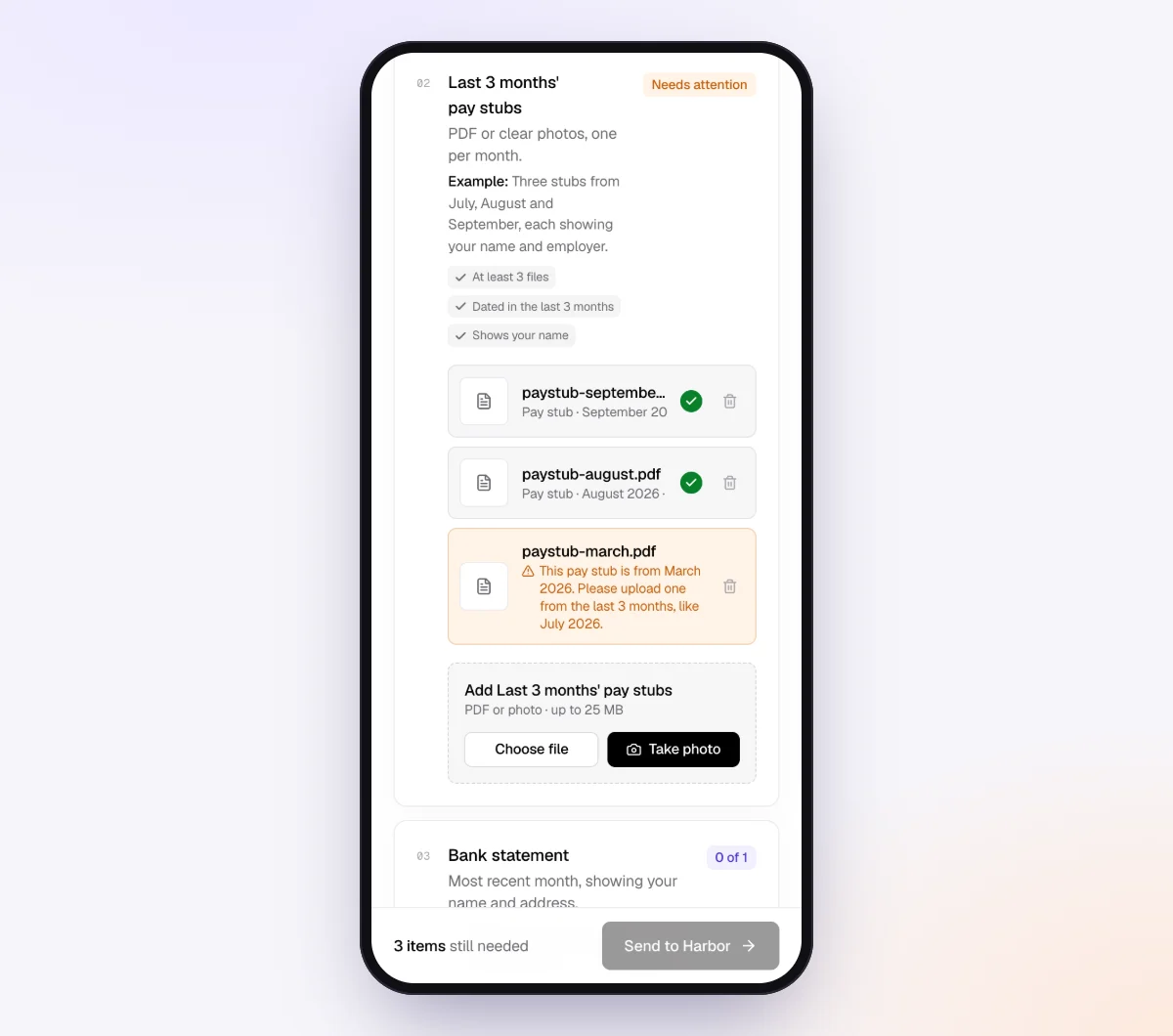
On Pro, tenants can also reply to the invitation email with the PDF attached. It is checked and filed under the right item, and only replies from the address on file are accepted.
5. Review the limits and record the date
Your request page shows each file with its check result, the tenant's answers and an activity timeline. Now do the part that is yours: confirm the liability limit meets your lease, the unit number is right and you are listed as an interested party. Use "Ask for changes" on the file if the address is wrong or the limit is too low.

Copy the policy end date into your tracking list, download the files (or deliver them to Google Drive on Pro) and mark the request complete.
What Tangentflow does and does not do here
The agent paces reminders to your needed-by date, answers questions like "Where do I find my declarations page?" from your checklist and notes, and hands off to you in "Alerts" when a deadline passes. For renewals across a building, "Batches" (Pro) sends the same checklist to up to 100 tenants at once from an Excel file or CSV, each with their own link and due date. Extra columns like the unit number or policy end date are passed to the agent so its emails are specific to each tenant. You can schedule a batch up to 30 days ahead. See bulk requests.
Setups by rental type
| Rental type | Items to add or change | Settings worth turning on | Learn more |
|---|---|---|---|
| Single-family or duplex | Declarations page, interested party question | Needed-by date 3 days before move-in | Property management |
| Apartment community | Declarations page per adult, higher liability limit for pet owners with "Only ask if…" | Batches for annual renewals across the building | Bulk requests |
| Managed for an owner | Your company and the owner as interested parties, if the management agreement requires it | A note listing both names | Owner onboarding checklist |
| Move-in package | Insurance alongside condition photos from the Move-in / move-out photos template | Two separate requests on the same day | Move-in inspection checklist |
When something goes wrong
| Problem | Likely cause | Fix |
|---|---|---|
| Tenant sends a payment screenshot or quote | They do not know what a declarations page is | Ask for changes and repeat the tip: "first page of your policy, in the insurer's app" |
| Address is missing the unit number | Tenant entered it wrong when buying | Ask them to correct it with the insurer and send the updated page |
| Only one roommate is on the policy | Assumed one policy covers everyone | Ask each adult for their own page, or the insurer's written confirmation they are covered |
| Liability limit below your lease minimum | Tenant picked the cheapest option | Ask them to raise the limit; it is usually a small premium change |
| You are not listed as an interested party | Tenant skipped that step | Send your exact legal name and mailing address and ask for confirmation |
Free and Pro, honestly
You can run a real request without paying anything.
| Free | Pro ($29/month) | |
|---|---|---|
| Open requests | 1 at a time | Unlimited |
| AI check on each file | Yes | Yes |
| AI autopilot (answers, reminders, follow-ups) | Your first request | Every request |
| Tenants reply by email with attachments | No | Yes |
| Branding | Tangentflow badge | Your logo |
| Delivery to Google Drive or a webhook | No | Yes |
| Works with AI assistants (MCP) | No | Yes |
| File retention | 7 days | 60 days |
Both plans include unlimited checklists, QR codes and posters, ZIP export, AI summaries and email delivery. Pro is billed monthly with no contract, and you can cancel any time. Full details on the pricing page.
What Tangentflow does not do: SMS or text messages, a native mobile app, full legal e-signature certificates, identity verification, collecting payments, or permanent storage. If you need any of those, pair it with a tool that does.
The whole process as a checklist
- Check your state, province and housing program rules before requiring insurance.
- Put the requirement, the minimum liability limit and the interested party wording in every lease.
- Mention it in your listing and application so nobody is surprised.
- Request the declarations page right after approval, due before keys.
- Check named insured, address and unit, policy period, liability limit and interested party.
- Ask each adult on the lease for their own proof unless their insurer confirms shared coverage.
- Record insurer, policy number and expiration date for every policy.
- Review your list monthly and request renewed pages 30 to 45 days ahead.
- Follow up on any lapse the same week.
- Keep the declarations pages in your own records and delete extra copies.
Frequently asked questions
Can a landlord require renters insurance?
In most US states, generally yes, as long as it is written into the lease and applied to every tenant. Some states regulate how it is done, and public housing, voucher and rent-regulated units may have their own rules. Check your state law and housing program, or ask a local attorney.
What is the best proof of renters insurance?
The policy's declarations page. It shows the named insured, the insured address, the policy period and the coverage limits on one or two pages. A quote, an application or a payment receipt is not proof that a policy is in force.
What is the difference between an interested party and an additional insured?
An interested party is typically notified if the policy is canceled or not renewed, but gets no coverage. An additional insured may get some coverage under the tenant's policy, which is harder to arrange on a renters policy and can interact with exclusions. Most landlords ask to be an interested party; talk to your broker before asking for more.
Do landlords in Canada require tenant insurance?
Many do, as a lease term. Ontario's standard lease has a tenant insurance section where the landlord and tenant can agree that the tenant must carry liability insurance. Rules differ by province, so check your residential tenancy office.
How do I know if a tenant's renters insurance lapses?
Ask to be listed as an interested party so the insurer can notify you, and keep a list of policy expiration dates. Request a fresh declarations page a few weeks before each renewal, because notice practices vary and some lapses are never reported to you.
Does Tangentflow verify that a tenant's coverage is adequate?
No. The AI check confirms the upload looks like a current declarations page with the tenant's name on it and flags expired or wrong documents. You still confirm the liability limit, the address and the interested party listing yourself.
Is there a free way to try this?
Yes. The Free plan gives you one open request at a time with the full AI agent on your first request, so you can collect a real declarations page from a real tenant. Try it free.