Checklists
Car Loan Documents Checklist: What Lenders Need (2026)
Documents needed for a car loan: ID, proof of income and residence, insurance, references and trade-in payoff. What lenders call stips and how to clear them.
By Bibin MathewUpdated 19 min read
The short answer
Most auto lenders ask for a valid driver's license, proof of income (a recent pay stub with year-to-date earnings, or tax returns and bank statements if self-employed), proof of residence dated in the last 30 days, proof of insurance, a list of personal references, and the trade-in title or payoff letter. Lenders call these "stips," and a deal does not fund until every one is in and matches the credit application. Send the buyer one private link with the stips list before they come in to sign, check each upload for the right name and date, and chase the rest on a schedule.
A car deal can be approved in minutes and then sit for two weeks. The buyer drove home happy, the lender came back with stips, and now someone in F&I is texting a customer for a pay stub, a utility bill and the back of their license. The money does not arrive until every document is in, matches the credit application and gets accepted by the lender's funding team.
This guide is for F&I managers, finance coordinators and sales staff at dealerships in the US and Canada, the people who chase stips so deals fund. It is also for buyers who want to know which documents are needed for a car loan before they walk into the showroom. You will get the core checklist, what a good copy of each document looks like, Canadian differences, privacy rules for buyer documents, and a step-by-step dealer workflow in Tangentflow.
The core car loan documents checklist
These are the documents needed for a car loan in most deals, whether the buyer finances through the dealer or directly with a bank or credit union. Prime buyers often need fewer; subprime and first-time buyers usually need all of them.
Identity
- Valid driver's license, front and back, not expired, with the name and address matching the credit application. Some lenders occasionally ask for a second ID, for example when the license address is out of date.
Proof of income
- Salaried and hourly buyers: the most recent pay stub, usually dated within the last 30 days, showing year-to-date (YTD) earnings. Some lenders ask for two stubs or a full month.
- Self-employed buyers: the last one or two years of personal tax returns (US) or T1 Generals and Notices of Assessment (Canada), plus several months of bank statements showing regular deposits. Lenders vary on how many.
- Other income: benefit award letters (Social Security, pension, disability), a child support or alimony order with proof of receipt, or an offer letter for a new job.
Proof of residence
- A utility bill or bank statement in the buyer's name, showing the address on the application, usually dated within the last 30 days. More on what counts below.
Proof of insurance
- An insurance card or declarations page for the vehicle being purchased, naming the lender as lienholder or loss payee when required. Most lenders require comprehensive and collision coverage for the life of the loan.
References
- Personal references, typically four to eight, with name, phone number, address or city, and relationship. Subprime lenders ask for these most, and many will not accept relatives living at the same address.
Trade-in
- The title and registration, with the title signed by every owner listed on it.
- A payoff letter if there is a loan on the trade, with the account number, payoff amount and the date it is good through, or a lien release if the loan was paid off but the title still shows a lienholder.
Down payment
- Proof of the down payment if the lender asks for it: a receipt, a cashier's check copy, or a bank statement showing the funds.
What lenders call "stips," and why deals sit unfunded
A stipulation is a condition attached to a loan approval. The lender says yes, provided you send proof of income, proof of residence, references and so on. Until every stip is cleared, the deal is "in contracts" or "pending funding," and the dealer has delivered a car without being paid for it.
That gap is expensive, and the longer a deal sits, the more likely something changes: the buyer's job, the lender's program, or the buyer's mind. Deals usually sit unfunded for a short list of reasons:
| Why the deal is stuck | What happened | How to prevent it |
|---|---|---|
| Missing stip | Buyer never sent the pay stub or utility bill | Collect stips before delivery whenever you can |
| Stale document | Pay stub or bill was dated outside the lender's window | Ask for documents dated within 30 days and check dates on arrival |
| Name mismatch | Bill is in a spouse's or roommate's name | Ask for documents in the applicant's own name, or a lease showing both |
| Address mismatch | License shows the old address, bill shows the new one | Match every document to the address on the credit application |
| Income does not support the application | YTD on the stub is lower than the stated income | Check YTD against the application before you submit |
| Incomplete trade paperwork | Payoff letter expired or title has an open lien | Order the payoff with a good-through date past funding |
| Bad references | Wrong numbers, or references the lender cannot reach | Ask for current cell numbers and confirm a couple yourself |
Most of these are not credit problems. They are collection problems, which a better process can fix.
What "good" looks like for each document
A stip that gets kicked back means asking the buyer twice. Spell out the standard in your request.
| Document | A good copy | Common problems |
|---|---|---|
| Driver's license | Front and back, all four corners, not expired, address matches the application | Only the front, glare across the photo, expired, old address |
| Pay stub | Most recent, dated within 30 days, shows employer name, buyer's name, pay period and YTD earnings | Stub from two months ago, cropped so YTD is cut off, a handwritten stub |
| Self-employed income | Full tax returns with every page and schedule, plus complete bank statements | First page only, statements with pages missing, screenshots of a banking app |
| Utility bill | Buyer's name, service address matching the application, dated within 30 days | Spouse's name, P.O. box, a past-due notice with no address |
| Insurance card | Buyer's name, the purchased vehicle's VIN, current policy dates, lienholder if required | Card for the old vehicle, expired policy period |
| References | Full names, working cell numbers, relationship, city | "Mom" with no number, two references at the buyer's address |
| Trade-in title | Every page or side, all owners' signatures where required | Unsigned, a second owner missing, lien still showing |
| Payoff letter | Lender name, account number, payoff amount, good-through date | Expired payoff quote, a screenshot of the balance instead |
Three rules catch most kickbacks: names match the credit application exactly, addresses match across license, bill and application, and dates are current, with 30 days as the default for pay stubs and bills unless your lender says otherwise.
Proof of income for a car loan, by buyer type
Proof of income is the stip that varies most. Use this table to decide what to request before the deal goes in.
| Buyer type | What to ask for | Watch out for |
|---|---|---|
| Salaried or hourly | Most recent pay stub with YTD | New job with no stub yet: ask for an offer letter |
| Commission or tips | Two or more recent stubs, sometimes last year's W-2 or T4 | YTD well below the stated income |
| Self-employed or 1099 | Tax returns (one or two years) and recent bank statements | Write-offs that lower reported income below what was stated |
| Retired | Pension or benefit award letter, bank statement showing deposits | Award letter from a prior year |
| Co-buyer | The same set of documents as the primary buyer | Collecting only from the primary buyer |
Proof of residence for a car loan
Proof of residence trips up more deals than it should, mostly because buyers do not know which bill counts. A short list helps:
- Usually accepted: utility bills, bank or credit card statements, a mortgage statement or a signed lease.
- Sometimes accepted: a cell phone bill, insurance declarations page or property tax bill.
- Usually not accepted: personal mail or anything addressed to someone else.
If the buyer lives with family and has no bills in their name, ask the lender what they accept before you send the buyer looking. Our mortgage documents checklist covers the same kinds of evidence in a mortgage context.
Car loan documents in Canada
The core list is the same in Canada: driver's license, proof of income, proof of residence, insurance, references and trade-in paperwork. A few things differ.
- Income documents. Lenders often ask for a pay stub plus an employment letter. Self-employed buyers usually provide T1 Generals and Notices of Assessment from the CRA.
- Insurance in Ontario. Proof of insurance is the liability card commonly called the "pink slip." Since 2019 FSRA has allowed insurers to offer an electronic version, so the buyer may have an app card rather than paper. Ask which version the lender accepts.
- Public auto insurance provinces. In British Columbia, Saskatchewan and Manitoba, basic coverage comes from a public insurer (ICBC, SGI and MPI), so the paperwork looks different from a private insurer's card.
- Quebec. Bodily injury coverage comes from the public plan run by the SAAQ, while property damage and civil liability coverage come from private insurers. Documents may be in French, and Quebec's consumer protection and privacy rules (including Law 25) can affect what you collect and keep. Check the specifics with your lender and compliance advisor.
Keeping buyer documents private
A finance file is full of exactly the information identity thieves want: license numbers, Social Security or Social Insurance numbers, income, bank details and addresses. That makes how you receive stips a compliance question, not just a convenience one.
In the US, the FTC treats dealers that arrange or offer financing or leasing as financial institutions under the Gramm-Leach-Bliley Act, so the FTC Safeguards Rule applies. It requires a written information security program, encryption of customer information, multi-factor authentication, access controls and staff training. A 2023 amendment added a duty to notify the FTC of certain incidents involving the unencrypted information of 500 or more consumers within 30 days of discovery. The FTC publishes an FAQ for auto dealers on ftc.gov.
In Canada, PIPEDA applies to most private-sector dealers, with substantially similar provincial laws in Quebec, Alberta and British Columbia. They expect you to collect only what you need, protect it and keep it only as long as you need it.
What that means day to day:
- Do not take stips by text message. Photos of licenses and pay stubs on a salesperson's personal phone are hard to secure and end up in personal cloud backups.
- Avoid plain email for sensitive documents. Attachments multiply across inboxes and stay there.
- Give each buyer a private link to their own request, and delete copies once the deal funds and the documents are in your system of record.
Our guide to secure ways to receive sensitive documents covers the principles in more detail.
Ways to collect stips from buyers, compared
| Method | Speed | Buyer effort | Security | Tracking what is missing | Fits best |
|---|---|---|---|---|---|
| Text photos to the salesperson | Fast | Low | Weak, files on personal phones | None | Nothing sensitive |
| Email to the F&I inbox | Medium | Low | Weak, files sit in inboxes | Manual | One stray document |
| Upload portal in your digital retailing tool | Fast | Medium, sometimes a login | Usually good | Some | Online deals already in that tool |
| Private link per buyer with checks and reminders (Tangentflow) | Fast | Low, no account | Private link, auto-deletion | Built in | Chasing stips after approval or before delivery |
If your digital retailing platform already collects documents and buyers use it, keep using it. A separate link earns its place when stips arrive by text and email today.
Clearing car loan stips in Tangentflow, step by step
Tangentflow does not have a built-in auto finance template, so start from the Document collection template, which ships with Photo ID, Proof of address and Anything else, and build your stips list on top. You only do this once. After that, every deal uses the same checklist.
1. Build your stips checklist
Go to Checklists, choose "Browse templates," and pick Document collection. Then edit the items:
- Rename Photo ID to "Driver's license," turn on "Front and back," and keep "Not expired" and "Shows your name."
- Rename Proof of address to "Proof of residence." The template's date rule is three months; change it to "dated in the last 30 days" if that is what your lenders want, and in "What should it be?" write "utility bill or bank statement showing the same address as your credit application."
- Add "Most recent pay stub" with a 30-day date rule and a description that mentions year-to-date earnings.
- Add a yes/no "Form field" asking "Are you self-employed?" and use "Only ask if…" to show "Last year's tax return" with "Every page" only for buyers who say yes.
- Add "Insurance card," "Trade-in title," "Payoff letter" (shown with "Only ask if…" when the buyer says there is a loan on the trade), and an "Example" for each.
- Add references as form fields: short text for the name, phone for the number, and a choice field for the relationship.

If you want the license reviewed by a person only, switch the AI check off on that item. The file is stored and marked "Received," and it is never sent to the AI provider.
2. Turn on the email code for finance files
Turn on "Require an email code" for the checklist: before the link opens, the buyer enters a 6-digit code sent to their email. If a link goes to the wrong person, reset the customer's link from the request. Once the buyer sends everything, the link no longer shows the files.
3. Send the link from the desk
When the deal comes back approved with stips, go to Requests and click "New request." Choose your stips checklist, add a reference such as the stock number and buyer's last name ("Stock 24117, Ramirez"), the buyer's name and email, and a needed-by date a few days before the date you need the deal funded. Leave "Email the link" on and the AI agent sends the invitation from your dealership's name.

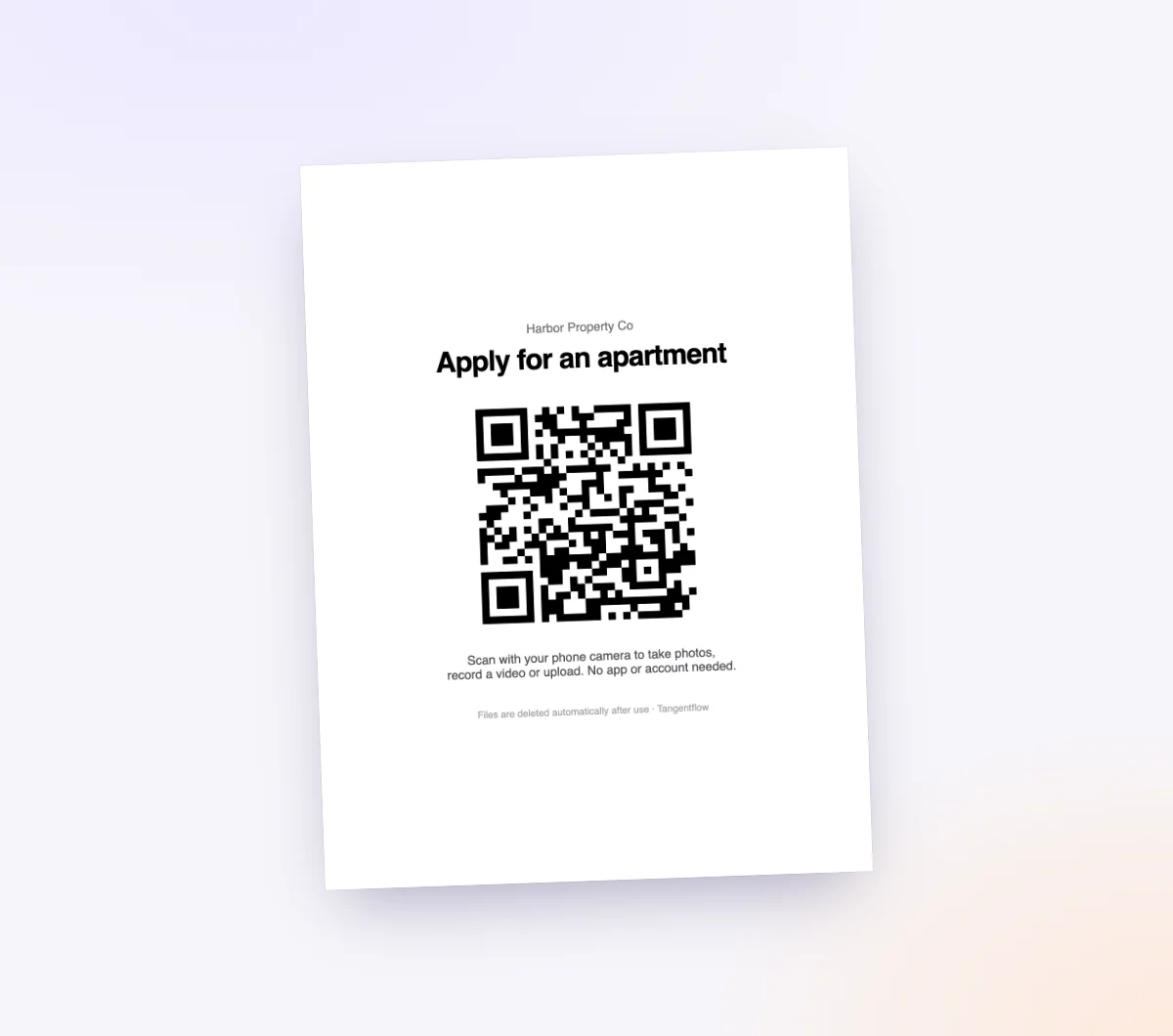
If the buyer is sitting in the F&I office, click "Show full screen" to display a QR code. They scan it with their phone camera and start photographing documents from their wallet before they leave.
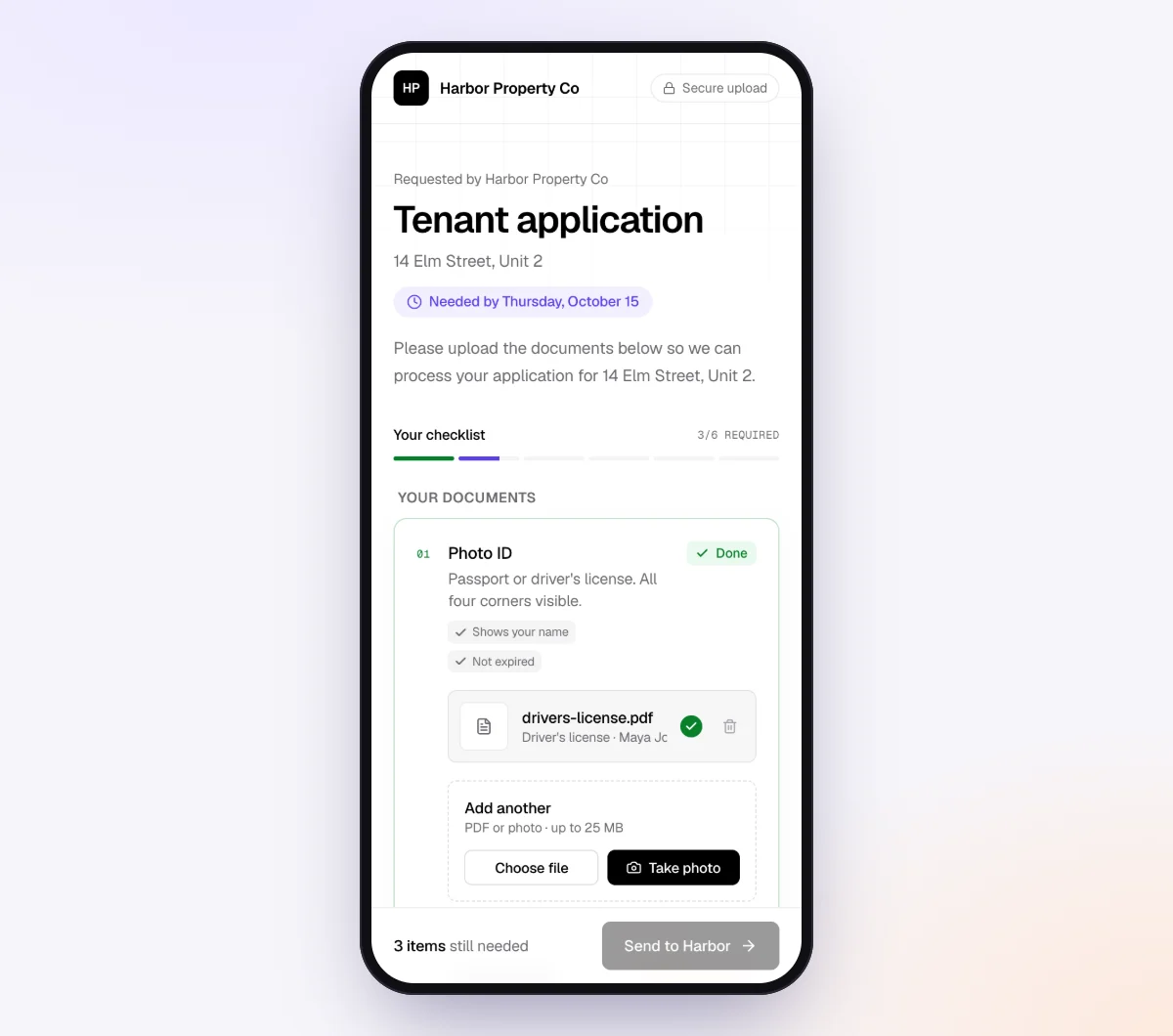
4. The buyer uploads from their phone
The buyer sees which stips are done and which are missing, on any phone browser with no app or account, and can come back to the same link after finding the utility bill at home.
5. Problems are flagged on the spot
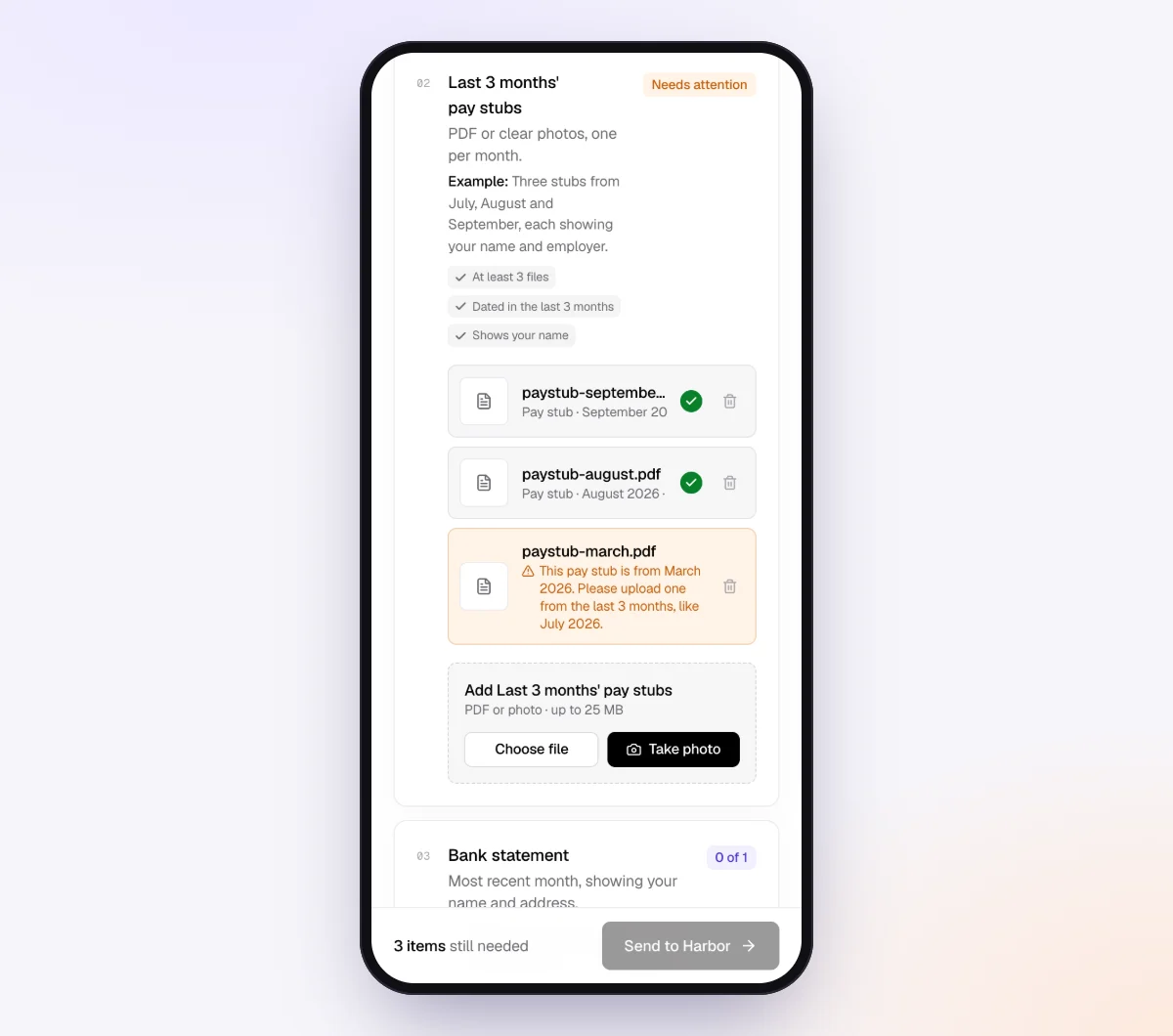
Each upload is checked in seconds by document checks. A pay stub from two months ago, a license with only the front, or a bill in someone else's name gets a friendly note explaining what to fix, while the buyer is still holding the document.
6. Chase on autopilot, then build the deal jacket
The AI collection agent reminds the buyer about only what is still missing, paced to the needed-by date, and answers questions like "Does my bank statement count as proof of residence?" from your checklist and notes. Questions about the rate, payment or trade value are handed to you. When everything is in, download the ZIP, upload to the lender and mark the request complete. The files are deleted 24 hours later.

Setups for different dealership situations
The same checklist covers most deals; handle these variations with separate checklists or "Only ask if…" questions. See the auto dealers page for more on how dealerships use Tangentflow.
| Situation | Key stips | Settings worth turning on |
|---|---|---|
| Prime retail deal | License, insurance card, maybe one pay stub | Short checklist, 2 to 3 day needed-by date |
| Subprime or first-time buyer | License, two pay stubs, proof of residence, references, insurance | 30-day date rules, references as form fields |
| Self-employed buyer | Tax returns, bank statements, license, insurance | "Every page" on returns and statements |
| Deal with a trade-in | Title, registration, payoff letter | "Only ask if…" there is a loan on the trade, an "Example" photo of the title |
| Co-buyer | Same stips for each buyer | A separate request per buyer so each has their own link |
| Walk-in finance office | Whatever the lender asked for | A printed poster from "Walk-in QR codes" at the F&I desk |
A poster on the F&I office wall lets a buyer scan and start a fresh request without anyone typing an email address. If you also collect trade-in photos, our guide on how to ask customers for photos has a vehicle shot list.
When something goes wrong
| Problem | Likely cause | Fix |
|---|---|---|
| Buyer has not opened the link | Email went to spam or the wrong address | Ask them to check spam, show the QR code next time they are in, or copy the link and send it yourself |
| Pay stub keeps getting flagged as old | Buyer is paid monthly or is between pay dates | Ask the lender whether they accept the last stub, and adjust the date rule for that deal |
| Utility bill in a spouse's name | Bills are not in the buyer's name | Ask for a bank statement or lease instead, or ask the lender what they accept |
| Trade payoff letter expired | Funding took longer than the good-through date | Order a new payoff dated past the expected funding date |
| Buyer texted documents to the salesperson | Habit | Save them to the request, delete the texts and photos from the phone, reply with the link |
| Link went to the wrong person | Typo in the email address | Reset the customer's link from the request and send it to the right address |
Check "Alerts" each morning. Handoffs and missed needed-by dates show up there.
Free and Pro, honestly
You can run a real deal through Tangentflow without paying anything.
| Free | Pro ($29/month) | |
|---|---|---|
| Open requests | 1 at a time | Unlimited |
| AI check on each file | Yes | Yes |
| AI autopilot (answers, reminders, follow-ups) | Your first request | Every request |
| Buyers reply by email with attachments | No | Yes |
| Branding | Tangentflow badge | Your logo |
| Delivery to Google Drive or a webhook | No | Yes |
| Works with AI assistants (MCP) | No | Yes |
| File retention | 7 days | 60 days |
Both plans include unlimited checklists, QR codes and posters, ZIP export, AI summaries and email delivery. Pro is billed monthly with no contract, and you can cancel any time. A dealership with more than one deal in contracts at a time will need Pro. Full details on the pricing page.
What Tangentflow does not do: SMS or text messages, a native mobile app, full legal e-signature certificates, identity verification, collecting payments, or permanent storage. If you need any of those, pair it with a tool that does.
The whole process as a checklist
- Save one stips checklist: license, pay stub, proof of residence, insurance, references, trade-in.
- Put a 30-day date rule on pay stubs and bills, and "Front and back" on the license.
- Use a self-employed question to switch between pay stubs and tax returns.
- Turn on "Require an email code" for finance files.
- Send the link as soon as the deal looks likely, from the desk or by QR code.
- Set a needed-by date a few days before you need the deal funded.
- Confirm addresses match the credit application before you submit.
- Let the agent chase what is missing, and step in on handoffs.
- Download the deal jacket, submit to the lender and mark the request complete.
- Delete any stips that arrived by text or email.
Frequently asked questions
What documents are needed for a car loan?
Most lenders ask for a valid driver's license, proof of income such as a recent pay stub with year-to-date earnings, proof of residence such as a utility bill dated in the last 30 days, proof of insurance, personal references, and trade-in paperwork if you have a trade. Self-employed buyers usually provide tax returns and bank statements instead of pay stubs. Your lender's approval notice lists exactly what applies to your deal.
What are stips on a car loan?
Stips, short for stipulations, are conditions a lender attaches to an approval, such as proof of income or proof of residence. The deal does not fund until every stip is cleared.
What counts as proof of income for a car loan?
For employees, the most recent pay stub showing year-to-date earnings is the usual standard. Self-employed buyers typically provide tax returns plus recent bank statements, and retirees can use award letters with bank statements showing the deposits.
What counts as proof of residence for a car loan?
A utility bill, bank statement, mortgage statement or signed lease in the buyer's name, showing the same address as the credit application and usually dated within the last 30 days. Cell phone bills are accepted by some lenders and not others, so ask first.
Why is my car deal not funded yet?
Usually because a stip is missing, out of date, or does not match the application, such as a pay stub older than 30 days or a bill with a different address. Ask the dealer which stip is outstanding and send it the same day.
Does the FTC Safeguards Rule apply to car dealers?
Yes, for dealers that arrange or offer financing or leasing. The FTC treats them as financial institutions under the Gramm-Leach-Bliley Act, so they need a written information security program, encryption and multi-factor authentication, among other safeguards. Start with the FTC's guidance for auto dealers and your own counsel.
Does Tangentflow integrate with RouteOne, Dealertrack or my DMS?
No. Tangentflow collects and checks the documents, then you download a ZIP, send by email, or on Pro deliver to Google Drive or a webhook. You upload to the lender portal the way you do today.