Checklists
Acceptable Proof of Address Documents: US and Canada (2026)
Which proof of address documents are usually accepted in the US and Canada, how recent they should be, what gets rejected, and what to use without a utility bill.
By Bibin MathewUpdated 19 min read
The short answer
Most businesses accept a recent utility bill, bank or credit card statement, lease, mortgage statement, property tax bill, insurance document or government letter that shows the person's full name and street address. Many ask for one dated within the last 60 to 90 days, though that is common practice rather than a single law, and the exact list depends on who is asking. P.O. boxes, envelopes on their own and documents in someone else's name are usually turned down. Write your accepted list and date rule down before you ask, then check every document for name, address, date, issuer and missing pages.
"Can you send a proof of address?" sounds like one of the easiest requests a business can make. The customer sends a photo of an envelope. Or a bill in their partner's name. Or a phone screenshot of a bank app with the address cut off. Or a statement from last spring. Each one means another email, another wait and another chance the customer gives up.
This guide is for businesses that have to collect proof of address as part of their work: landlords and property managers, mortgage brokers and lenders, accountants and law firms with anti-money-laundering (AML) duties, auto dealers, and schools, clubs and leagues that need to confirm where a family lives. It is also for anyone on the other side of the request who is trying to work out what counts.
You will get a table of accepted documents with typical date rules, what usually gets rejected, options for people without bills in their name, what to check, official US and Canadian reference points, and a step-by-step setup in Tangentflow.
What proof of address is actually for
A proof of address document links a person's name to a physical address, from a source other than the person themselves. A utility bill works because the utility has its own reason to know where the customer lives.
Landlords use it to confirm current address, lenders to match the application and credit file, firms with AML duties as part of confirming who a new client is, auto lenders as a condition on financed deals, and schools and leagues to check that a family lives in the area they serve. Knowing why you ask helps you decide what to accept. A youth soccer league checking a catchment area has no reason to demand bank statements.
Commonly accepted proof of address documents
Not every organization accepts every one of these, so treat this as a starting list for your own policy.
| Document | What it should show | Typical recency rule (common practice) | Notes |
|---|---|---|---|
| Utility bill (electric, gas, water, internet, landline) | Full name, service address, issuer, date | Within 60 to 90 days | The classic choice. Some places exclude cell phone bills |
| Bank or credit union statement | Full name, mailing address, bank name, statement date | Within 60 to 90 days | Ask for the page with the address; other pages can be blacked out |
| Credit card statement | Full name, address, issuer, date | Within 60 to 90 days | Customers can black out the card number |
| Mortgage statement | Full name, property address, lender, date | Most recent statement | Strong evidence for homeowners |
| Signed lease or rental agreement | Tenant name, rental address, landlord, dates, signatures | Current lease term | Should be signed by both parties |
| Property tax bill or assessment | Owner name, property address, municipality, tax year | Current or most recent tax year | Issued yearly, so a 90-day rule does not fit |
| Home or renters insurance policy or declarations page | Insured name, property address, insurer, policy period | Current policy period | Auto insurance is accepted by some, not all |
| Government letter (IRS, CRA, Social Security, Service Canada, state or provincial agency) | Full name, address, agency, date | Within the last year is common | Includes a CRA notice of assessment |
| Pay stub or employer letter | Full name, home address, employer, date | Within 30 to 60 days | Only works if the stub shows the home address |
| Vehicle registration | Owner name, address, issuing agency | Current registration | Accepted by many DMVs and dealers |
| School or university letter or transcript | Student name, address, school, date | Current term or year | Useful for students without bills |
| USPS or Canada Post change of address confirmation | Name, new address | Recent | Helpful right after a move |
How recent should proof of address be?
The most common rule you will see is dated within the last 3 months, and 60 or 90 days are both widely used. That is a convention, not a law that applies to everyone.
A few practical points:
- Match the rule to the document. A 90-day rule would reject a perfectly current property tax bill or insurance declarations page, which arrive once a year. Use "current tax year" or "current policy period" for those.
- Measure from the statement or issue date, not the due date.
- Write it down and apply it to everyone. Consistency matters, especially for landlords and lenders.
What is usually NOT accepted as proof of address
Telling customers up front saves a round of fixes.
| Usually rejected | Why | What to ask for instead |
|---|---|---|
| P.O. box or private mailbox address only | Does not show where the person lives | A document showing the street address (some agencies accept a P.O. box on one document if another shows the street address) |
| An envelope or the outside of a letter on its own | No issuer details, date or account context | The bill or letter inside the envelope |
| A screenshot of a bank or utility app | Often cropped, missing the name, issuer or date | The downloadable PDF statement from the website |
| A document in someone else's name | Does not link the customer to the address | One of the alternatives below |
| Handwritten or self-made letters | Not from an independent source | A letter from a bank, employer, school or agency |
| Documents with the address blacked out or cut off | The one thing you need is missing | The full page, with account numbers optionally blacked out |
| A document older than your date rule | May be out of date | A newer statement |
Proof of address without a utility bill
Plenty of people do not have bills in their own name: young adults living with parents, recent movers, roommates and spouses where the other person holds the accounts, and renters whose utilities are included. Their paperwork just sits under someone else's name.
Commonly accepted alternatives (whether each works depends on who is asking):
- A signed lease or rental agreement in the person's name.
- A bank, credit union or credit card statement.
- Government mail in their name: a tax notice, benefits letter, jury summons, voter notice or similar.
- An employer letter, school letter or insurance policy showing the home address.
- A letter from the household member who holds the bills, plus that person's own proof of address, and sometimes their ID. Some organizations require the letter to be notarized or use their own form, and some do not accept this route at all, so check first.
- Documents showing the relationship to the bill holder, such as a marriage or birth certificate. The California DMV accepts this route (see below).
- A shelter or service organization letter for people without a fixed address.
What to check on every proof of address
- Name matches. The name on the document matches the name on the application or ID. Small differences (a middle initial, a married name) may need a note or a second document.
- Full street address. Number, street, unit, city, state or province, and ZIP or postal code, matching what the customer gave you.
- Date. The statement or issue date is inside your window.
- Issuer. The company, bank or agency is clearly identified, with a logo or letterhead.
- Readable. Not blurry, dark or cut off at the edges.
- Complete. Every page you asked for.
- Not altered. Fonts and alignment look consistent, and nothing looks pasted in. If something looks off, ask for the original PDF or verify with the issuer.
US and Canadian reference points
United States: state DMV residency documents for REAL ID
Each state DMV publishes its own list of residency documents for a REAL ID license or ID card. California is a useful example. According to the California DMV REAL ID checklist, applicants bring two different printed documents that show their California mailing address, with their first and last name and the same mailing address as their application.
The California list includes, among others: home utility bills (including cell phone), bank and financial institution records, mortgage bills, rental or lease agreements signed by the owner and tenant, property tax bills, insurance documents, medical documents, employment documents, school documents, IRS or California tax returns, vehicle registration or title, U.S. Postal Service change of address confirmation, and documents from government agencies.
Two rules worth noting:
- P.O. boxes: one document must show both the P.O. box and the physical residence address; the second may show only the P.O. box.
- Documents in a relative's name: an applicant can present a birth certificate, marriage license or domestic partner registration certificate to show their relationship to the person named on the residency document.
Other states use similar lists. Check your own state DMV's current page.
United States: banks and the Customer Identification Program
US banks must run a Customer Identification Program under federal rules (31 CFR 1020.220). For an individual, the bank must collect a residential or business street address (with limited alternatives, such as an APO or FPO box or a next of kin's address for people without one). The document verification part of the rule centers on unexpired government-issued photo ID, such as a driver's license or passport, and banks can also use non-documentary methods. That is why one bank may never ask for a utility bill while another does: each sets its own procedures within the rule.
Canada: FINTRAC's methods to verify identity
Businesses covered by Canada's anti-money-laundering law (banks, securities dealers, real estate brokers, accountants doing certain work and others) follow FINTRAC's guidance on methods to verify the identity of persons. It is worth being precise here: these are methods for verifying identity, not a list of proof of address documents.
The guidance sets out five methods: the government-issued photo identification method, the credit file method, the dual-process method, the affiliate or member method, and the reliance method. Address only comes into some of them:
- The government-issued photo ID method checks a person's name and photo against a valid, authentic photo ID. It does not require a separate address document.
- The credit file method confirms name, address and date of birth from a Canadian credit file.
- The dual-process method uses information from two different reliable sources to confirm any two of: name and address, name and date of birth, or name and a financial account. Examples of reliable sources in the guidance include utility bills, property tax assessments, bank statements, insurance documents and government-issued documents. The information must be valid and current, and it can be an original or a copy such as a scan, photocopy or electronic image.
So under FINTRAC's guidance, a utility bill is one possible piece of a dual-process check, not a standalone proof of address requirement. If you are a reporting entity, follow FINTRAC's guidance and your own compliance program, not a generic checklist.
Outside AML rules, Canadian landlords, schools and provincial licensing offices set their own lists, and they differ by province, so check the specific organization's page.
Setups by business
Here is how different businesses typically ask for proof of address. Adjust to your own policy.
| Business | What to ask for | Date rule | Settings worth using | Learn more |
|---|---|---|---|---|
| Landlord or property manager | Utility bill, bank statement or current lease from the applicant's current address | Last 60 to 90 days | "Shows your name," "Dated in the last 3 months" | Rental application checklist |
| Mortgage broker or lender | Statement or bill matching the application address, plus ID | Last 60 to 90 days | Name must match, every page on statements | Mortgage lending |
| Accountant or law firm with AML duties | Photo ID plus a recent address document, per your compliance program | Last 3 months is common | "Client ID check (AML / KYC)" template | Collect documents from clients |
| Auto dealer | Proof of residence matching the credit application, often a utility bill or bank statement | What the lender asks for, often 30 to 60 days | Name must match, AI check off for ID if you prefer | Auto dealers |
| School, club or league | One or two documents showing the family's address in your area | Current school year or last 60 days | Optional second document, "Only ask if…" for shared households | Bulk requests |
How to collect proof of address online in Tangentflow, step by step
Tangentflow is an AI agent that collects documents, photos and signed forms through one private link. It does not perform identity verification. It collects what you ask for and checks each upload: right kind of document, readable, recent enough, shows the customer's name, not expired. You (or your compliance process) still decide.
Here is the setup using the built-in "Client ID check (AML / KYC)" template.
1. Start from the Client ID check template
Go to Checklists, choose "Browse templates" and pick "Client ID check (AML / KYC)." It ships with Photo ID, Proof of address (last 3 months), Selfie holding your ID, an optional Acting for a company? question and an optional Source of funds item. The address item's hint reads "Utility bill, bank statement or property tax bill showing your name and address."
If you only need proof of address, delete the rest.

2. Tune the proof of address item
Open Proof of address (last 3 months) in the checklist editor. The "What should it be?" field already describes a utility bill, bank statement or property tax bill showing a name and address. Edit it to match your accepted list, for example adding "signed lease" or "government letter."
"Dated in the last 3 months" suits monthly bills; if you accept annual documents like a property tax bill, widen the window or say so in the hint. Keep the "Shows your name" condition on, and add "Every page" if you want the full statement. Add an "Example" of a good upload and a tip like "A PDF downloaded from your bank's website is better than a screenshot."
For customers in shared households, add a yes/no question such as "Are the bills at your address in your name?" and use "Only ask if…" to show an extra item ("Letter from the account holder, plus their bill") only to people who answer no.

3. Create the request and send the link
Go to Requests, click "New request," choose the checklist, and add a reference (for example "Lee, new client intake"), the customer's name and email, and a needed-by date. Leave "Email the link" on and the AI agent sends a branded invitation from your business name.
If you want an extra step before the link opens, turn on "Require an email code" for the checklist. The customer then enters a 6-digit code emailed to them before they can see the request. If a link went to the wrong person, you can reset it.

4. The customer uploads from their phone
The customer opens the link on their phone with no account or app and uploads a photo or PDF. If they ask "My bills are in my husband's name, what do I send?" in the upload page chat or by email reply, the agent answers from your checklist and notes.
5. Problems are flagged on the spot
Each file is checked in seconds by document checks. If a bill is older than three months, shows a different name, is blurry or is clearly an envelope rather than a statement, the customer sees a friendly note explaining what to fix while they still have the document in hand.
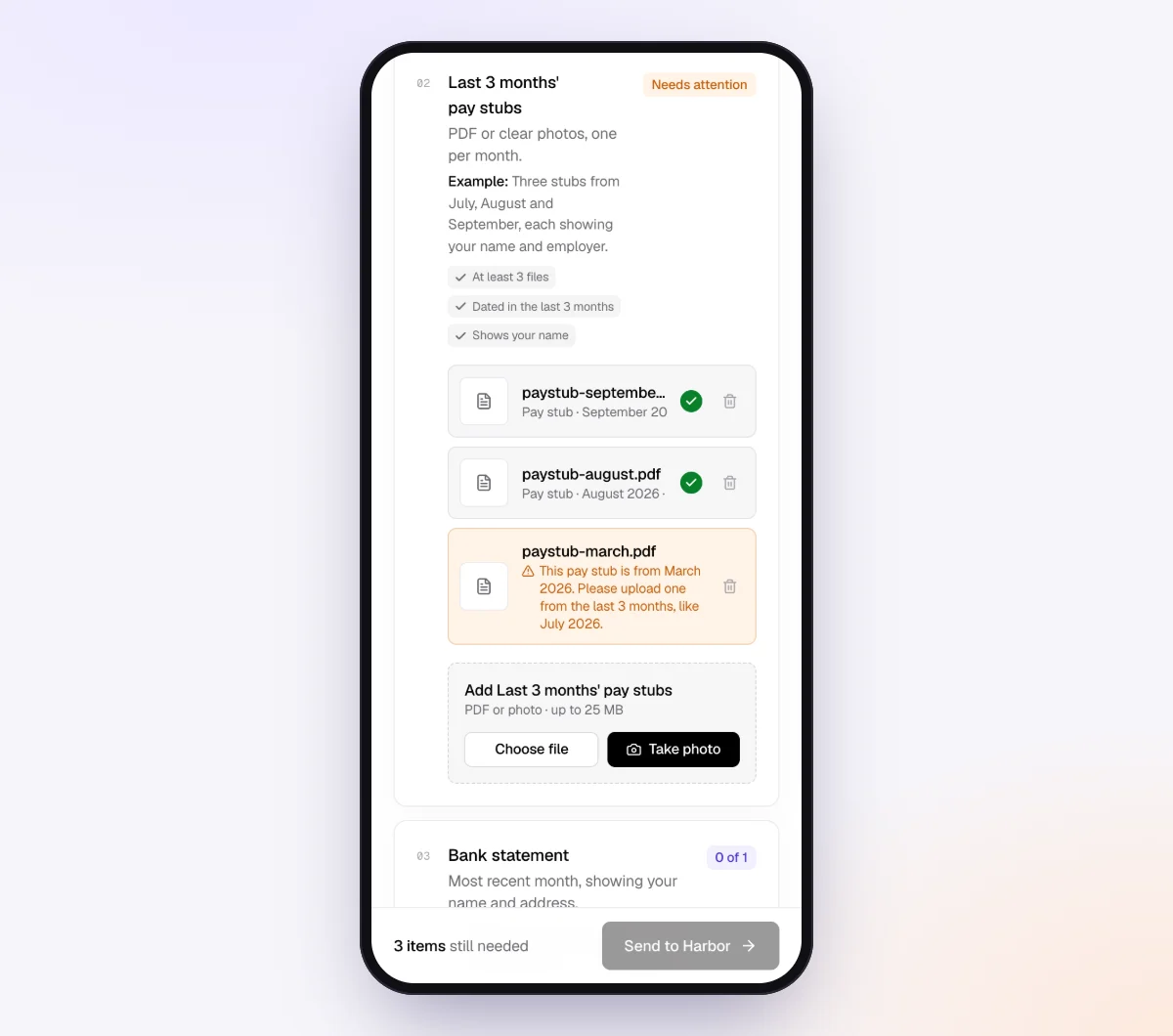
Your request page shows every file with its check result, what is missing and an activity timeline. Use "Ask for changes" on any file. When everything is in, download the ZIP package or, on Pro, deliver to Google Drive or a webhook so records live in your own storage. After the customer sends everything, the link no longer shows their files.

Keeping proof of address documents secure
Address documents often carry account numbers and balances too. If you only need the name and address, tell customers they can black out the rest. Use a private link per customer instead of email, and keep files only as long as you need them. In Tangentflow, files are deleted 24 hours after you complete a request, or when retention ends (7 days on Free, 60 days on Pro), and you can delete immediately and get a deletion certificate. Records that AML or lending rules require you to keep belong in your own system. See our security page and our guide to secure ways to receive sensitive documents.
When something goes wrong
| Problem | Likely cause | Fix |
|---|---|---|
| Bill is in a spouse's or parent's name | Shared household | Offer your accepted alternatives, or an "Only ask if…" item for a letter from the account holder |
| Statement is older than your window | They grabbed the one on the counter | The date rule flags it; suggest downloading the latest PDF online |
| Address does not match the application | Recent move, or old address on file with the bank | Ask for a document showing the new address, such as a lease or change of address confirmation |
| Only a P.O. box is shown | Rural address or mail service | Ask for a second document that shows the street address |
| Customer has no documents at all | No fixed address, or just arrived | Hand off to a person; check whether your policy accepts a shelter, school or agency letter |
Check "Alerts" daily. That is where handoffs and missed deadlines show up.
Free and Pro, honestly
You can run a real request without paying anything.
| Free | Pro ($29/month) | |
|---|---|---|
| Open requests | 1 at a time | Unlimited |
| AI check on each file | Yes | Yes |
| AI autopilot (answers, reminders, follow-ups) | Your first request | Every request |
| Clients reply by email with attachments | No | Yes |
| Branding | Tangentflow badge | Your logo |
| Delivery to Google Drive or a webhook | No | Yes |
| Works with AI assistants (MCP) | No | Yes |
| File retention | 7 days | 60 days |
Both plans include unlimited checklists, QR codes and posters, ZIP export, AI summaries and email delivery. Pro is billed monthly with no contract, and you can cancel any time. Full details on the pricing page.
What Tangentflow does not do: SMS or text messages, a native mobile app, full legal e-signature certificates, identity verification, collecting payments, or permanent storage. If you need any of those, pair it with a tool that does.
Proof of address recap checklist
- Decide why you need proof of address and how much assurance you really need.
- Write down the documents you accept, including alternatives for shared households.
- Set a date rule per document type: 60 to 90 days for monthly bills, current period for annual ones.
- Tell customers what is not accepted: P.O. box only, envelopes, cropped screenshots, other people's names.
- Ask for the same documents from everyone in the same situation.
- Send one private link instead of asking for email attachments.
- Check name, full address, date, issuer, readability and completeness on every upload.
- Ask for fixes right away, while the customer still has the document in hand.
- Escalate anything that looks altered, and verify with the issuer if your policy calls for it.
- Move the records you must keep into your own system, and delete every other copy.
Frequently asked questions
What documents count as proof of address?
The most commonly accepted are recent utility bills, bank or credit card statements, mortgage statements, signed leases, property tax bills, insurance documents and letters from government agencies, each showing your full name and street address. The organization asking decides the exact list, so check its official page or ask before you send.
How recent does proof of address need to be?
Many organizations ask for a document dated within the last 60 to 90 days, and "the last 3 months" is a very common rule. That is common practice rather than one law. Annual documents such as property tax bills or insurance declarations are usually judged by whether they are for the current year or policy period.
What can I use as proof of address if I don't have a utility bill?
Common alternatives include a signed lease, a bank or credit card statement, government mail such as a tax notice, an employer letter or pay stub showing your home address, insurance documents or a school letter. Some organizations also accept a letter from the household member who holds the bills, sometimes notarized and with their own proof of address. Check what the organization accepts first.
Is a P.O. box accepted as proof of address?
Usually not on its own, because it does not show where you live. Some agencies accept a P.O. box on one document if another shows your street address. The California DMV, for example, requires one residency document to show both your P.O. box and your physical address.
Does Tangentflow verify a customer's identity or address?
No. Tangentflow collects documents and checks each upload: right document type, readable, recent enough, shows the customer's name, not expired. It does not confirm that a document is genuine or that the person lives at the address. If you need identity verification, use a dedicated service or your regulator's methods.
How do I collect proof of address online securely?
Send each customer a private link instead of asking for email attachments, tell them they can black out details you do not need, check each file as it arrives, and delete the copies once you have moved what you must keep into your own records. Tangentflow's "Client ID check (AML / KYC)" template is a ready-made starting point.